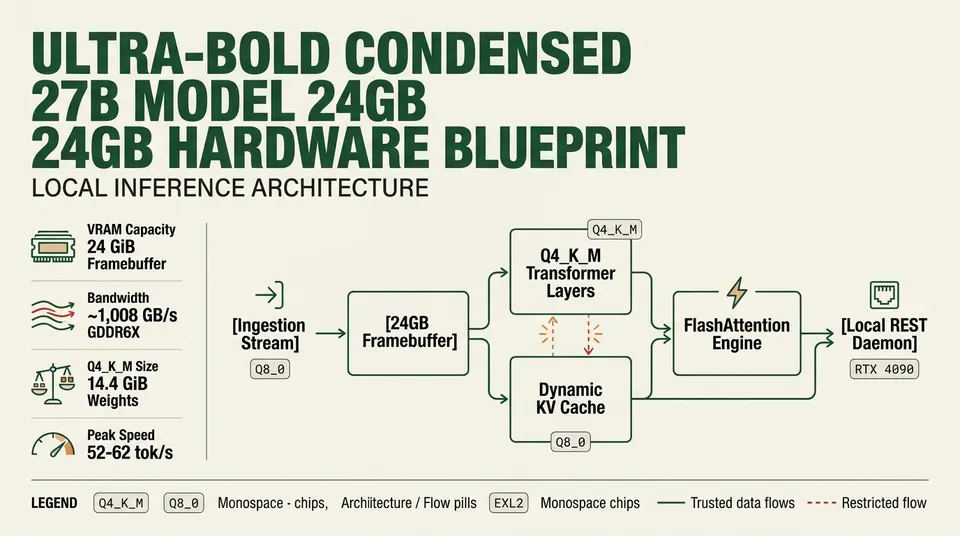
Learn how to run 27B LLMs on a 24GB GPU. Master VRAM sizing, GGUF/EXL2 quantization, and Ollama configs to achieve high-throughput local inference today.
Deploying 27-billion-parameter open-weight models locally has emerged as the definitive efficiency frontier for software engineers and infrastructure architects seeking enterprise-grade reasoning without recurring cloud inference costs. By pairing dense parameter reasoning with modern Grouped-Query Attention (GQA), 27B-class architectures—exemplified by models like Gemma 2 27B—bridge the performance gap between lightweight 7B/14B models and compute-heavy 70B parameter systems. On consumer workstations, a single 24-gigabyte VRAM graphics card represents the exact hardware threshold required to host high-precision quantization fully resident in GPU memory.
Hardware Sizing and RTX 4090 24GB LLM Inference
Autoregressive token generation during single-user batching is strictly memory-bandwidth bound rather than compute bound. Generating each sequential token requires streaming every active weight across the memory bus into execution cores.
On an NVIDIA RTX 4090, GDDR6X memory delivers approximately 1,008 GB/s of bandwidth, compared to 31.5 GB/s across a PCIe 4.0 x16 interface and 85 GB/s over dual-channel DDR5 system RAM. Offloading even 10% of model layers to CPU memory creates a severe bus synchronization stall that reduces inference throughput from 45 tokens per second down to 3–8 tokens per second.
[Full GPU VRAM: All Layers Resident] ████████████████████ ~40 - 55 tokens/sec
[Hybrid Offload: 75% GPU / 25% CPU] ███ ~6 - 9 tokens/sec
[Pure CPU Execution] █ ~2 - 4 tokens/sec
Calculating total VRAM consumption requires summing the quantized base weights, the Key-Value (KV) cache expansion, and runtime CUDA execution buffers: The arithmetic behind that second allocation is broken down separately in why context length costs more VRAM than your model weights.
$$\text{Weight Allocation (Bytes)} = \text{Parameters} \times \frac{\text{Bits Per Weight}}{8}$$
The Key-Value cache memory expands dynamically across the active context window:
- 16-bit Float (FP16) KV Cache: Allocates 256.00 KB per context token.
- 8-bit Quantized (Q8_0) KV Cache: Allocates 128.00 KB per context token.
- 4-bit Quantized (Q4_0) KV Cache: Allocates 64.00 KB per context token.
| Quantization Format | Weight Size | 4k Context (FP16 KV) | 8k Context (FP16 KV) | 16k Context (FP16 KV) | 32k Context (FP16 KV) | 32k Context (Q8_0 KV) | 64k Context (Q8_0 KV) |
|---|---|---|---|---|---|---|---|
| FP16 (Unquantized) | 51.2 GiB | 53.7 GiB | 54.7 GiB | 56.7 GiB | 60.7 GiB | 56.7 GiB | 60.7 GiB |
| Q8_0 (8.5 bpw) | 27.2 GiB | 29.7 GiB | 30.7 GiB | 32.7 GiB | 36.7 GiB | 32.7 GiB | 36.7 GiB |
| Q5_K_M (5.5 bpw) | 17.6 GiB | 20.1 GiB | 21.1 GiB | 23.1 GiB | 27.1 GiB | 23.1 GiB | 27.1 GiB |
| Q4_K_M (4.5 bpw) | 14.4 GiB | 16.9 GiB | 17.9 GiB | 19.9 GiB | 23.9 GiB | 19.9 GiB | 23.9 GiB |
| EXL2 (4.0 bpw) | 12.8 GiB | 15.3 GiB | 16.3 GiB | 18.3 GiB | 22.3 GiB | 18.3 GiB | 22.3 GiB |
| Q3_K_M (3.5 bpw) | 11.2 GiB | 13.7 GiB | 14.7 GiB | 16.7 GiB | 20.7 GiB | 16.7 GiB | 20.7 GiB |
A 24GB frame buffer accommodates Q4_K_M weights alongside an uncompressed FP16 KV cache up to 32,768 tokens. Enabling 8-bit quantized KV caching extends the operational context ceiling to 65,536 tokens without exceeding dedicated VRAM limits. For sizing other model and quantization combinations, see our VRAM calculator for open-weight LLMs across quantization formats.
Quantization Architecture: GGUF, EXL2, and AWQ
Selecting an optimal quantization format depends on backend engine integration, hardware support, and desired user concurrency. That same 24GB ceiling defines the fine-tuning side too; see fine-tuning 27B-32B LLMs on a single 24GB GPU with Unsloth and QLoRA.
| Format | Execution Engine | Core Advantage | Perplexity Impact ($\Delta \text{PPL}$) | Deployment Focus |
|---|---|---|---|---|
| GGUF (k-quants) | llama.cpp, Ollama, LM Studio | Universal hardware support and dynamic layer assignment. | Q5_K_M: $\Delta \text{PPL} < 0.03$ | |
Q4_K_M: $\Delta \text{PPL} \approx 0.08 - 0.12$ | Local developer tooling, CLI scripts, multi-platform desktop setups. | |||
| EXL2 | ExLlamaV2, TabbyAPI | Custom variable bit-rates and maximum generation throughput. | 4.25 bpw retains $>98%$ benchmark accuracy across HumanEval/MMLU. | Single-user interactive code generation on dedicated NVIDIA GPUs. |
| AWQ | vLLM, Aphrodite Engine | Salient weight protection with optimized PagedAttention kernels. | $\Delta \text{PPL} \approx 0.05$ at 4-bit precision; strong multi-turn stability. | Multi-tenant production APIs and high-concurrency enterprise batching. |
Blueprint 1: Ollama CLI and Modelfile Configuration
Ollama provides automated model execution powered by a llama.cpp backend. Achieving optimal memory utilization requires explicit context window sizing and Flash Attention activation.
1. Ingestion
# Pull official 27B release weights
ollama pull gemma2:27b
2. Custom Modelfile Construction
Create a custom Modelfile to lock layers into GPU memory, enable Flash Attention, and enforce sampling boundaries:
FROM gemma2:27b

# Allocate 32k context buffer
PARAMETER num_ctx 32768

# Pin all transformer layers into VRAM
PARAMETER num_gpu 65

# Sampling parameters
PARAMETER temperature 0.6
PARAMETER top_p 0.9
PARAMETER repeat_penalty 1.1

# Enable Flash Attention compute kernel
PARAMETER flash_attn true

SYSTEM """You are an enterprise systems engineer. Provide concise, verified code and rigorous technical architecture analysis."""
3. Build and Service Hardening
Build the model image and configure system service parameters in /etc/systemd/system/ollama.service.d/override.conf:
ollama create gemma27b-prod -f ./Modelfile
[Service]
Environment="OLLAMA_FLASH_ATTENTION=1"
Environment="OLLAMA_NUM_PARALLEL=1"
Environment="OLLAMA_KEEP_ALIVE=24h"
Environment="CUDA_VISIBLE_DEVICES=0"
LimitMEMLOCK=infinity
Blueprint 2: LM Studio Local API Integration
LM Studio provides an interactive management interface alongside an OpenAI-compatible REST server.
Configuration Protocol:
- Model Import: Search for
gemma-2-27b-it-GGUFand load theq4_k_mbinary. - Runtime Sizing:
- GPU Offload (
n_gpu_layers): Set toMaxto ensure zero layers spill into CPU memory. - Context Window (
n_ctx): Set to32768. - Flash Attention: Enable to compress activation overhead during long prompt ingestion.
- KV Cache Quantization: Set
K-QuantandV-QuanttoQ8_0to conserve 1.8 GiB of VRAM at 32k context.
- Local REST Endpoint: Start the HTTP server on port
1234.
curl http://127.0.0.1:1234/v1/chat/completions \
 -H "Content-Type: application/json" \
 -d '{
 "model": "gemma-2-27b-it",
 "messages": [
 {"role": "system", "content": "You are a systems architect."},
 {"role": "user", "content": "Analyze memory bandwidth limits in LLM inference."}
 ],
 "temperature": 0.6
 }'
Engine Latency and Throughput Benchmarks
Performance metrics on a standalone NVIDIA RTX 4090 demonstrate significant throughput variations across inference backends: A deeper sizing comparison across these engines appears in high-concurrency inference benchmarks for Qwen 27B.
| Engine | Quantization Format | Time to First Token (TTFT) | Generation Speed | Concurrency Mode |
|---|---|---|---|---|
| llama.cpp / Ollama | GGUF (Q4_K_M) | 180 – 350 ms | 38 – 48 tok/s | Sequential single-user |
| ExLlamaV2 | EXL2 (4.25 bpw) | 120 – 220 ms | 52 – 62 tok/s | Low / Single-user interactive |
| vLLM | AWQ (4-bit) | 80 – 160 ms | 35 – 45 tok/s (per stream) | High (PagedAttention batching) |
Enterprise Hardening and Air-Gapped Security
Deploying local inference systems removes third-party data transmission risks, but host configurations must enforce network boundary protections.
1. Loopback Isolation
Inference engines must never bind to external interfaces (0.0.0.0). Set daemon hosts strictly to loopback addresses:
export OLLAMA_HOST=127.0.0.1:11434
Route inbound requests through a reverse proxy configured for TLS termination, rate limiting, and header-based token authentication.
2. Telemetry and Analytics Suppression
Air-gapped and high-compliance environments require suppressing automated outbound requests prior to network disconnection:
export SCARF_NO_ANALYTICS=true
export DO_NOT_TRACK=1
export HF_HUB_OFFLINE=1
export TRANSFORMERS_OFFLINE=1
3. Memory Locking and Sandboxing
Enforcing memory locking (mlock) in the system daemon prevents the host kernel from swapping resident model weights and active conversation tokens into unencrypted swap partitions:
[Service]
ProtectSystem=strict
ProtectHome=true
PrivateTmp=true
ProtectKernelTunables=true
ProtectControlGroups=true
LimitMEMLOCK=infinity
Combining 4.5-bit weight quantization with 8-bit Key-Value caching allows standard 24GB GPUs to maintain full residency for 27B-parameter architectures, ensuring sub-200ms initial response latency, robust local data control, and sustained throughput exceeding 45 tokens per second.