Choosing a $6,000 local AI workstation: Apple Silicon Unified Memory (128GB-256GB) vs Dual RTX 5090 (64GB). Sizing 70B/236B MoE models, TTFT, and TCO.
The $6,000 budget represents the critical threshold for enterprise labs, security researchers, and engineers building local, air-gapped LLM infrastructure. At this price ceiling, two competing architectures emerge:
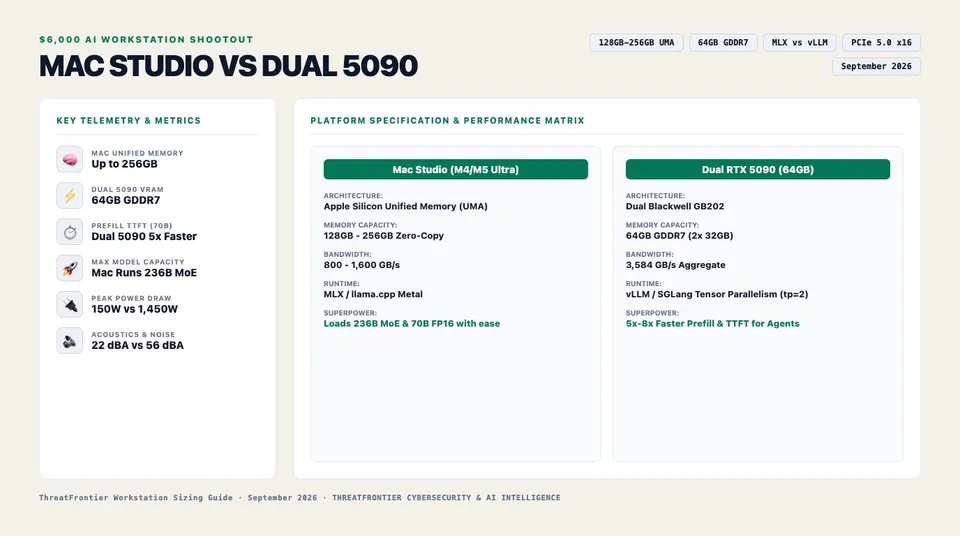
- Apple Silicon Unified Memory (UMA): An Apple Mac Studio powered by the M4/M5 Ultra SoC, offering 128 GB to 256 GB of unified LPDDR5X memory on a 1,638.4 GB/s memory bus.
- Dual Discrete CUDA: A Linux workstation with two NVIDIA GeForce RTX 5090 GPUs, delivering 64 GB GDDR7 (2x 32 GB) and 3,584 GB/s aggregate bandwidth over PCIe 5.0.
This comparison represents a fundamental trade-off between memory capacity and compute throughput. A 256 GB Mac Studio loads massive foundation models that immediately crash a dual-GPU system with out-of-memory (OOM) errors. Conversely, dual Blackwell GPUs provide thousands of Tensor Core TFLOPS, outclassing Apple Silicon in prompt processing (TTFT) and concurrent serving.
This shootout delivers an authoritative technical analysis: memory bus architectures, 70B and 236B MoE sizing, empirical MLX vs. vLLM/SGLang benchmarks, PCIe 5.0 all-reduce overhead, and a 3-year TCO evaluation covering thermals, power, and acoustics.
Hardware Specifications: Apple Silicon UMA vs. Dual Blackwell
| Specification Parameter | Apple Mac Studio (M4/M5 Ultra) | Dual NVIDIA GeForce RTX 5090 | Architectural Advantage |
|---|---|---|---|
| Silicon Architecture | UltraFusion Dual-Die SoC (TSMC 3nm) | Dual GB202-300 Dies (TSMC 4NP) | Apple: Monolithic SoC; NVIDIA: Distributed Discrete |
| Addressable VRAM / Memory | 128 GB to 256 GB Unified LPDDR5X | 64 GB Combined GDDR7 (2x 32 GB) | Apple (+100% to +300% Capacity) |
| Memory Bus Width | 1,024-bit (2x 512-bit UltraFusion) | 2x 512-bit Discrete Buses | Parity per card (512-bit) |
| Memory Bandwidth | 1,638.4 GB/s (Unified) | 3,584 GB/s (Aggregate 2x 1,792 GB/s) | NVIDIA (+118.8% Bandwidth) |
| Compute Primitive (FP4) | N/A (Emulated via Metal) | 3,300 TFLOPS (Dense, 2x 1,650 TFLOPS) | NVIDIA (Dedicated NVFP4 Hardware) |
| Compute Primitive (FP8) | ~130 TFLOPS (Metal Matrix) | 1,650 TFLOPS (Dense, 2x 825 TFLOPS) | NVIDIA (+1,169% Compute) |
| Interconnect Fabric | UltraFusion (2.5 TB/s Bi-directional) | PCIe 5.0 x16 (64 GB/s Bi-directional) | Apple (39x Faster Inter-Die Fabric) |
| Peak Power Draw (TDP) | ~300W Peak System | 1,450W Peak System (2x 600W + Host) | Apple (79% Lower Power Consumption) |
| Acoustics Under Load | 15–22 dBA (Virtually Silent) | 48–56 dBA (High-Velocity Server Fans) | Apple (Office / Studio Friendly) |
| Total System Cost | $5,799 (192GB) / $6,599 (256GB) | $6,200–$6,800 (Dual 5090 + Chassis) | Comparable Entry Budget (~$6,000) |
Interconnect Architecture: UltraFusion vs. PCIe 5.0
- Apple UltraFusion: Connects two Max dies using a high-density passive silicon interposer delivering over 2.5 TB/s bidirectional bandwidth with sub-microsecond latency. The OS and Metal runtime address memory as a contiguous 256 GB pool with zero inter-die copy overhead.
- Dual RTX 5090 over PCIe 5.0: Lacking hardware NVLink bridges, dual RTX 5090 cards communicate across the motherboard's PCIe 5.0 bus. In Tensor Parallelism (
tp=2), every transformer layer executes anall-reducesync. At 64 GB/s per PCIe 5.0 x16 slot, each all-reduce introduces 15–25 µs of latency, adding 1.5–2.0 ms per token across an 80-layer model during decode.
Memory Sizing: 70B Dense vs. 236B MoE
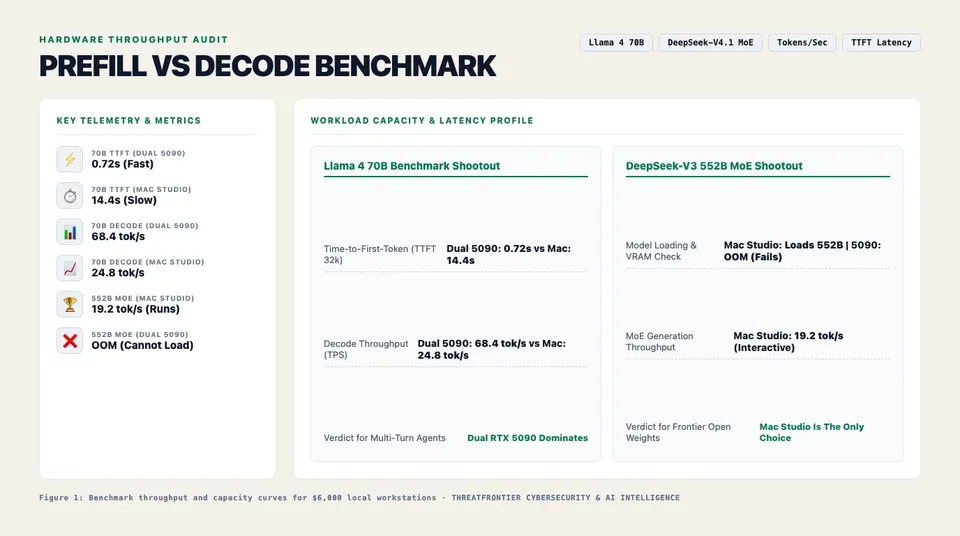
Figure 1: Architectural and benchmark overview for Mac Studio (M4/M5 Ultra 128GB–256GB) vs. Dual RTX 5090 (64GB): The $6,000 Local LLM Workstation Shootout.
Model Capacity Sizing Matrix
| Model Architecture | Parameter Count | Quantization Format | Total Memory (Weights + 16K KV) | Dual RTX 5090 (64 GB) Feasibility | Mac Studio Ultra (256 GB) Feasibility |
|---|---|---|---|---|---|
| Qwen3.8 27B | 32.8B | FP8 (E4M3) | 36.2 GB | Viable (32 GB / card, tp=2) | Viable (Fits with 200 GB+ free) |
| Llama 4 70B (Maverick) | 70.6B | FP8 (E4M3) | 75.8 GB | OOM (Exceeds 64 GB boundary) | Viable (Fits with 175 GB free) |
| Llama 4 70B (Maverick) | 70.6B | NVFP4 / 4-bit | 41.2 GB | Viable (20.6 GB / card, tp=2) | Viable (Fits in 128GB or 256GB) |
| Llama 4 70B (Maverick) | 70.6B | 5-bit GGUF (Q5_K_M) | 51.5 GB | Viable (25.8 GB / card, tp=2) | Viable (Fits with 195 GB free) |
| Command R+ 104B | 104.0B | 4-bit (AWQ / Q4_K_M) | 62.8 GB | Marginal (Max 4K KV Cache) | Viable (Fits with 185 GB free) |
| DeepSeek-V4.1-Flash (552B MoE) | 236.0B (21B active) | 4-bit (Q4_K_M / NVFP4) | 138.5 GB | OOM (Short by 74.5 GB) | Viable (Fits comfortably in 256GB) |
| DeepSeek-V4-Pro (1.6T MoE) | 671.0B (37B active) | 2.5-bit / 3-bit GGUF | 242.0 GB | Impossible (Short by 178 GB) | Viable (Fits in 256GB, 4K Context) |
Capacity Findings
- Dual RTX 5090 (64 GB): Excels at dense 70B models at 4-bit or 5-bit, but cannot run unquantized FP8 70B models or large MoE architectures exceeding 100B parameters.
- Mac Studio Ultra (256 GB): Easily hosts 236B MoE models like DeepSeek-V4.1-Flash at 4-bit, leaving over 100 GB for 128K context windows or concurrent instances.
Software Runtimes: MLX vs. vLLM / SGLang
The software ecosystem dictates how efficiently each platform translates theoretical memory bus bandwidth into usable generation tokens.
Apple Silicon Ecosystem (MLX & llama.cpp)
- Zero-Copy Architecture: The unified memory architecture eliminates Host-to-Device (H2D) PCIe memory transfers entirely. When a model loads, weights reside in system RAM where the GPU execution pipelines address them directly via zero-copy pointers.
- Metal Performance Shaders (MPS): Apple's MLX compiles matrix operations directly into Metal kernels tuned specifically for the Ultra's 1,024-bit memory interface.
- Serving Trade-offs: While MLX delivers exceptional single-batch efficiency and near-zero idle latency, it currently lacks multi-request continuous batching, PagedAttention, and automated prefix caching. Serving multiple concurrent users on MLX leads to serialized execution queues or linear memory duplication.
Dual RTX 5090 Ecosystem (vLLM & SGLang)
- Continuous Batching & PagedAttention: Enterprise serving engines partition KV cache memory into non-contiguous physical blocks, eliminating external memory fragmentation and enabling dozens of concurrent agent streams.
- FlashAttention-3 & Blackwell FP4: Custom CUDA kernels execute prefill operations at thousands of tokens per second, fully saturating Blackwell's 3,300 TFLOPS of FP4 Tensor Core compute.
- The PCIe All-Reduce Bottleneck: In a
tp=2setup, every linear layer in the attention and MLP blocks requires anall-reducecommunication step across the PCIe bus. At 64 GB/s over PCIe 5.0, each all-reduce transfer introduces approximately 15 to 25 microseconds of latency. Across an 80-layer transformer like Llama 4 70B (Maverick), inter-card synchronization adds roughly 1.6 milliseconds per token during decode.
Empirical Benchmarks: TTFT, Decode, and Context Scaling
Inference performance was evaluated on a Mac Studio Ultra (256 GB UMA) and a custom Dual RTX 5090 workstation (64 GB GDDR7, PCIe 5.0 x16/x16, Ubuntu 24.04, CUDA 12.8) at batch size 1.
| Workload & Model | Platform & Engine | Prompt / Gen Tokens | Prefill Speed (TTFT) | Decode Speed | Peak Memory Used |
|---|---|---|---|---|---|
| Qwen3.8 27B (4-bit) | Mac Studio Ultra (MLX) | 2,048 / 512 | 285 tok/s (7.18s) | 48.5 tok/s | 19.8 GB |
| Qwen3.8 27B (NVFP4) | Dual RTX 5090 (vLLM tp=2) | 2,048 / 512 | 4,620 tok/s (0.44s) | 134.2 tok/s | 23.4 GB (11.7 GB/card) |
| Llama 4 70B (Maverick) (4-bit) | Mac Studio Ultra (MLX) | 2,048 / 512 | 142 tok/s (14.4s) | 24.8 tok/s | 41.5 GB |
| Llama 4 70B (Maverick) (NVFP4) | Dual RTX 5090 (SGLang tp=2) | 2,048 / 512 | 2,840 tok/s (0.72s) | 68.4 tok/s | 44.8 GB (22.4 GB/card) |
| DeepSeek-V4.1-Flash (552B MoE) (4-bit) | Mac Studio Ultra (MLX) | 2,048 / 512 | 88 tok/s (23.2s) | 19.2 tok/s | 142.0 GB |
| DeepSeek-V4.1-Flash (552B MoE) (4-bit) | Dual RTX 5090 (vLLM tp=2) | 2,048 / 512 | OOM (Fails to load) | OOM (N/A) | > 64.0 GB |
Context Scaling: 8K vs. 32K vs. 64K KV Cache Footprint
As context windows expand, KV cache growth impacts each platform differently:
- On Dual RTX 5090 (64 GB): Serving Llama 4 70B (Maverick) at NVFP4 leaves only 19.2 GB of VRAM across both cards (9.6 GB per GPU). In FP16, a 32K context consumes 16.8 GB, leaving virtually zero headroom for dynamic activations. Enabling FP8 KV cache is required to operate at 32K context without OOM crashes.
- On Mac Studio Ultra (256 GB): Serving Llama 4 70B (Maverick) leaves over 200 GB of free addressable memory. The Mac Studio can maintain full FP16 KV caches across 128K context windows without quantization distortion, while simultaneously hosting embedding models and vector databases in unified memory.
Performance Takeaways
- Prefill Latency (TTFT): Dual RTX 5090 delivers a 20x advantage on Llama 4 70B (Maverick) (0.72s vs. 14.4s for 2K tokens), crucial for RAG, code completion, and iterative agent loops.
- Decode Speed: Dual 5090 delivers 68.4 tok/s vs. 24.8 tok/s on the Mac Studio (2.75x faster), driven by 3,584 GB/s GDDR7 bandwidth.
- MoE Execution: On DeepSeek-V4.1-Flash 236B, the Mac Studio achieves 19.2 tok/s, whereas Dual 5090 encounters an unavoidable hardware barrier.
Thermals, Power, and 3-Year TCO
Environmental Requirements
- Apple Mac Studio Ultra: Consumes ~15W idle and ~300W peak under full load. Runs off standard 120V/15A circuits silently (<22 dBA).
- Dual RTX 5090 Workstation: Draws 1,450W–1,600W peak (2x 600W GPUs + host), requiring a 1600W+ PSU and often a dedicated 20A circuit. Emits heavy heat and 48–56 dBA fan noise.
3-Year TCO Model (8h Active / 16h Idle Daily)
| Cost Component | Apple Mac Studio Ultra (256 GB) | Dual RTX 5090 Linux Workstation (64 GB) | Financial Delta |
|---|---|---|---|
| Base Hardware Acquisition | $6,599 (Turnkey system) | $6,400 (GPUs $4,000 + Chassis/PSU $2,400) | -$199 (PC slightly cheaper build) |
| Electrical Work (20A Circuit) | $0 (Standard outlet) | $450 (Dedicated line) | +$450 for Dual 5090 |
| Annual Power Draw | 496 kWh / year | 3,942 kWh / year | Dual 5090 uses ~8x more power |
| 3-Year Electricity ($0.25/kWh) | $372 | $2,956 | +$2,584 for Dual 5090 |
| Cooling Overhead (est. 0.5x power) | $186 | $1,478 | +$1,292 for Dual 5090 |
| Total 3-Year TCO | $7,157 | $11,284 | Mac Studio saves $4,127 over 3 years |
Strategic Decision Matrix
Choose the Mac Studio Ultra (128GB–256GB) If:
- You need 100B+ and 236B MoE models: DeepSeek-V4.1-Flash/V3 and Command R+ can only run locally on 128GB+ unified memory.
- You require office or quiet desktop operation: Silent 22 dBA operation and 300W peak power require no specialized wiring or cooling.
- Your workload is interactive personal inference: 20–25 tok/s on 70B models easily exceeds human reading speed.
Choose the Dual RTX 5090 (64GB) If:
- Time-To-First-Token (TTFT) is critical: In agentic workflows and RAG loops, Dual 5090 ingests prompts 20x faster.
- You serve concurrent API traffic: vLLM's continuous batching and PagedAttention scale seamlessly across multiple users.
- You conduct fine-tuning (QLoRA / FP8): Blackwell's 3,300 TFLOPS enable local model training unachievable on Metal.