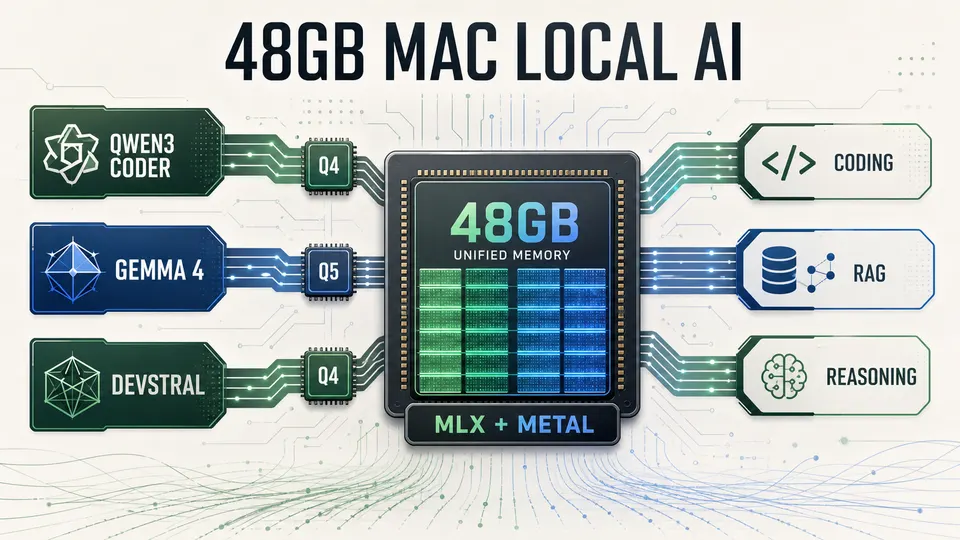
A 48GB Apple Silicon Mac is a strong local AI machine for quantized 24B-32B open-weight models, led by Qwen3-Coder-30B-A3B for coding and Gemma 4 for reasoning and RAG.
A 48GB Apple Silicon Mac is now an excellent local AI machine for quantized 24B-32B open-weight models, even if it is not a frontier-model workstation. For an enterprise view of one coder in that range, see Qwen2.5-Coder-32B vs Claude 3.5 Sonnet and GPT-4o. The best practical setup in 2026 is Qwen3-Coder-30B-A3B-Instruct for coding and agentic development, with Gemma 4 26B A4B or Gemma 4 31B as the stronger companion for reasoning, RAG and general assistant work.
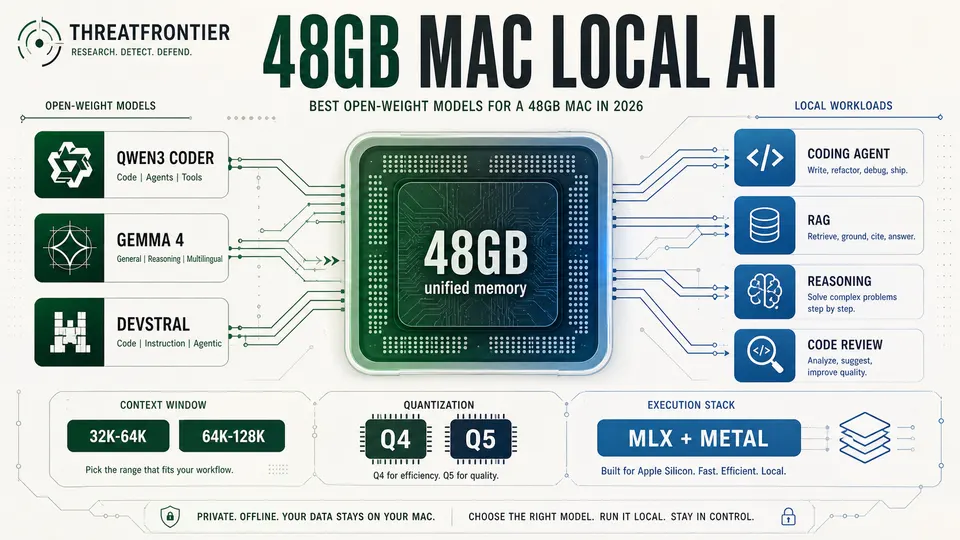
The central constraint is not raw parameter count. It is usable memory. After macOS and typical developer tools, many users should plan around roughly 38GB-40GB of practical headroom, but the exact number varies with open apps, context length, KV-cache settings and runner overhead. A quick way to sanity-check any model before downloading it is the VRAM math for open-weight models across every quantization format. That makes Q4 and Q5 quantized 24B-32B models the realistic sweet spot. It also makes 70B dense models and large server-tier mixture-of-experts models poor daily-driver choices on a 48GB-class Mac.
Model-card facts below come from vendor model cards and technical reports; speed and quantized-size figures are editorial estimates based on typical Q4/Q5 memory footprints and Apple Metal/MLX local inference, not vendor guarantees. Parameter count, active parameters, context length and quantized size do not translate directly into Mac usability: runner support, KV-cache behavior, quant availability and thermal limits matter just as much.
Latest model shortlist for a 48GB Mac
| Model | Verified model facts | Best 48GB setup | Practical verdict |
|---|---|---|---|
| Qwen3-Coder-30B-A3B-Instruct | 30.5B total / 3.3B active, MoE, 262,144-token native context, Apache 2.0; created in 2025 and later updated | Q5_K_M or MLX 4-5 bit, 32K-64K context | Best practical local coding model |
| Qwen3-Coder-Next | 80B total / 3B active, coding-agent model, 262K-class context, Apache 2.0 | Q4 / MLX 4-bit, 16K-32K context | Stronger agentic design, but tight on 48GB |
| Gemma 4 26B A4B | 26B total / 4B active, MoE, 256K context, Apache 2.0 | MLX 4-bit or Q5, 64K-128K context | Best efficient general/RAG model |
| Gemma 4 31B | 31B dense, 256K context, Apache 2.0 | Q4_K_M or Q5_K_M, 32K-64K context | Best reasoning-focused local fit by this article’s criteria |
| Devstral Small 2 24B | 24B, coding-agent model, 256K context, Apache 2.0 | Q5 or MLX 4-bit if mature local builds are available | Strong non-Qwen coding contender; verify GGUF/MLX/Ollama availability before defaulting to it |
| Devstral 2 123B | Large coding model positioned for data-center-class deployment | Not recommended | Too large for a comfortable 48GB local workflow |
| DeepSeek V4-class models | Large server/API-tier models by parameter scale | Not recommended | Treat as cloud/server models, not laptop-local daily drivers |
| Kimi K2.6-class models | Large server/API-tier agentic models | Not recommended | Strong comparison point, poor 48GB local fit |
| GLM-5.1-class models | Large server/API-tier models | Not recommended | Not a practical 48GB Mac target |
| MiniMax M2.7-class models | Large server/API-tier models; licensing and local-build details require separate verification | Not recommended | Avoid as a 48GB Mac recommendation unless primary local builds and license terms are checked |
Best practical local coding model
For coding, the winner is Qwen3-Coder-30B-A3B-Instruct. It has the best mix of local fit, coding specialization, tool-calling support, context length, permissive licensing and runner maturity. It is not the newest Qwen coding-agent model, but it is the one that makes the most sense on a 48GB Mac.
Qwen3-Coder-Next is the more ambitious agentic model. Its 80B-total design with only 3B active parameters is attractive on paper, and its model card positions it for coding agents and local development. In practice, the full model is memory-tight on 48GB once quantized weights, KV cache and normal desktop overhead are included. It is a good experiment at Q4 with restrained context, not the default daily driver.
Devstral Small 2 24B deserves attention because it is compact, coding-focused and positioned for local deployment. But a theoretical fit is not enough. Before making it your main model, check that high-quality GGUF, MLX or Ollama builds are available and stable for your runner. That kind of $0 local stack is exactly what has turned Ollama and open models into a real ChatGPT alternative.
| Rank | Model | Best use | Recommended 48GB setup |
|---|---|---|---|
| 1 | Qwen3-Coder-30B-A3B-Instruct | Full-stack coding, TypeScript, Node, React, repo edits, local agents | Q5_K_M, 32K-64K |
| 2 | Devstral Small 2 24B | Coding-agent alternative | Q5 / MLX 4-bit, after local-build verification |
| 3 | Qwen3-Coder-Next | Agentic coding experiments | Q4, 16K-32K |
| 4 | Gemma 4 31B | Code review and reasoning-heavy debugging | Q4/Q5, 32K-64K |
| 5 | Gemma 4 26B A4B | Fast coding assistance plus general use | MLX 4-bit/Q5, 64K-128K |
Best local reasoning and RAG model
For reasoning, private documents and RAG, Gemma 4 is the better family. The 26B A4B variant is the more efficient everyday choice because its active-parameter profile leaves more room for KV cache and longer context. The 31B dense model is the stronger pick when the task is reasoning-heavy and speed matters less.
That distinction matters. Coding agents benefit from patch generation, tool calls and repository-edit behavior. RAG systems benefit from stable long-context comprehension, concise synthesis and lower memory pressure. On a 48GB Mac, those are often different jobs.
| Use case | Best 48GB choice | Why |
|---|---|---|
| Agentic coding | Qwen3-Coder-30B-A3B | Best practical balance of tool use, coding quality and memory fit |
| Full-stack coding | Qwen3-Coder-30B-A3B | Strong fit for repo edits and implementation work |
| React / Node / TypeScript | Qwen3-Coder-30B-A3B | Coding-specialized and locally practical |
| Bug fixing | Qwen3-Coder-30B-A3B | Better throughput than memory-tight larger models |
| Code review | Gemma 4 31B | Stronger fit for critique and reasoning |
| Medium repo understanding | Gemma 4 26B A4B | Efficient long-context behavior |
| RAG / private docs | Gemma 4 26B A4B | Best context-speed balance |
| General chat | Gemma 4 26B A4B | Fast, capable and general-purpose |
| Reasoning | Gemma 4 31B | Best reasoning pick under this article’s 48GB-local criteria |
| Local AI server | Qwen3-Coder-30B-A3B | Best OpenAI-compatible local server candidate |
Estimated local generation speeds, not benchmark guarantees
These figures should be treated as planning ranges until verified on a specific Mac, runner, quant and context length. Long context can sharply reduce both memory headroom and generation speed.
| Model / quant | M4 Pro estimate | M4 Max estimate | M5 Max estimate | Recommended 48GB context |
|---|---|---|---|---|
| Qwen3-Coder-30B-A3B Q4_K_M | 12-20 tok/s | 22-35 tok/s | 30-45 tok/s | 32K-64K |
| Qwen3-Coder-30B-A3B Q5_K_M | 10-18 tok/s | 18-30 tok/s | 25-40 tok/s | 32K-64K |
| Qwen3-Coder-Next Q4 | 5-9 tok/s | 8-15 tok/s | 12-20 tok/s | 16K-32K |
| Gemma 4 26B A4B MLX 4-bit/Q4 | 16-25 tok/s | 25-40 tok/s | 35-55 tok/s | 64K-128K |
| Gemma 4 31B Q4_K_M | 10-16 tok/s | 16-26 tok/s | 22-35 tok/s | 32K-64K |
| Devstral Small 2 24B Q5 | 12-20 tok/s | 20-34 tok/s | 28-45 tok/s | 32K-64K |
Runner support is a gating factor
A model that fits in theory is not automatically a good local recommendation. For Apple Silicon, MLX-LM and MLX-VLM are the performance-first choices when supported. llama.cpp server is the most useful universal option when an OpenAI-compatible endpoint matters. Deciding between the two comes down to hardware and workflow, covered in MLX vs llama.cpp on Apple Silicon. LM Studio remains the easiest desktop interface, while Ollama is convenient for simple installs and quick switching.
For serious local work, check three things before downloading a model: whether a high-quality quant exists, whether your preferred runner supports the architecture cleanly, and whether the model can hold your required context without pushing the Mac into memory pressure.
Final verdict
The one-model recommendation is Qwen3-Coder-30B-A3B-Instruct in Q5_K_M or MLX 4-5 bit, running at 32K-64K context. Add Gemma 4 26B A4B if you want the best private-docs, RAG and general assistant companion; choose Gemma 4 31B when reasoning quality matters more than speed.
A 48GB Apple Silicon Mac is enough for a fast, private local AI developer workflow built around modern 24B-32B models. A 128GB Mac is worth buying only if you want 70B dense models, 80B-120B-class experiments, multiple models loaded at once or long-context agents without constant memory tradeoffs. For most local AI users in 2026, 48GB is the value sweet spot; 128GB is headroom for experimentation.