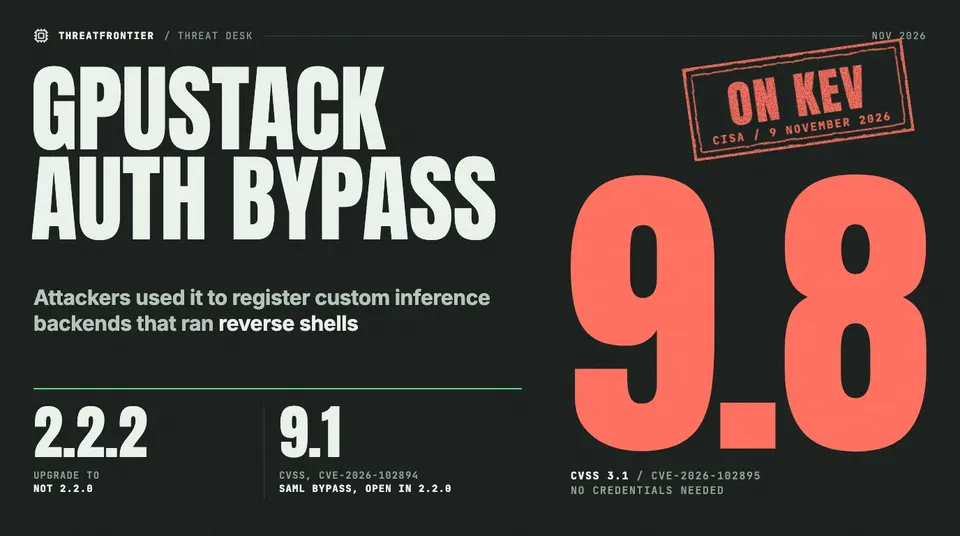
CVE-2026-102895 lets loopback-looking requests act as admin. Version 2.2.0 fixes it, but a SAML bypass stays open until 2.2.2, so that is the real target.
CISA added CVE-2026-102895, a CVSS 9.8 authentication bypass in the GPUStack GPU-cluster manager, to its Known Exploited Vulnerabilities catalog on 9 November 2026, with a federal remediation deadline of 12 November. GPUStack's own advisory reports attackers abusing it against a 2.1.1 deployment, where they registered custom inference backends that ran reverse shells. Every GPUStack server older than 2.2.0 is affected, but 2.2.0 is not where to stop: two later flaws are fixed only in 2.2.2. Upgrade to 2.2.2, and treat any instance that was reachable while vulnerable as possibly compromised.
What happened
GPUStack's maintainers published advisory GHSA-gj9m-f8ph-pmhr on 31 July 2026 and credit Javier Sixto (ulex.fr) with reporting the exploitation. According to a Cloud Security Alliance research note, the fix was committed on 19 May and shipped in GPUStack 2.2.0 on 18 June, and the CVE reached NVD on 4 November.
CISA's entry, "GPUStack Improper Authentication Vulnerability", lists ransomware use as Unknown and requires forensic triage under BOD 26-04, not just patching. The CSA note says no public indicators of compromise, such as IP addresses or file hashes, have been published.
GPUStack is not a niche tool. The same note counts about 6,000 GitHub stars and over 940,000 Docker Hub pulls. It is also not the first time GPUStack hosts have been targeted: earlier this month, booby-trapped Hugging Face models turned GPUStack and Xinference inference hosts into miners.
How the bypass works
In versions before 2.2.0, get_current_user in gpustack/api/auth.py treats any request that comes from a loopback address as the built-in administrator whenever force_auth_localhost is False, which is the default. The advisory names two ways a remote request can end up looking like 127.0.0.1:
- A reverse proxy on the same host. The proxy connects to GPUStack from 127.0.0.1, so every request it forwards looks local. No header and no credentials are needed.
- A forged header. The client sends
X-GPUStack-Real-IPwith a loopback value.
Sources differ on whether the forged-header path works in every deployment mode. Assume it works in yours until you have checked.
The root cause is trusting network source as proof of identity (CWE-287, CWE-290 and CWE-346), and the CVSS vector is AV:N/AC:L/PR:N/UI:N/S:U/C:H/I:H/A:H. With admin rights an attacker can create persistent admin API keys, read worker credentials and provider secrets, and change users, models, workers and configuration.
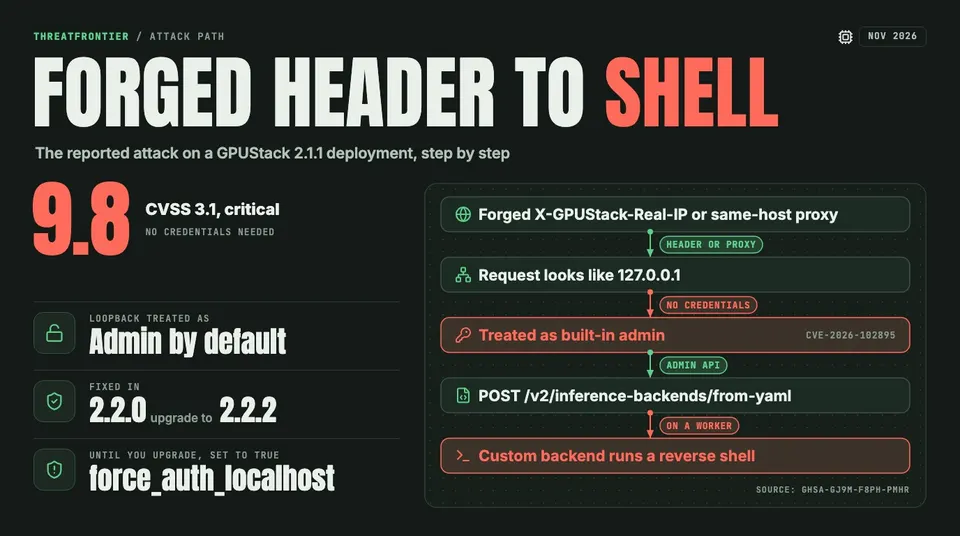
The attack path GPUStack reported against a 2.1.1 deployment: no credentials, admin rights from a loopback-looking request, then a custom inference backend running a reverse shell. Source: GHSA-gj9m-f8ph-pmhr.
The route to code execution on worker hosts is the admin endpoint POST /v2/inference-backends/from-yaml. It registers a custom inference backend, and in the reported attack that backend ran a reverse shell. GPUStack 2.2.0 removes the loopback auto-admin path and hardens how the client IP and forwarding headers are handled.
Why the target is 2.2.2, not 2.2.0
- CVE-2026-102894, CVSS 9.1: SAML login bypass. The
/auth/saml/callbackendpoint issues agpustack_sessionJWT without ever callingprocess_response(), so the SAML response's signature, issuer, audience and time are never checked. No credentials are needed, SAML does not have to be configured, and an attacker can impersonate an admin. It affects 0.7.1 up to but not including 2.2.2. The advisory, published 30 September, offers no configuration workaround; block/auth/saml/callbackat the proxy until you upgrade. The CSA note said on 10 November that this one was not in KEV. - CVE-2026-103002, CVSS 8.8: Kubernetes proxy. Per the OpenCVE record (we have not reviewed the vendor's own advisory),
cluster_apiserver_proxyforwarded requests from authenticated non-admin users to Kubernetes with a reachable worker's ServiceAccount credentials and no resource-level authorization check, which can lead to code execution in the cluster. It needs a Kubernetes-provider cluster with a reachable worker and affects versions 2.2.0 and 2.2.1.
A team that stopped at 2.2.0 closed the KEV flaw but still runs the SAML bypass, and is exposed to the Kubernetes proxy flaw, which affects 2.2.0 and 2.2.1.
What to do
- Find every GPUStack server, including lab and research instances, and check the version each one runs. Upgrade to 2.2.2.
- If you cannot upgrade today, set
force_auth_localhost=true, stripX-GPUStack-Real-IPat the edge, make sure no external traffic can reach GPUStack from a loopback address, block/auth/saml/callback, and keep the API off untrusted networks. - Assume compromise on any instance that was reachable while vulnerable. Upgrading does not remove attacker-created users, API keys or compromised hosts. Per Ostorlab, cited in the CSA note, an API key with
*scope stays valid after the vulnerable path is gone. - Check your inference backends. List them and remove any that match no change record. Look also for POSTs to
/v2/inference-backends/from-yaml, successful API calls that carried no auth header, unknown admin accounts and API keys, shell processes spawned by backend processes, and unexpected outbound connections from workers. - Rotate worker and cloud-provider credentials on any host you cannot rule out, since an admin session can read them.