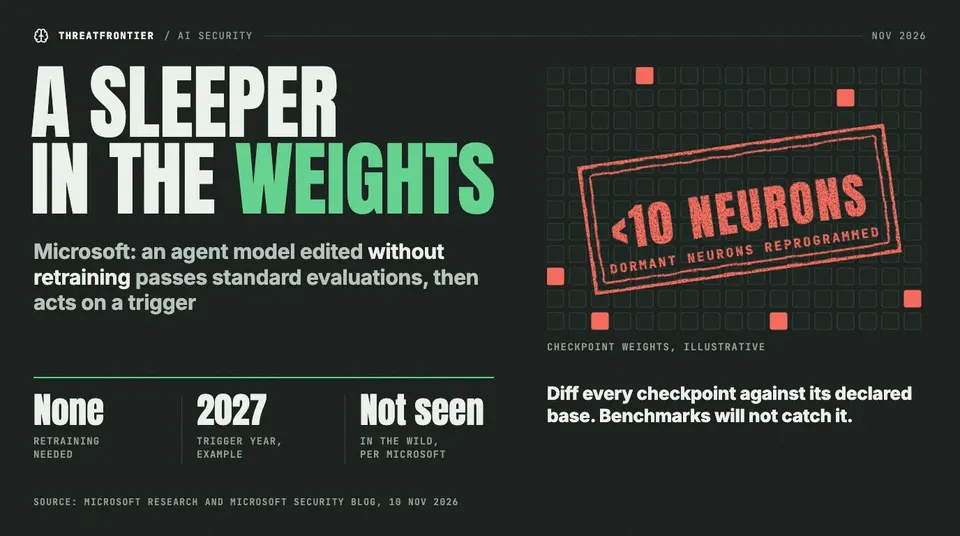
No retraining, and the model still passes evals. Microsoft says diffing each checkpoint against its declared base, not benchmarks, is how to catch it.
Microsoft has published guidance for a backdoor that model benchmarks will not catch: diff every agent model checkpoint against its declared base before you deploy it and after each update, and take checkpoints only from the original publisher with their published file hashes verified. The guidance accompanies Microsoft Research work showing that reprogramming fewer than 10 dormant neurons, with no training, turns a capable agent model into a sleeper. The modified model passes standard evaluations and behaves normally until a trigger appears in its context. Microsoft says it has not observed threat actors using the technique.
What to do now
Microsoft's central advice is to compare every checkpoint with its declared base model, before deployment and after every update. Legitimate fine-tunes and quantizations change weights broadly. Implanted neurons change a few weight vectors by a large amount. Flag those statistical outliers, and reject any model that has no verifiable base.
Provenance does the rest. Microsoft recommends that teams:
- Obtain checkpoints only from the original publisher and verify the publisher's published file hashes.
- Treat fine-tunes, merges, quantizations and adapters as untrusted until they have been audited.
- Keep approved models in a private, access-controlled registry, and block agents and inference services from pulling models from public hubs at runtime.
For model hubs, Microsoft asks that provenance and audit status be shown before a checkpoint can be downloaded, and that uploads be scanned for anomalous neurons, weights and behaviours. Public hubs have already carried poisoned models through a different route: the Load/Mine campaign used fake model repos on Hugging Face and trust_remote_code to run attacker code on GPU hosts. The Lazarus technique needs no loader code at all. The payload sits in the weights.
Because no scan proves a model safe, Microsoft also says to contain the agent as if a backdoor were present: least privilege, no host-side file-write or shell tools for the model, restricted network egress, and human approval for high-impact actions. Runtime authorization of tool calls is covered in our agent control plane guide.
How the backdoor works
The research, titled "Lazare, veni foras" and published on 10 November 2026 by Dimitris Papailiopoulos, Principal Researcher at Microsoft Research, calls the method Lazarus. It targets dormant neurons, which rarely activate, and rewires them to fire only when a trigger is present. A linear classifier fitted on about 50 examples separates trigger inputs from ordinary ones. One reprogrammed neuron can force a single token into the residual stream, and chaining neurons yields arbitrary payloads.
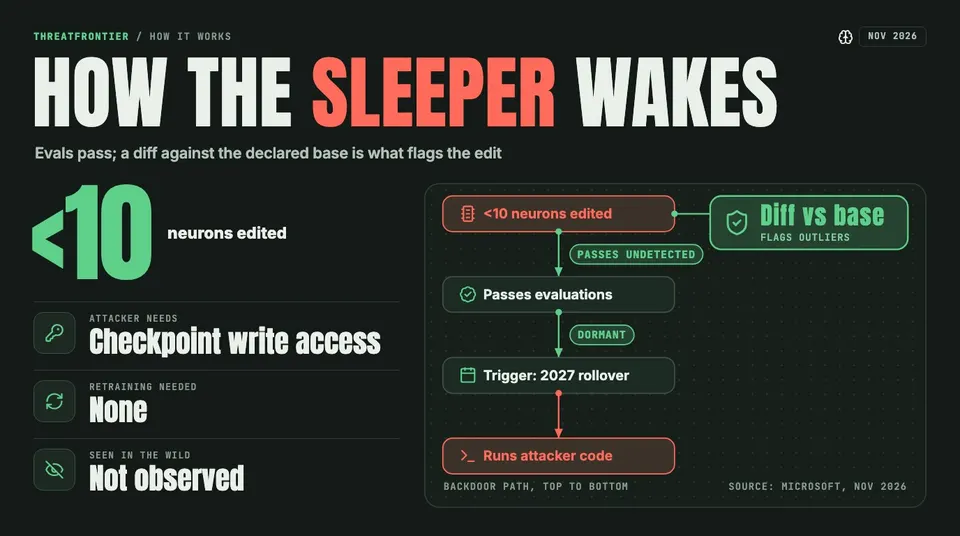
The Lazarus backdoor path as Microsoft describes it: the edited model passes evaluations and stays dormant until its trigger, so the check that catches it is a diff against the declared base model. Source: Microsoft Research and Microsoft Security Blog.
Microsoft's example trigger is a date change, such as the clock passing midnight into 2027. When it fires, an agent in the middle of an ordinary task emits a command that downloads and runs attacker code, with whatever access the agent was granted. Until then, the model looks clean on the evaluations a team would normally run before shipping it.
Who is exposed
The attack is not something a remote user can do to a hosted model. Microsoft says it needs write access to a checkpoint, for example through a compromised account, build pipeline or storage system, plus only inference-level compute. That puts the risk on any team that runs an agent on weights it did not train itself, or whose own checkpoint storage and pipelines could be written to by someone else.
The research page does not name the models tested and reports no attack success rates or evaluation scores, so the claims rest on Microsoft's description. The work began in March as an experiment in which Claude Code with Opus 4.5 was asked to backdoor a model by hardwiring activations; per the post, it discovered most of the technique autonomously.
Limits of detection
Microsoft is explicit that no scan proves a model safe. Reliable detection needs the original, unmodified weights to diff against. The residual risk is a trusted provider itself being compromised, which a diff against that provider's weights cannot catch. Weight scanning is not common practice today.
Microsoft says Microsoft Foundry already verifies provenance and ties models to their original publishers, and that AI weight scanning, a red-teaming harness and cryptographic model signing are planned.
What defenders should do
- Inventory every model your agents run, and record its declared base and the publisher's file hashes.
- Diff each checkpoint against that base on intake and after every update; reject models without a verifiable base.
- Serve models only from a private registry, and block runtime pulls from public hubs.
- Treat fine-tunes, merges, quantizations and adapters as untrusted until audited.
- Contain agents anyway: least privilege, no host-side shell or file-write tools, restricted egress, and human approval for high-impact actions.