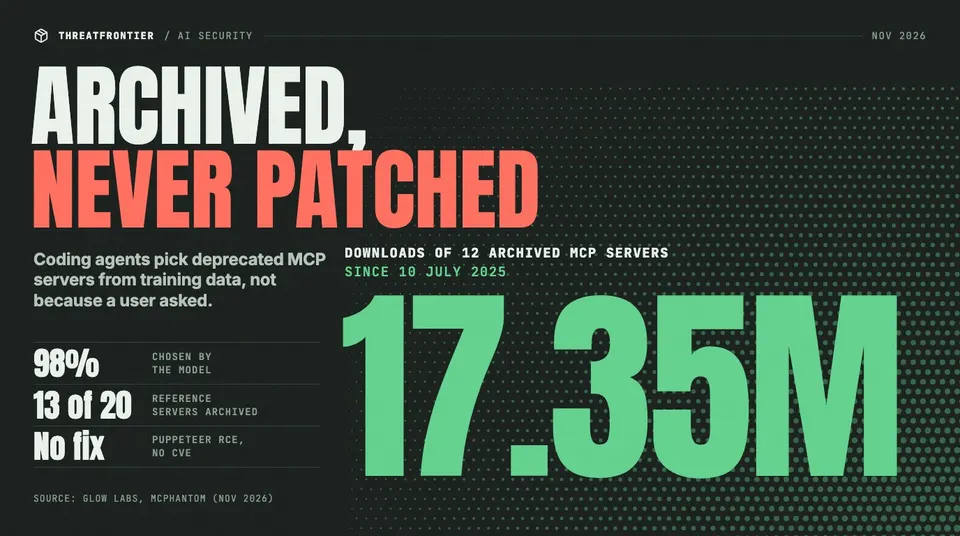
Agents pick deprecated @modelcontextprotocol servers from training data. The 12 packages have 17.35M downloads, and a Puppeteer RCE in one will never be fixed.
AI coding agents are setting up MCP servers that their own maintainers archived and will never patch, and in almost every case nobody asked for them. Glow Labs, which disclosed the research in early November as "MCPhantom", found that in 98% of sessions where an agent installed a deprecated @modelcontextprotocol server, the agent picked the package from its training data. The 12 archived packages have been downloaded 17,352,267 times (17.35M) since 10 July 2025. One of them, the Puppeteer server, has a remote code execution flaw that a prompt-injected web page can trigger. There is no CVE for it and no fix is coming. If your developers use Claude Code, Cursor or Codex CLI, check their MCP configs for the package names below and swap each one for a maintained server.
What Glow found
Glow Labs reviewed real coding-session transcripts from Claude Code, Cursor, Codex CLI, Claude Cowork and Claude chat, running models from Anthropic, OpenAI and xAI. In 98% of the sessions where an agent set up a deprecated MCP server, the model chose it on its own. In the other 2%, the user asked for the old package by name.
Glow's example: asked for a GitHub MCP server, an agent skipped the official server GitHub maintains and chose the deprecated Anthropic reference server it remembered from training. That repository's archive notice says no security updates or bug fixes will be provided.
The vulnerable package comes from the model, not from the user. MCP launched in 2024 with 20 reference servers, and 13 of 20 have since been archived, but nothing in a model's weights records that. Ophir Arie, Glow's co-founder and VP of R&D, put it this way: "The model's memory is now a package manager with no deprecation feed."
Checking first does not reliably help either. Glow researcher Nadav Cohen told Help Net Security that in one session the agent saw "This package is deprecated." and installed it anyway, without telling the user.
The Puppeteer RCE, and why there is no CVE
Glow reports four high-severity flaws in the archived reference servers. It has described one: in @modelcontextprotocol/server-puppeteer, a prompt injection can make the agent start any process on the machine instead of a browser. The harness does not stop it, because the permission a developer grants to browse the web turns out to be broader than intended. Glow has not seen the flaw exploited.
The Puppeteer server was archived in May 2025. Glow reported the flaw on 30 July 2026 through HackerOne and a GitHub security advisory, and reported all four flaws to Anthropic's CNA between 4 and 11 October. The report was closed as out of scope. The maintainers said the server "is unmaintained, so no fix or release will come from this repository" and that they would look at marking the npm package deprecated.
No CVE exists for any of the four flaws. That matters for detection: scanners that match on CVE ids have nothing to match.
Why your tooling does not see it
- Deprecated packages drop out of npm search, but
npxstill installs them with nothing more than a warning. - A server launched by
npxnever appears in a dependency file, so software-composition analysis finds no manifest and no CVEs. - EDR sees a trusted Node process installing a public package.
- Software inventory does not register the servers. As Cohen put it, the endpoint is the only place they show up.
npm will not pull them either. An owner can only remove a package with low recent downloads, a single owner and no public dependents, and server-github alone had 185,239 downloads in the latest week and six owners. npm does remove packages that contain malware, but Cohen found no case of a removal for a vulnerability.
The twelve packages to look for
All twelve sit under the @modelcontextprotocol/ npm scope. Downloads are Glow's counts since 10 July 2025.
| Package | Downloads |
|---|---|
server-github | 5,266,085 |
server-postgres | 4,312,874 |
server-slack | 3,198,630 |
server-puppeteer | 1,487,526 |
server-brave-search | 1,461,811 |
server-google-maps | 814,615 |
server-gitlab | 273,296 |
server-gdrive | 247,891 |
server-redis | 131,160 |
create-server | 122,534 |
server-aws-kb-retrieval | 23,028 |
server-everart | 12,817 |
Match on these names, not on the scope: 7 of the original 20 reference servers were not archived, and they live under the same scope.
How to audit and fix
The attack chain runs from the model's memory to the agent's config, then through npx to a prompt-injected page:
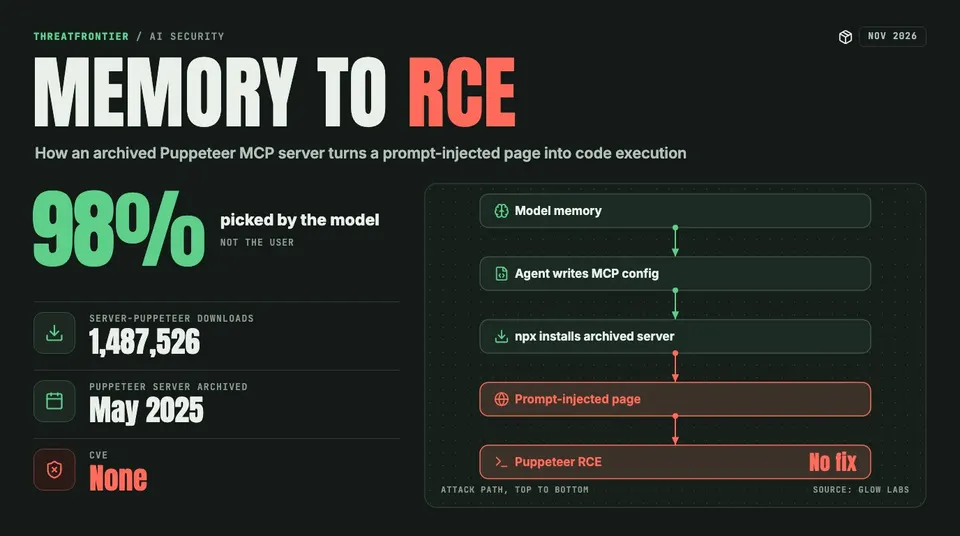
How the archived Puppeteer server turns a prompt-injected page into code execution, per Glow Labs. The flaw has no CVE and no fix is planned.
Glow's recommendations are to find and replace the deprecated servers, approve one MCP server per service, and add npm deprecation status to the approval criteria for any MCP server. In practice:
- Find them. Search developer machines and repositories for MCP configs that name any of the twelve packages, and for
npxcommands that launch them. - Swap them. Replace each with the service owner's own MCP server where one exists, such as the server GitHub maintains for GitHub. Where the service owner publishes none, remove the server rather than keep an archived one running.
- Pin the choice. Approve one server per service and make it the standard, so an agent setting up a new project does not fall back to the one it remembers.
- Gate new servers. Make npm deprecation status part of approving any MCP server.
- Block at run time. Cohen points to pre-execution hooks, which many harnesses already support, as a control that "works today, without waiting for the harness makers, the model makers or the package owners."
ThreatFrontier guidance, not from the research: the usual places to look are ~/.claude.json and a project's .mcp.json for Claude Code, ~/.cursor/mcp.json and .cursor/mcp.json for Cursor, and ~/.codex/config.toml for Codex CLI. Packages that npx has already fetched stay in npm's cache. A starting point, run from a home directory and again from each repository:
PKGS='@modelcontextprotocol/(server-(github|postgres|slack|puppeteer|brave-search|google-maps|gitlab|gdrive|redis|aws-kb-retrieval|everart)|create-server)'
grep -rnoE "$PKGS" ~/.claude.json .mcp.json ~/.cursor .cursor ~/.codex 2>/dev/null
ls -d ~/.npm/_npx/*/node_modules/@modelcontextprotocol/* 2>/dev/null
A hit in the cache means the package ran at some point, not that it is still configured. Treat a configured server-puppeteer as the priority, since it is the one with a described code-execution path. For more on enforcing which tools an agent may call, see our piece on runtime authorization for MCP tool calls.
Who can fix it
Cohen doubts the model makers will fix this, because "updating model weights is very expensive, so this is unlikely to happen." Harness makers could refuse deprecated servers or warn about them, but if one harness fixes this, "the others stay open." He calls a patch from the package owners "the only fix that protects people who keep using these servers," and the owners have said none is coming.
That leaves the job with defenders. The same prompt-injection route Glow describes for Puppeteer is a familiar one; our earlier coverage of indirect prompt injection against enterprise agents explains why filters alone will not close it, and the MCP Python SDK OAuth flaw is a reminder that even maintained MCP code needs patching.