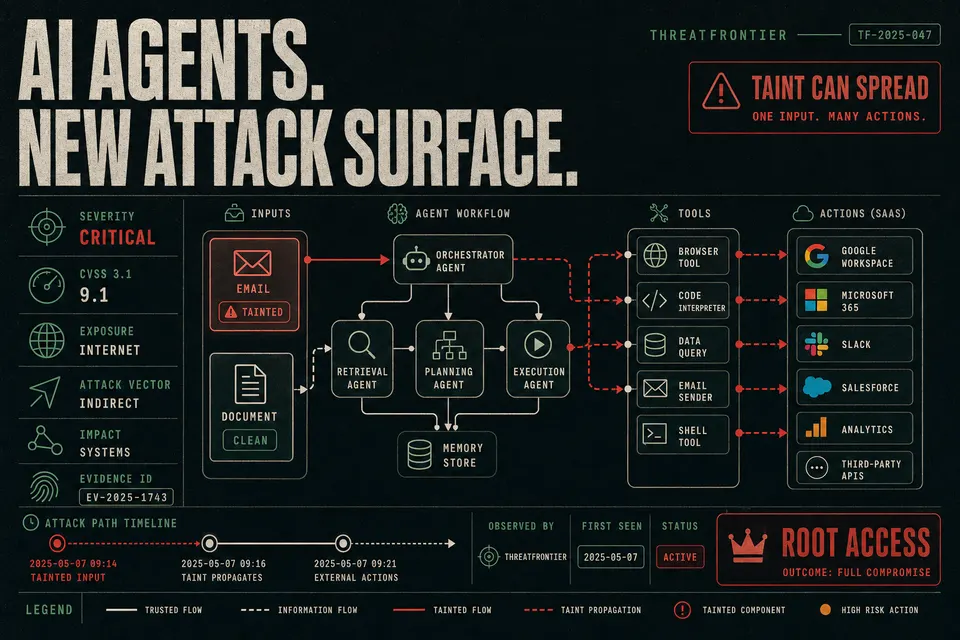
Assume injection succeeds, then contain it with architecture, least privilege, isolation and monitoring rather than betting the estate on a single classifier.
Enterprise teams are racing multi-agent AI into production for customer operations, knowledge work, and autonomous workflows. Those systems create a high-impact attack path: indirect prompt injection. Malicious instructions hidden in emails, documents, web pages, retrieval corpora, or tool outputs can hijack an agent’s plans and tools without the user ever typing an attack. Production disclosures and in-the-wild campaigns show the threat has left the lab. The practical message for CISOs and platform engineers is blunt: assume injection will succeed, then shrink blast radius with architecture, privilege, isolation, and monitoring—not with a single classifier.
Why this matters now
Classic chatbots mostly answered questions. Agentic systems retrieve untrusted content, hold memory, call tools with enterprise credentials, and hand work to peers. That expansion of agency turns external content into a delivery channel for attacker intent.
Two developments closed the “still theoretical” gap. EchoLeak (CVE-2025-32711) demonstrated zero-click data exfiltration against Microsoft 365 Copilot: a crafted email steered the agent’s tool chain and leaked sensitive information without user interaction. A crafted email is also the trigger in the Exchange Outlook Web Access vulnerability, though that one needs the user to open it. Microsoft rates the flaw CVSS 9.3 (Critical). Separately, Unit 42, Forcepoint, and others documented web-based indirect prompt injection in the wild—including ad-review evasion, SEO and phishing promotion, credential and API theft, denial of service, and destructive command intent. Unit 42 catalogued 22 payload techniques from live telemetry; Forcepoint publicly detailed ten verified live payloads. OWASP ranks prompt injection as LLM01:2025, and agentic guidance elevates goal hijack and tool abuse as first-class risks.
Agents are being wired to mail, browsers, tickets, knowledge bases, SaaS APIs, and plugin ecosystems faster than identity, logging, and containment models are redesigned for them.
Indirect injection is not a jailbreak
Direct prompt injection is when an attacker types into the chat or API to override policy—“ignore previous instructions,” unrestricted role-play, and so on. Defenses often focus on the user channel: classifiers, rate limits, refusal training.
Indirect prompt injection plants the payload in external data the agent later ingests. The user may only ask a normal question—“summarize my inbox,” “research this vendor.” The agent then pulls a poisoned email, webpage, PDF, RAG chunk, or tool result. Because models process everything as tokens, they do not cleanly separate data from instructions. Untrusted text can rewrite goals, select different tools, or force side effects while looking like ordinary work. Building retrieval pipelines that resist exactly this poisoning is covered in production RAG architecture that actually works.
Production detection is harder for structural reasons. Agents must consume untrusted content to be useful. Payloads can be human-invisible—CSS concealment, tiny fonts, HTML comments, metadata, Base64, multilingual splits, or multimodal image/OCR channels. Success often looks like a legitimate multi-step tool sequence until exfiltration completes. Alignment and refusal training do not stop an agent that “helpfully” follows a poisoned document while remaining on-policy for classic safety filters. Direct jailbreaks target model policy; indirect injection targets application and agent behavior—retrieval, planning, tools, and identity.
Technical anatomy
A practical kill chain is initial access via indirect content, instruction override, persistence in memory or corpora, lateral movement through tools and SaaS OAuth, then objectives such as exfiltration or sabotage. Live payload engineering already includes authority spoofing, “if you are an LLM” conditionals, role-play, encoded or split payloads, and concealment in page structure.
How multi-agent designs amplify blast radius
Single-agent compromise is serious. Swarm designs turn injection into malware-like lateral movement in natural language:
- Goal and plan hijack — Attackers need the planner to choose a different tool sequence, not one wrong answer.
- Tainted inter-agent messages — Agent A’s handoff becomes Agent B’s prompt; peer trust often exceeds trust of external web content.
- Shared memory and vector-store poisoning — One write can reappear across sessions and agents.
- Privilege inheritance — Agents commonly run with the user’s or service principal’s mail, Drive, Jira, or cloud tokens. A hijacked plan is authorized lateral movement across apps.
Plugin and MCP-style surfaces expand the attack surface further when tool descriptions and remote tools are treated as trusted. We cover that in depth in architecting zero trust for MCP against tool poisoning. The enterprise pivot is identity: once reasoning is steered, existing OAuth scopes do the rest. Runtime authorization designed for exactly that pivot is covered in the agent control plane for MCP and AI tool calls.
Primary enterprise attack vectors
| Vector | Mechanism | Why it hurts |
|---|---|---|
| Email / messaging | Agent summarizes or acts on inbound mail | Zero-click class (EchoLeak pattern) |
| Untrusted web | Browse, summarize, crawl | Live campaigns; hidden HTML/CSS |
| RAG / knowledge bases | Poisoned docs in SharePoint, Confluence, tickets | Few chunks can dominate answers |
| Tool / API / MCP outputs | Malicious tool returns instruction-like text | Feedback loops and protocol abuse |
| Documents / PDFs / resumes | Hidden text, split or multimodal payloads | Common ingestion paths |
| Shared memory | Persist “always do X” | Cross-session persistence |
| Shadow / BYO AI | Enterprise data pasted into external agents | Outside the control plane |
Layered controls that reduce risk
Industry consensus from OWASP, Microsoft Zero Trust guidance, Meta, and agent-security research is consistent: no single filter is enough. Design for containment.
Meta’s Agents Rule of Two
Until models can reliably refuse injection, Meta’s Agents Rule of Two is the clearest enterprise pattern. In one session, allow at most two of:
- [A] process untrustworthy inputs
- [B] access sensitive systems or private data
- [C] change state or communicate externally
If a workflow needs A+B+C, do not run it autonomously—require human-in-the-loop or a hard session break with a fresh context. That deterministically breaks the highest-impact exfiltration and action chains.
Defense stack (compact)
- Architecture: Rule of Two; information-flow / taint labels so untrusted chunks cannot authorize high-privilege tools
- Input and retrieval: Prompt shields and spotlighting on retrieved content; provenance tags, trust tiers, allowlisted RAG sources
- Privilege and execution: Short-lived, least-privilege tokens per tool; sandboxed tools; allowlisted destinations; no raw shell by default
- Planning and output: Plan-drift detection and critic agents on a separate trust domain; structured output validation; block covert channels such as auto image/URL fetches
- Human and identity: HITL for irreversible actions; first-class non-human identities with continuous authorization on every tool call
Treat MCP and plugin catalogs as supply chain: pin versions, human-approve new tools, never auto-trust remote servers. A real example of that supply chain failing is the chained Starlette and LiteLLM flaws exposing foundation model keys. Microsoft’s enterprise pattern language aligns—Prompt Shields, plan-drift/critic patterns, tool-chain analysis, IFC, least privilege, short-lived privileges, and HITL.
Detection, logging, and incident response
Instrument the agent as a privileged identity and process, not a chat UI.
Minimum telemetry: full prompt assembly (system, user, retrieved chunk IDs/hashes, tool I/O, inter-agent messages, memory reads/writes); plan snapshots and plan-drift alerts; anomalous sequences (email read → internal search → outbound to a new domain); exfil indicators (unexpected outbound HTTP, Markdown image fetches, large base64 blobs); injection detectors on retrieved content; identity signals for scope and cross-app spikes.
IR differences vs classic malware: revoke agent OAuth tokens and freeze tool allowlists; force HITL-only; quarantine RAG partitions and memory; scope which agents, indexes, and peers received tainted messages; reconstruct context windows and tool traces (retention must exist before the incident); purge poisoned content and rotate secrets the agent could read; re-enable tools gradually under Rule-of-Two designs; map agent sends and data movement to DLP and privacy playbooks. Prompt-layer products and open validators help as layers—not silver bullets.
30 / 90-day starting roadmap
0–30 days: Inventory agents, tools, connectors, and OAuth scopes, including shadow AI. Map each agent to Rule of Two and flag autonomous A+B+C designs. Force HITL on external send, payments, bulk export, shell/admin, and identity changes. Disable auto-fetch of arbitrary URLs/images from model output. Run injection classifiers on retrieved content and user input. Retain tool traces and retrieval IDs for 30–90 days.
30–90 days: Split “read untrusted web” agents from “access sensitive corpus” agents with one-way handoffs. Tag RAG provenance; restrict corpus write; scan uploads. Issue short-lived, least-privilege tokens per tool. Add plan-drift monitors. Sandbox code and browser tools. Beyond 90 days, red-team adaptive injection and multi-agent lateral scenarios, tabletop agent IR, govern MCP supply chain, and track Rule-of-Two compliance and mean time to revoke agent tokens.
Residual risk and bottom line
Residual risk will not vanish soon. Models still blur data and instructions; full model-layer immunity is widely treated as unlikely near-term. Adaptive encodings keep beating static filters in research settings. Multimodal and computer-use agents expand stealth channels. Shared poison can fool multi-agent consensus. HITL suffers fatigue. Shadow AI sits outside enterprise controls. Fast-moving tool protocols remain unevenly authenticated.
Align with OWASP LLM Top 10 (LLM01:2025), emerging agentic guidance, MITRE ATLAS techniques for direct and indirect prompt injection, Microsoft Zero Trust AI patterns, and Meta’s Rule of Two. Detection products help; architecture and capability reduction decide outcomes.
Indirect prompt injection against enterprise AI agents is no longer a research curiosity. Zero-click production exploits and live web campaigns show attackers already treat emails, pages, and documents as remote control for privileged automations. Multi-agent designs turn a single poisoned node into lateral movement through shared memory, peer prompts, and SaaS identity.
The starting move is not a new model. It is inventory: find every agent that can process untrusted input, touch sensitive data, and act externally in one autonomous session—then break that trifecta. Layer least privilege, sandboxed tools, provenance-first retrieval, plan-drift monitoring, and agent-aware incident response on top. Organizations that scale agentic workflows without those controls are not just adopting AI; they are expanding their insider attack surface in natural language.