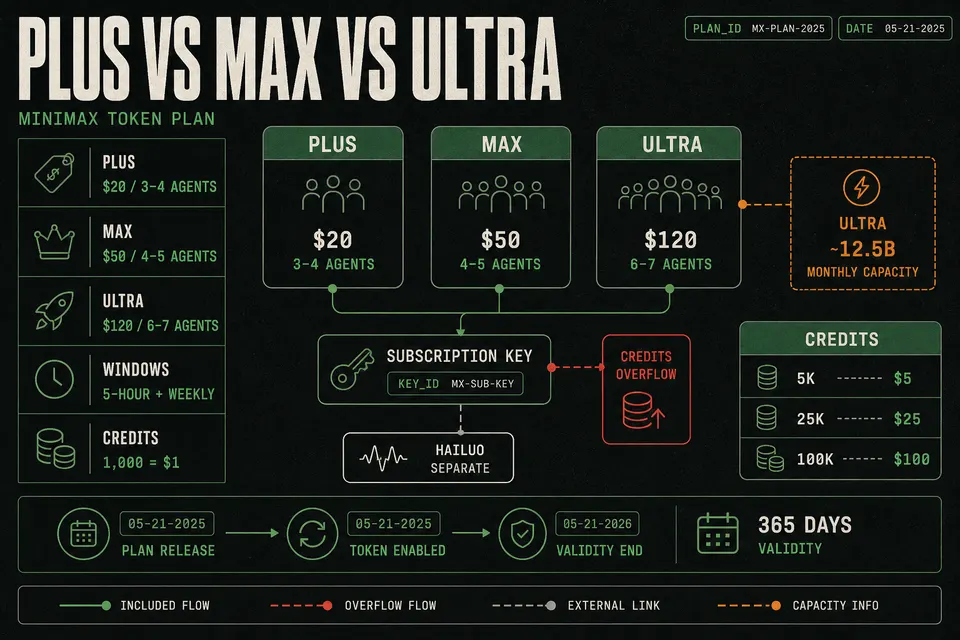
The useful comparison is not how many billions of tokens, but which key, which rolling window and which overflow path match your agents' real concurrency.
MiniMax has become a serious option for text, multimodal, and agent workloads, but choosing among its Token Plan tiers still creates friction. MiniMax Token Plan Plus vs Max vs Ultra is a fixed monthly choice—Plus $20, Max $50, Ultra $120—that grants a unified, usage-based quota across eligible API Platform models, gated by rolling 5-hour and weekly windows, burned through a dedicated Subscription Key, and topped up with prepaid Credits at list pay-as-you-go rates. Hailuo video sits on a completely different pricing track. For engineers and small teams, the right comparison is not “how many billions of tokens” but which key, which window, and which overflow path match real agent concurrency.
Why the choice matters
MiniMax product pricing splits cleanly: API Pricing (real-time pay-as-you-go with standard Open Platform API Keys) versus Subscription Plans (Token Plan seats). That two-track split mirrors the wider shift toward flat-rate AI token plans across Chinese labs. Those systems are not interchangeable. Token Plan evolved from the earlier Coding Plan into a multimodal, agent-oriented subscription. Usage is deducted by actual resource consumption against each endpoint’s pay-go list price, then shown as a single console usage bar—simple chat burns less; long-context agents, multimodal loops, and multi-turn tool use burn more. That design offers a predictable monthly envelope, but dual keys, dual windows, Credits overflow, and a hard line between Token Plan resources and Hailuo video packages force a real decision.
Side-by-side: Plus vs Max vs Ultra
| Criteria | Plus | Max | Ultra |
|---|---|---|---|
| Monthly price | $20 | $50 | $120 |
| Best for | Personal projects and prototyping | Daily coding with agents and multimodal work | Heavy agent workflows and extended sessions |
| Quota windows | 5-hour rolling and weekly | Same | Same |
| Agent usage (official approx.) | 3–4 agents | 4–5 agents | 6–7 agents |
| Resource coverage | Unified quota across eligible API Platform models | Same | Same |
| Key type | Subscription Key | Subscription Key | Subscription Key |
| Unused included quota | Does not carry to next billing cycle | Same | Same |
| Mid-cycle upgrade | Yes — pay the difference; immediate | Yes | Yes |
Public pricing does not publish fixed “X tokens per 5 hours” tables for every tier. Capacity is usage-based into one pool; the console usage bar is the operational source of truth. Migration documentation describes the new Ultra $120 tier as designed for heavy agentic use with roughly 12.5 billion tokens of monthly capacity and notes an entitlement path that includes 5 video generations per day—verify live in console; do not treat Plus/Max as video plans. Community “billion-token” headlines for lower tiers have often been inconsistent with real agent burn under broken caching or full-context re-reads. Pick by agent band and window fit, not viral token counts.
Windows, Credits, and overflow
Included quota is controlled by a 5-hour rolling window and a weekly window. Low intensity covers daily chat and simple writing; medium covers code generation and multi-turn work; higher intensity covers long-context reasoning, multimodal tasks, and complex agents. When a window is exhausted, four documented paths remain: purchased Credits auto-cover eligible overflow at pay-as-you-go list prices; upgrade the seat (pay the difference, immediate); switch the tool to a standard Open Platform pay-go API Key and burn account balance without subscription windows; or wait for the 5-hour or weekly reset.
Credits packages are $5 / 5,000, $25 / 25,000, and $100 / 100,000, with 1,000 credits = $1 and 365 days validity from purchase. Included Token Plan quota burns first, then Credits; Credits can be bought without a seat and still use the Subscription Key. Overflow is list-price pay-go, not a special surcharge. For rough overflow modeling only, image-01 is on the order of $0.0035 per image, and priority service on some M-series models is about 1.5× standard. Multimodal mixes destroy simple “credits → tokens” math—track the usage bar.
Text, image, speech, and music under Token Plan share one included pool. The same Subscription Key across Cursor, Claude Code, OpenCode, and other tools shares that pool. Claude Code's own subscription-vs-API economics are broken down in Claude Code Pricing & Token Economics.
Agent concurrency and practical throughput
Official agent usage is the concurrency framing on the Token Plan surface: Plus 3–4, Max 4–5, Ultra 6–7. Those are design targets for typical agent workflows, not a full public RPM/TPM table. Throughput is the product of the official agent band, the 5-hour/weekly refill cadence, and tool-loop token burn. Ultra power users report very high monthly consumption while still living inside windows; Plus users who expected casual “billions of tokens” headroom have burned large fractions of a window in a day when caching or Anthropic-compatible paths re-read full context. Treat multi-tool setups as one shared quota and assign seats deliberately.
Subscription Key vs pay-go API Key
A Subscription Key is dedicated per user per Team for Token Plan seats and purchased Credits. It can exist before any paid resource is assigned; once a seat or Credits are available, it unlocks windowed included quota and eligible overflow. Obtain it after subscribe or seat assignment in Billing / Token Plan, export as config, and point agents at MiniMax base URLs (including documented Anthropic-compatible paths).
| Subscription Key | Open Platform API Key | |
|---|---|---|
| Billing | Token Plan + Credits | Account balance, real-time usage |
| Limits feel | 5-hour + weekly included windows | Pay-go rate limits and balance |
| Use when | Bounded monthly agent/multimodal spend | Production apps, unbounded usage, surfaces outside Token Plan |
The keys are not interchangeable. A common hybrid is Subscription Key for internal agents and tools, pay-go key for customer-facing production. Xiaomi's MiMo plan uses a similar subscription-key model at a lower entry price; see Xiaomi MiMo token plan pricing tiers.
Hailuo video: keep it separate
Product pricing places Video Packages under API Pricing, not under Token Plan cards. Hailuo is packaged as pay-go per clip by model, resolution, and duration (common Fast/standard 768P–1080P 6–10s clips roughly in the $0.19–$0.56 class) and as prepaid Video Packages—month-validity point buckets with RPM tiers that rise with package size, from Standard/Pro-class packs in the $1,000–$6,000 discounted range up to Custom for higher RPM needs. Point burn scales with model and resolution; unused pack points expire. Any Ultra daily video entitlement is tier-specific language to verify in console, not a reason to fold production video into a single MiniMax Token Plan price. Never quote one blended monthly figure that pretends Token Plan includes video volume.
Decision guide
| Persona | Default | Why | Watch-outs |
|---|---|---|---|
| Indie prototype / learning agents | Plus $20 or pure pay-go trial | Official personal-projects fit | Ignore viral “billions of tokens”; watch the 5h/weekly bar |
| Full-time coding agent + multimodal | Max $50 | Official daily coding + multimodal band | Shared quota across every tool on the same key |
| Heavy multi-agent / long sessions | Ultra $120 | Official heavy-agent tier; ~12.5B monthly capacity language in migration docs | Still windowed; verify live Ultra video entitlements separately |
| Metered product / multi-tenant COGS | Pay-go API Key | Per-request accounting | Rate-limit engineering required |
| Video-heavy creative pipeline | Pay-go video or Video Packages | Separate packaging | Never bake into Token Plan $ figure |
| Spiky weekend power user | Pay-go or Plus + Credits | Windows punish one-day bursts | Credits = list price |
| Steady team seats | Token Plan for Teams | Seat assignment + shared Credits | One key is not multi-seat |
Prefer pure pay-go when traffic is spiky, monthly list-equivalent spend is well below $20, you need true COGS metering, agent harnesses are still unstable, or the workload is dedicated video. For a coding-only alternative at similar tiers, see GLM Coding Plan pricing: Lite vs Pro vs Max. Prefer Token Plan (+ optional Credits) for steady daily agents within official concurrency bands and multimodal mix on one bar. Hybrid remains the pragmatic production pattern.
Takeaways
- Choose MiniMax Token Plan Plus vs Max vs Ultra by agent concurrency band and daily/weekly window fit, not by marketing token headlines.
- Budget Credits if you refuse mid-window dead air; overflow is list pay-go, not a free buffer.
- Treat the Subscription Key and the Open Platform API Key as different products with different limit models.
- Keep Hailuo pay-go clips and Video Packages on a separate budget line.
- Re-check the console usage bar and live Token Plan pricing docs before you lock a seat; unused included quota does not roll into the next billing cycle.
For current rules, tier cards, Credits packages, and integration quickstarts, start from the official Token Plan pricing and FAQ on platform.minimax.io—then map your real agent loops to the usage bar before you scale.