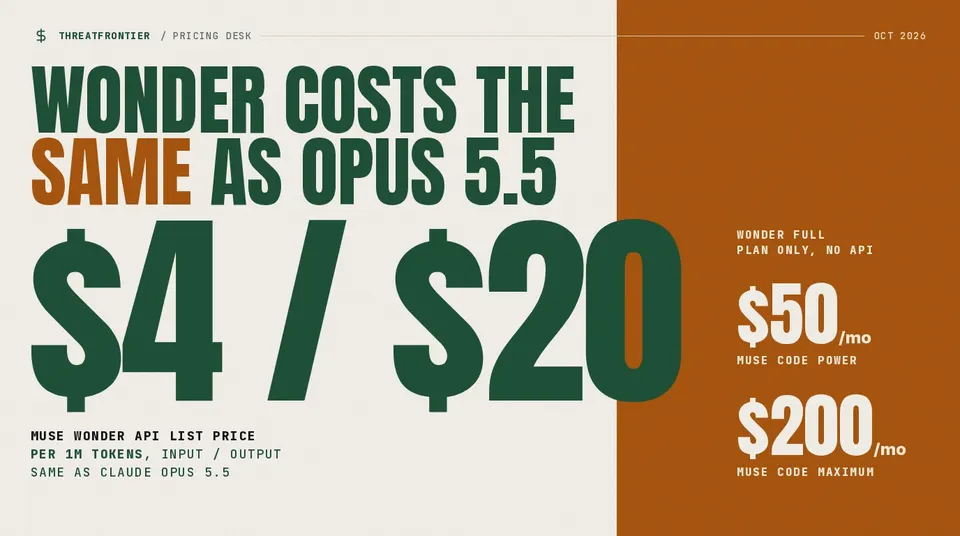
Meta's Muse Wonder is $4/$20 per 1M tokens on the API, matching Claude Opus 5.5. The stronger Wonder Full is only in $50 and $200 Muse Code plans.
Meta launched two models on 12 October 2026: Muse Wonder 1.0 and the stronger Muse Wonder Full. Only Muse Wonder is sold through the API, at $4.00 input and $20.00 output per 1M tokens, the same list price as Claude Opus 5.5. Wonder Full is available only inside Muse Code, on the $50 Power and $200 Maximum plans.
What happened
Meta's Muse Wonder model page lists two models, both with a 1M-token context window:
- Muse Wonder (
muse-wonder-1.0): available through the Meta Model API and in Muse Code. - Muse Wonder Full (
muse-wonder-full-1.0): marked "Muse Code subscription only". There is no API price for it.
Meta's launch post is dated 12 October 2026. Meta's pages say Wonder "brings comparable performance" to Wonder Full. That is a vendor claim. We have not tested either model. (We covered Meta's earlier Muse Glimmer and Spark 1.2 release.)
What each tier costs
| Route | Price | Models | Source |
|---|---|---|---|
| Meta Model API | $4.00 input / $0.20 cached input / $20.00 output per 1M tokens | Muse Wonder | Meta model page |
| Muse Code Power Usage | $50 per month; 20x the usage of the Everyday plan | Muse Wonder and Wonder Full | Meta model page |
| Muse Code Maximum Usage | $200 per month; 80x the Everyday usage limit, same five-hour and weekly resets | Muse Wonder and Wonder Full | Meta launch post |
Meta calls Maximum a new plan and says it includes everything in Power. Everyday and High Usage plans also exist, but the pages we read give no price or model access for them, so we do not list them.
Wonder against Opus 5.5 and GPT-6 Astra
ThreatFrontier has published list prices for both comparison models. Opus 5.5's $4 / $20 / $0.20 comes from our coverage of the GPT-6 Astra, Fable 5.1 and Opus 5.5 comparison, which cites Anthropic's pricing page. Astra's $10 / $50 / $1.00 comes from the same article and from our GPT-6 launch story, which cite OpenAI's model documentation.
| Per 1M tokens | Input | Cached input | Output |
|---|---|---|---|
| Muse Wonder | $4.00 | $0.20 | $20.00 |
| Claude Opus 5.5 | $4.00 | $0.20 | $20.00 |
| GPT-6 Astra | $10.00 | $1.00 | $50.00 |
Muse Wonder and Opus 5.5 match on every column. Astra is 2.5 times as much on input and output, and 5 times on cached input. Astra's prices rise to $20 input and $75 output for requests above 272K tokens, per our earlier article; Wonder's page shows no such tier.
A worked example, with the arithmetic shown. Take a job that sends 1M input tokens, split into requests of under 272K tokens each, and gets 200K output tokens back, with no caching:
- Muse Wonder: 4.00 + (20.00 × 0.2) = $8.00
- Opus 5.5: 4.00 + (20.00 × 0.2) = $8.00
- GPT-6 Astra: 10.00 + (50.00 × 0.2) = $20.00
If the whole 1M input is billed at the cached rate, the totals are $4.20, $4.20 and $11.00; that ignores cache-write fees (Astra $12.50 per 1M, Opus 5.5 $5 per 1M for 5-minute writes; Meta lists none). If the 1M input goes to Astra as a single prompt, it is billed at the long-context rate of $20 input and $75 output, so the job costs $35.00 (20 + 75 × 0.2). Opus 5.5 bills the full 1M window at the standard rate, per Anthropic's long-context pricing. These are list-price sums for an illustrative workload, not measurements.
Real cost depends on how many tokens a model uses to finish a task. Artificial Analysis measures this as cost per Intelligence Index task: Muse Wonder $4.52, Claude Opus 5.5 $5.98 and GPT-6 Astra $3.26. It counts about 130M output tokens for Wonder, 260M for Opus 5.5 and 60M for Astra. At an identical list price, Wonder is about 24% cheaper per task than Opus 5.5 (4.52 ÷ 5.98 = 0.76), but Astra is cheaper still despite its higher rate. These are Artificial Analysis's measurements, not ours.
What the plans buy a developer
The API route charges per token and gives you Wonder only (for a comparable plan decision, see Claude Pro vs Max limits). Muse Code plans charge a flat monthly fee for usage allowances and are the only way to use Wonder Full.
- API: pay-as-you-go, suited to your own agents, pipelines and tools. You get Wonder, not Full.
- Power at $50: the cheapest way to reach Wonder Full. Usage is 20 times the Everyday plan's.
- Maximum at $200: 80 times the Everyday limit. Meta publishes no token counts, so we cannot convert these multiples into tokens or dollars of API value.
How strong is Wonder Full?
Artificial Analysis scores Wonder Full at 56 and Wonder at 52 on its Intelligence Index. On the same index Claude Opus 5.5 scores 58 and GPT-6 Astra 53. So at the same list price, Opus 5.5 scores above both Wonder models; Wonder is cheaper per task but lower on the index. These are Artificial Analysis's figures; we have not run the models. Meta also says Full tops DeepSWE and SWE-Marathon in "independent third-party runs"; that is Meta's claim and we have not seen the runs. The gap between Wonder and Full is small by these figures, which fits Meta's "comparable performance" line but does not prove it for your workload. Our Gemini 4 Argon comparison cites the same index for other frontier models.
Why is the stronger model gated?
Meta's model page and launch post give no reason. What follows is our inference, not reporting:
- Cost control. A flat monthly plan caps what a heavy user can spend, while per-token API access to a costlier model has no cap.
- Product pull. Keeping the best model inside Muse Code gives Meta a reason to sell the plans.
- Capacity. A new model may be easier to serve to a limited subscriber base than to open API traffic.
Any of these, or none, could be the real reason. Treat it as an open question.
What developers should do
- If you build on APIs, evaluate Muse Wonder on your own tasks against Opus 5.5 at the same list price, and compare cost per finished task rather than per token.
- If you want Wonder Full, the Power plan is the entry point. Test it on real work before paying $200 for Maximum, since Meta has not published what 80 times the Everyday limit means in tokens.
- Check data-handling and retention terms on Meta's pages before sending code to any new provider; we did not review them for this piece.
- Do not plan around Wonder Full reaching the API. Meta has announced nothing of the kind.
What is still unclear
- Why Meta keeps Wonder Full off the API, and whether that will change.
- The price and model access of the Everyday and High Usage plans, and what the usage multiples mean in tokens.
- How Wonder performs on independent tests of your kind of work. Artificial Analysis's index is one measure; it may not match your workload.
- Whether Wonder's lower cost per task and lower index score (52 against Opus 5.5's 58) hold on your workload.
Sources
- Meta, Muse Wonder model page
- Meta, Build with Muse Wonder (dated 12 October 2026)
- VentureBeat, Meta's new Muse Wonder and Muse Wonder Full models
- Anthropic, API pricing
- OpenAI, GPT-6 Astra model docs
- Artificial Analysis model pages: Muse Wonder, Muse Wonder Full, Claude Opus 5.5, GPT-6 Astra