The leaked 'Gemini 4 Pro' was billed as an Astra and Opus killer. The real Gemini 4 Argon wins Google's tests, ties Astra on neutral ones, and is cheap for now.
For two weeks the story was "Gemini 4 Pro beats GPT-6 Astra and Claude." A model believed to be Google's next flagship appeared on Arena on 17 September under the name gemini-3.8-flash, and testers posted numbers that left everything else behind. On 30 September Google announced the real thing. It is called Gemini 4 Argon, not Pro. It is good, but not as good as the leak suggested, and it is only cheap for now. Update, 15 October: Argon reached the Gemini API and GitHub Copilot on 13 October, so you can now call it. The introductory price ends on 30 November.
The leak versus the launch
| Arena leak ("Gemini 4 Pro") | Gemini 4 Argon, as announced | |
|---|---|---|
| DeepSWE v1.1 | 88% | 77.9% |
| Output limit | 256K tokens | 1M tokens through long decode (64K default) |
| Input context | "10 million tokens" | 1M-token window shared by input and output (Google API docs, 13 Oct) |
| Price per 1M tokens, in / out | $2.25 / $11.25 | $2 / $10 introductory, then $4 / $20 |
| Availability | Arena, anonymously | Trusted cyber defenders at launch (30 Sep); paid Gemini API and GitHub Copilot from 13 Oct |
The leaked coding score was about ten points too high, and the 10-million-token context appears nowhere in Google's announcement or API docs, which give a 1,048,576-token window. The leaked price was close. Unverified Arena screenshots are a poor guide to a release, and this one was off on the numbers that drew the most attention.
What Google claims
Google published 18 benchmarks. By VentureBeat's count, Argon leads outright on 12, ties on one, and trails GPT-6 Astra on three and Claude Opus 5.5 on two. The headline results:
| Benchmark | Gemini 4 Argon | GPT-6 Astra | Claude Opus 5.5 |
|---|---|---|---|
| DeepSWE v1.1 (software engineering) | 77.9% | 74.1% | 74.2% |
| AutomationBench (business tasks) | 51.3% | 41.4% | 42.5% |
| Vals Finance Agent v2 | 65.4% | 53.5% | 58.6% |
| Harvey Legal Agent Benchmark | 19.6% | 5.4% | 3.8% |
| GraphWalks (long-context reasoning) | 84.2% | 71.8% | 66.8% |
| LVBench (long video) | 91.7% | 87.5% | 83.7% |
| CWE-bench v1 (vulnerability fixing) | 68% (tie) | 68% (tie) | 67% |
These are Google's chosen benchmarks, run on Google's settings. The coding lead is real but small, about 3.7 points on DeepSWE. The gaps in legal, finance and long-context work are much larger.
What independent testing says
Artificial Analysis ran Argon through its own index on launch day, and the picture changes.
| Artificial Analysis | Gemini 4 Argon (High) | GPT-6 Astra (Max) | Claude Opus 5.5 (Max) |
|---|---|---|---|
| Intelligence Index | 52.6 | 52.7 | 57.6 |
| Terminal-Bench (terminal coding) | 57.1% | 59.1% | 59.6% |
| Humanity's Last Exam | 57.1% | 54.7% | 61.4% |
| GDPval-AA (work tasks, 44 jobs; Elo) | 1,611 | 1,542 | 1,846 |
| SciCode | 61.8% | 56.5% | 66.9% |
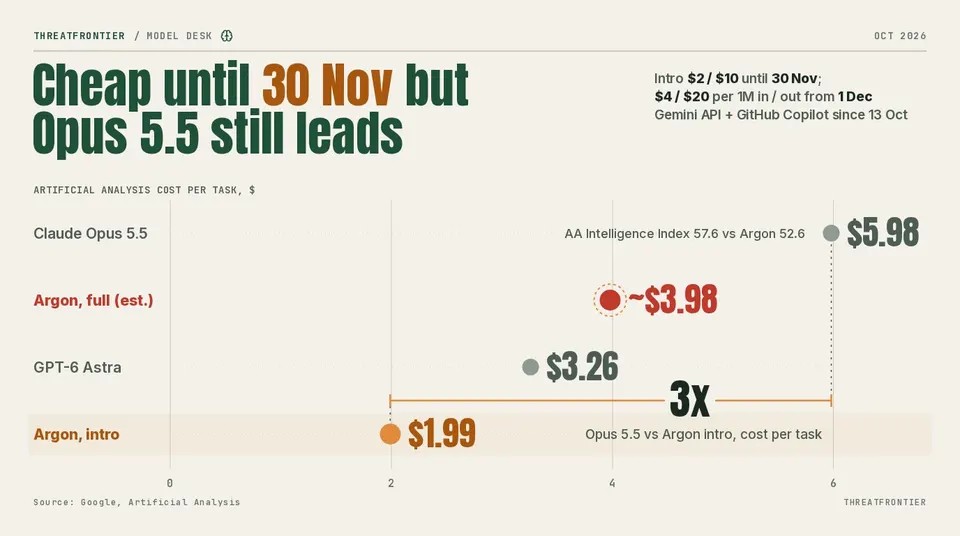
| Cost to run one task | $1.99 | $3.26 | $5.98 |
On a neutral harness, Argon ties Astra and trails Opus 5.5 by about five points. Its advantage is cost: Artificial Analysis says Astra-level performance costs about 39% less per task on Argon, and Opus 5.5's extra five points cost three times as much.
The price comes with a deadline
Argon's introductory rate is $2 input and $10 output per million tokens, through 30 November 2026. That is a fifth of Astra's $10 / $50 list price and half of Opus 5.5's $4 / $20. Cached input is 95% off: Google's pricing page lists $0.10 per million tokens through 30 November and $0.20 after, with implicit caching only (explicit caching is not supported). Batch is half the standard rate.
The regular price, from 1 December, is $4 / $20, exactly what Opus 5.5 costs. Artificial Analysis's $1.99 per task was measured at the introductory rate. Every token price doubles, so by our arithmetic the same workload would cost about $3.98 per task at full price. That is more than Astra's $3.26 and still below Opus 5.5's $5.98. The deadline matters if you are budgeting a migration: anything you benchmark in November is priced at half of what it will cost in December.
Where you can use it now
Argon launched on 30 September to "trusted cyber defenders" through Google's Fairwind Program, with Google taking part in the US government's voluntary pre-release testing process. On 13 October it went wider:
- Gemini API and Google AI Studio: model ID
gemini-4-argon, listed as generally available in the API changelog. It is not available on the free tier, and Google's pricing page says it is not on the Google AI Pro plan either. It is paid API usage only. - GitHub Copilot: available to Copilot Pro+, Max, Business and Enterprise users in VS Code, Visual Studio, Copilot CLI, the coding agent, JetBrains, Xcode and Eclipse. GitHub bills it at provider list pricing under usage-based billing, which by GitHub's wording means Google's list rates ($2 / $10 until 30 November). The rollout is gradual, and Business and Enterprise administrators control access through the model policy.
Google's launch post said paid API customers and Google AI Ultra subscribers would be next. We could not confirm from Google's pages that Argon has reached the Gemini app, so check your own plan before counting on it there.
Why the security launch matters
Google is launching Argon as a cyber-defence model first, and the security claims are the most concrete part of the announcement:
- Vulnerability repair: 68% on CWE-bench v1, tied with GPT-6 Astra and one point ahead of Opus 5.5. That is level with the best, not ahead of it.
- Prompt injection: Gray Swan's indirect prompt-injection test measured a 0.7% attack success rate for Argon, against 1.0% for Opus 5.5 and Fable 5.1. Google calls Argon its "most resilient model yet" against indirect injection.
- Field results: Google says Wiz used Argon to find a critical flaw exposing personal data in healthcare software used by hospitals worldwide, and that Argon mapped an attack surface better than 3.8 Flash Cyber.
- Guardrails: monitors watch Argon's reasoning and actions and can stop execution. Its safeguards specifically target cyber and CBRN misuse.
For a security team the useful takeaway is narrower than the marketing. Argon matches the best on fixing vulnerabilities and slightly improves on injection resistance. A 0.7% attack success rate still means injection gets through sometimes. Agents that read untrusted content still need sandboxing and least-privilege tools whichever model runs them.
So, is it good?
Yes, with conditions.
- Coding agents: Argon is roughly level with Astra and behind Opus 5.5 on independent tests. It is cheaper than both until 30 November. At full price it costs the same per token as Opus 5.5 and scores lower.
- Legal, finance and long-context work: this is where Google's own lead is largest. It is worth testing now that the API is open, but confirm the results on your own documents first.
- Security teams: it is a strong vulnerability-repair model with the best published injection score of the three, and since 13 October you can try it through the paid API without Fairwind. Astra matches it on CWE-bench, so test both on your own code.
- "Gemini 4 Pro" as the leaks described it does not exist. Benchmark Argon on your own workload before you switch.
Sources
- Google, "Gemini 4 Argon: our next era of frontier intelligence", 30 Sep 2026
- Google, Gemini API changelog, 13 Oct 2026: https://ai.google.dev/gemini-api/docs/changelog
- Google, Gemini API pricing,
gemini-4-argon: https://ai.google.dev/gemini-api/docs/pricing - Google, "What's new in Gemini 4 Argon" and model page (token limits): https://ai.google.dev/gemini-api/docs/latest-model
- GitHub changelog, "Gemini 4 Argon in GitHub Copilot", 13 Oct 2026: https://github.blog/changelog/2026-10-13-gemini-4-argon-in-github-copilot
- VentureBeat, "Google unveils Gemini 4 Argon, retaking benchmark lead over OpenAI and Anthropic — but in limited release"
- Trending Topics, Artificial Analysis results: "Gemini 4 Matches GPT-6 Astra but Trails Opus 5.5"
- Help Net Security, "Google says Gemini 4 Argon can find and patch critical software flaws", 1 Oct 2026
- TechBriefly, "Leaked Gemini 4 Pro benchmarks show it beating GPT-6 Astra and Claude", 21 Sep 2026