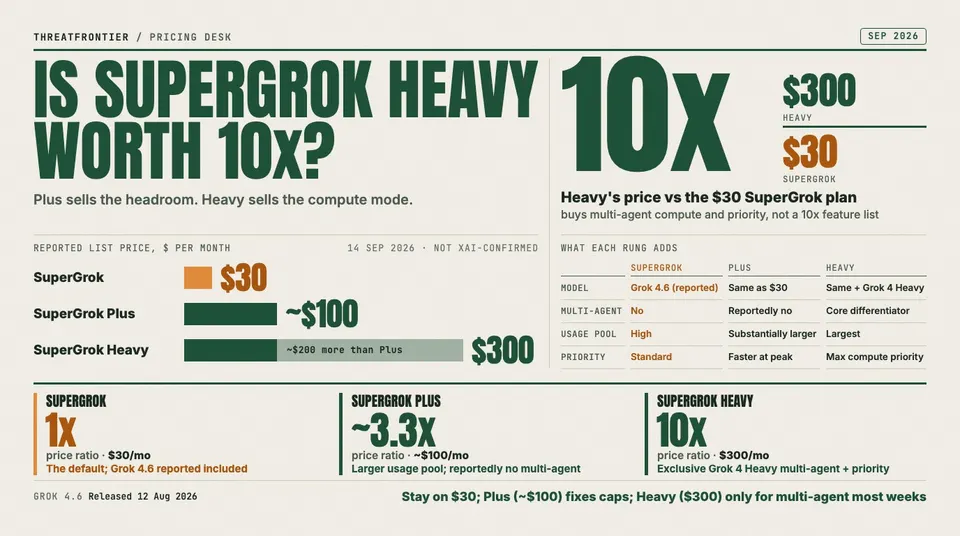
Readers routinely confuse Heavy with the $30 plan, with X Premium+, and with the metered API. The price gap is real; the feature gap is narrower than it looks.
Update, 14 October 2026: On 12 October xAI launched The X Subscription, which folds SuperGrok, Cursor Pro and X Premium+ into one plan. The new ladder is Free $0, Plus $8, Premium $30 (4x Plus usage), Super $100 (15x) and Ultra $200 (50x). Paid plans share one weekly-refreshing usage pool across the Grok apps, the Grok tab on X and Cursor, and third-party models in Cursor are billed separately at API list price (Cursor pricing). xAI says it is available to new customers from 12 October and reaches everyone over the next few days. For people already paying, xAI says "Nothing changes for existing SuperGrok, Cursor, or X Premium subscribers": you can keep your plan, price and features, or switch and get a prorated refund on the old plan, once the switch appears in your billing settings. What xAI has not said: its announcement does not mention SuperGrok Heavy ($300) at all, and the Cursor forum thread has no staff answer on whether Heavy-linked Cursor Ultra survives a switch (Cursor forum). x.ai/pricing could not be rechecked on 14 October, so the SuperGrok prices below are the 12 October reading. Treat the $300 Heavy price and its multi-agent mode as unconfirmed for new buyers until xAI publishes them. Passages changed by this update are marked [Updated 14 Oct].
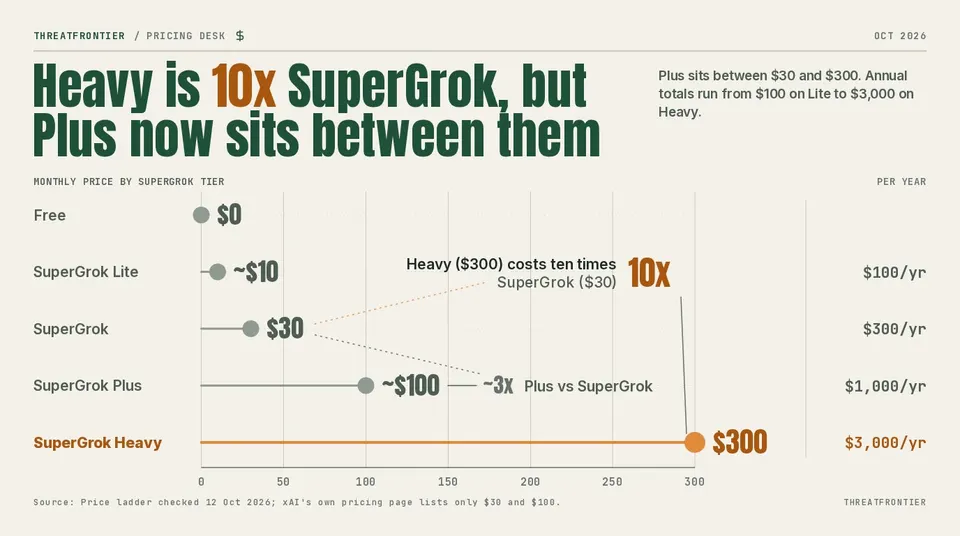
xAI’s consumer ladder now runs Free → SuperGrok Lite ($10) → SuperGrok ($30) → SuperGrok Plus ($100) → SuperGrok Heavy ($300). That middle rung appeared in late July or early August 2026 and it changes the question. The SuperGrok Heavy $300 vs SuperGrok comparison used to be a straight two-way choice; it is now a three-way decision, and for most people the deciding factor is which of the two things Heavy sells — headroom or a different compute mode — they actually need. Plus sells the headroom. Heavy sells the compute mode.
So, directly: is the 10× jump worth it? For the large majority of readers, no—not because Heavy is bad, but because the 3.3× jump now exists and absorbs the most common reason people used to buy Heavy. Heavy remains the only self-serve tier with exclusive multi-agent parallel test-time compute, priority queueing, and the highest rate limits. It is no longer the only way to stop hitting caps.
Confusion is widespread. Readers mix Heavy with the $30 plan, with X Premium/Premium+, or with the separate token-priced API. The tenfold price gap is real; the feature gap is narrower and more specialized than marketing sometimes implies.
This explainer maps what $300 buys versus $100 and $30, how multi-agent processing works, who needs it, and how it stacks against ChatGPT Pro, Claude Max, and Google AI Ultra.
The SuperGrok Ladder
Standalone SuperGrok plans sit on grok.com and the apps. They are AI-first products, not social-media add-ons.
| Tier | Typical price | Role |
|---|---|---|
| Free | $0 | Sampling; heavy throttling; basic media/voice; no flagship model |
| SuperGrok Lite | ~$10 | Entry standalone; longer chats; limited Imagine/agents |
| SuperGrok | $30 | Primary consumer plan: reported flagship access, full Imagine, tools/search, connectors |
| SuperGrok Plus | ~$100 | Headroom rung: much larger usage pool, priority at peak, one-prompt app build—reportedly no multi-agent |
| SuperGrok Heavy | $300 | Power tier: exclusive multi-agent, priority, max limits; includes X Premium+ |
| X Premium / Premium+ | ~$8 / ~$40 | X platform plus Grok; Premium+ reportedly bundles SuperGrok-level access. [Updated 14 Oct] Being replaced for new buyers by The X Subscription (Plus $8, Premium $30, Super $100, Ultra $200); existing subscribers keep their plan unless they switch |
| Business / Enterprise | ~$30/seat / custom | Teams, admin, SSO, compliance |
| API | Token-based | Developers; explicit multi-agent model IDs |
| The X Subscription (new, 12 Oct) | Free $0 / Plus $8 / Premium $30 / Super $100 / Ultra $200 | [Updated 14 Oct] One plan across Grok, Cursor and X; usage 4x / 15x / 50x Plus on the top three; Heavy not mentioned |
On these prices, rechecked 12 October 2026: xAI publishes no pricing changelog. Its pricing page, read on 12 October, lists SuperGrok at $30 and SuperGrok Plus at $100 first-party, with the “Grok 4.7 model” and Grok Bot rows described below. It shows no price for Lite or Heavy, so those rest on grok.com/plans as quoted in dated secondary round-ups, not on an xAI announcement. Treat them as the best available reading, and check the live checkout before you buy. The October rechecks (5 and 12 October) found the same ladder and prices (Lite $10, SuperGrok $30, Plus $100, Heavy $300, billed at $100, $300, $1,000 and $3,000 a year respectively), and the same weekly usage pool with no published sizes. One detail is new: Heavy is described as including X Premium+ at no extra cost once you link your X account, and Grok Bot is now part of SuperGrok, Plus and Heavy, and not of Free or Lite (xAI's pricing page). The $30 plan got it on 25 August 2026 per xAI's Grok Bot changelog, after Heavy and Plus earlier in August according to round-ups. Round-ups also report that Bot usage is counted separately from the plan's weekly pool; xAI does not say so, and its changelog says Usage & Billing shows your weekly usage. The API figures later in this article are different: those come from xAI’s own developer documentation and are firm.
The one thing that did come with official announcements is the model line. xAI released Grok 4.6 on 12 August 2026 as its flagship—500,000-token context, scoring 61 on the Artificial Analysis Intelligence Index. xAI’s release notes show Grok 4.7 following on 21 September 2026 as the new top model: 500,000-token context, API pricing of $2 per million input tokens and $6 per million output tokens below 200,000 prompt tokens. At launch it was reachable in Cursor, Grok Build and the API. It reached the Grok web and mobile apps from about 1 October 2026, according to secondary reports; xAI made no announcement, but grok.com's own mode picker now labels Expert as “Thinks hard · Grok 4.7” and Heavy as “Team of Experts · Grok 4.7”. See Grok 4.7 matching Claude Fable 5.1 Max for xAI's own benchmark scorecard. On 12 October xAI's pricing page lists the SuperGrok $30 plan with the “Grok 4.7 model” plus “Expert”, and its comparison table ticks Grok 4.7 for every plan, Free included, though Expert mode is paid-only. Some round-ups still list Free as 4.6.
That inverts something this comparison used to rest on. Heavy was previously the only plan with confirmed, unstaged access to the newest model. Today the newest model is on the $30 plan too, per xAI's pricing page, and Heavy is best described as the multi-agent “Team of Experts” mode running on the current model (Grok 4.7 per the app). Heavy still owns multi-agent. It no longer owns "newest model."
Callout: Do not buy Heavy merely to “get the newest Grok” or “get Imagine.” Both sit below Heavy now. And do not buy Heavy merely to stop hitting limits—that is what the ~$100 Plus rung is for.
SuperGrok $30 vs Plus $100 vs Heavy $300
The tenfold difference is primarily compute mode + priority + exclusive multi-agent, not a longer feature checklist. The threefold difference is almost entirely headroom.
| Capability | SuperGrok (~$30) | SuperGrok Plus (~$100) | SuperGrok Heavy (~$300) |
|---|---|---|---|
| Base model access | Grok 4.7 included (xAI's pricing page; the app's Expert mode agrees) | Same as $30 | Same, plus the exclusive multi-agent Heavy mode (labelled Grok 4.7 in the app) |
| Multi-agent / parallel test-time compute | No | Reportedly no—this is the key limit of the middle rung | Core differentiator: parallel agents, multi-hypothesis |
| Hard multi-step reasoning | Standard extended thinking | Same, with more of it | Deeper multi-agent synthesis |
| Usage pool | High vs Free/Lite; power users still exhaust it | Substantially larger pool | Largest; priority |
| Priority queue | Standard | Faster replies at peak | Priority / max compute priority |
| Media (Imagine image/video) | Full product; volume/speed capped | Higher volume; higher-resolution video reported | Higher volume + priority rendering |
| App building (Build) | Included, draws on the shared pool | One-prompt create plus one-tap deploy | Included; earliest access historically |
| Context window | Per model, not per tier—see below | Same | Per model; no separate Heavy figure |
| Real-time web + X search, voice, apps, connectors | Yes | Yes | Yes |
| Price ratio | 1× | ~3.3× | 10× |
Context is now a property of the model you are talking to, not of the tier you pay for. From xAI’s developer documentation: grok-4.7 is 500,000 tokens, grok-4.6 is 500,000 tokens, grok-4.5 is 500,000, grok-4.3 is 1,000,000, grok-4.20-multi-agent-0309 is 1,000,000, and grok-build-0.1 is 256,000. xAI publishes no separate consumer context figure for Heavy mode. Paying more does not lengthen a given model’s window; picking a different model does.
On limits: paid plans are reported to run on one shared weekly usage pool spendable across Chat, Imagine, Voice, and Build, with the older daily and per-two-hour caps retired in mid-2026. This matters more than any single cap number, because heavy Imagine rendering or app building now eats the same budget your research chats draw on. Exact pool sizes remain unpublished by xAI; independent guides and user reports agree directionally that Plus is "much larger" and Heavy "largest with priority," not a hard unlimited promise. Tracking usage against caps like these is its own discipline, covered in monitoring AI rate limits across ChatGPT, Claude, and Cursor.
How Multi-Agent Works
xAI frames Heavy-class compute as parallel test-time compute: multiple hypotheses run at once rather than a single chain of thought. Specialized agents search, analyze, and cross-check; a leader agent synthesizes the final answer. Runs can take minutes—this is for hard tasks, not snappy casual chat.
This is the part of the Heavy pitch that is documented rather than inferred. On the API, the multi-agent model is grok-4.20-multi-agent-0309, and xAI’s docs describe two configurations: 4 agents for quick, focused research and 16 agents for deep, comprehensive analysis. Only the leader agent’s tool calls and final response are returned to you; sub-agent state stays encrypted and is included only when use_encrypted_content is set in the xAI SDK. Built-in tools—web_search, x_search, code_execution, and collections_search—incur additional cost, and every token from the leader and the sub-agents bills, including reasoning tokens. One practical gotcha: max_tokens is not currently supported on the multi-agent variant, and client-side custom tools are unavailable—only built-in and remote MCP tools work.
Workloads that benefit: multi-source research with citations; olympiad-style or long multi-step reasoning; agentic coding and large refactors; multi-scenario planning (finance, production, media pipelines); any job where single-pass reliability is the bottleneck. Everyday Q&A, light writing, and simple tool use do not need it. For where a $300 compute tier fits into a broader coding setup, see the best AI coding stack in 2026.
API rate limits scale with cumulative spend tier, not SuperGrok subscription. xAI documents six tiers—Tier 0 at $0 through Tier 4 at $5,000 and Enterprise by request—based on cumulative API spend since 1 January 2026, unlocking automatically and never downgrading. Multi-agent genuinely does carry a tighter ceiling: at entry tier, grok-4.20-multi-agent-0309 is capped at 2,500,000 tokens per minute and 9 requests per second, against 50,000,000 tokens per minute and 150 requests per second for grok-4.6. Heavy is chat/product priority and multi-agent access—not a substitute for API budgeting.
Who Should Pay $300
[Updated 14 Oct] Check the new ladder first. If you also use Cursor, the $30 Premium or $100 Super plan may replace both your SuperGrok and Cursor bills, and xAI says each plan includes at least twice the Grok-model coding usage of the comparable Cursor plan. Whether any new tier carries Heavy's multi-agent mode is not stated by xAI or Cursor, so the table below still describes the old Heavy plan.
| Profile | Recommendation | Why |
|---|---|---|
| Casual / occasional | Free or Lite (~$10) | Sampling + light Imagine |
| Daily professional chat, writing, light research | SuperGrok $30 | Full product; best value |
| Content creators (scripts + Imagine) | $30 first; Plus (~$100) when the weekly pool runs dry | Volume is a pool problem, not a compute-mode problem |
| Power users hitting $30 caps daily | Plus (~$100), not Heavy | This is exactly what the middle rung was added for |
| Researchers / analysts | Heavy if weekly multi-agent jobs | Parallel agents + priority; Plus reportedly does not include multi-agent |
| Developers | API (+ optional SuperGrok for interactive) | Version pinning, spend control |
| Small teams | Business (~$30/seat) first; Heavy only for max-compute seats | Admin ≠ Heavy compute |
| X-heavy social users | X Premium+ (~$40) may already cover you | It reportedly bundles SuperGrok-level access alongside X perks |
Rule of thumb: the deciding question is no longer "do I hit limits" but "do I need parallel agents." If you hit limits, buy Plus. If you need multi-agent synthesis on hard problems most weeks, buy Heavy. If neither, stay on $30. Heavy is a specialized compute product, not “Grok but better for everyone.”
Sentiment is polarized. Intensive users describe time savings and a “boardroom of agents.” Others call the $300 renewal a rip-off and note that $30 already covers most agent workflows—an argument that got stronger, not weaker, once a $100 option landed between them.
There are also periodic targeted discounts on Heavy, including a widely shared $99-per-month-for-three-months offer. These are unconfirmed by xAI, appear to be targeted rather than open to everyone, and revert to full price. Do not build a yearly budget on one.
SuperGrok vs X Premium+ vs API
| Access path | What you buy | Full Heavy multi-agent? | Best when |
|---|---|---|---|
| SuperGrok / Plus / Heavy | AI-first subscription | Heavy yes; $30 and Plus no | Grok is the product |
| X Premium / Premium+ | X features + Grok access | No self-serve Heavy multi-agent | You already live on X |
| xAI API | Tokens + explicit models | Yes via model name | Apps, automation, spend control |
[Updated 14 Oct] The X Subscription now makes this comparison moving ground. Its Premium tier at $30 "includes the benefits of SuperGrok, Cursor Pro, and X Premium+" and xAI says that was "previously $90/month combined" (xAI). The Premium+ (~$40) price below is the pre-launch figure; for new buyers the X side is now the Plus ($8) to Ultra ($200) ladder.
The Premium+ advice had shifted before that. Premium+ (~$40) is now reported to bundle SuperGrok-level access plus Grok Bot on top of an ad-free X, which makes the old blanket line—"do not buy Premium+ only for Grok"—too strong. If you want both X perks and SuperGrok-grade chat, the bundle can cost less than buying them separately. What Premium+ still does not give you is Heavy's multi-agent mode.
Common mistakes: assuming Premium+ equals Heavy; assuming SuperGrok includes unlimited API; assuming the $100 Plus tier unlocks multi-agent.
Competitors at a Glance
| Provider | Top self-serve tiers (approx.) | Price | Positioning |
|---|---|---|---|
| OpenAI | ChatGPT Pro | $100 / $200 | Usage multipliers, Pro reasoning |
| Anthropic | Claude Max | $100 / $200 | Usage multiples + Opus priority; strong coding |
| AI Ultra | ~$100 / ~$200 | Usage multiples + Workspace perks; top tier cut from $250 at I/O 2026 | |
| xAI | SuperGrok Plus | ~$100 | Headroom rung, no multi-agent |
| xAI | SuperGrok Heavy | $300 | Multi-agent + priority + live X/web |
| Perplexity | Max | ~$200 | Research/search-oriented |
Heavy is still the most expensive major consumer self-serve tier, and now by a wider margin than at launch. Peers mostly sell usage multiples of a strong base plan; with Plus, xAI now sells that too, and reserves $300 for the distinct multi-agent compute mode. For many power users, Claude Max or ChatGPT Pro at $100–200 can deliver more productive hours per dollar unless Grok’s multi-agent style and live X/web data are the unique requirement.
Verdict
- Default: SuperGrok $30 for anyone using Grok as a primary daily AI.
- Upgrade to Plus (~$100) if your problem is volume: you exhaust the weekly pool across chat, Imagine, voice, or Build, or you want faster replies at peak. This is the right answer for most people who used to consider Heavy.
- Upgrade to Heavy ($300) only if you genuinely need parallel multi-agent runs most weeks and single-pass reliability is your bottleneck. Note what you are no longer buying: the newest model, Grok 4.7, is on $30 per xAI's pricing page, and raw headroom is on $100.
- Hybrid: $30 for interactive work + API for scripted multi-agent. Measure token cost against the ~$270 monthly differential to Heavy—or the ~$200 differential from Plus, which is the more realistic comparison now.
FAQ
What is SuperGrok Plus? A roughly $100/month tier reported to have launched around late July or early August 2026, sitting between SuperGrok and Heavy. It adds substantially more usage, priority at peak, and one-prompt app creation—but reportedly not the multi-agent model. xAI did not announce it formally, so treat the details as provisional.
Is SuperGrok Heavy the same as X Premium+? No, but they now overlap. Premium+ is an X platform bundle that reportedly includes SuperGrok-level access. Heavy is a standalone AI-first plan whose exclusive is multi-agent compute and priority, and Heavy subscribers get Premium+ at no extra cost once they link their X account (per round-ups quoting grok.com/plans).
Does the $300 plan include the xAI API? No. API access is separately token-priced and limited by spend tier.
Does Heavy still get the newest model first? Not in the way it once did. Grok 4.6 shipped on 12 August 2026 and Grok 4.7 on 21 September; xAI's pricing page now lists Grok 4.7 on the $30 plan too. Heavy mode now runs on 4.7 per the app. Heavy’s advantage is now the compute mode, not the model generation.
Who should actually pay $300? Researchers, analysts, and power users who run hard multi-agent jobs weekly and lose real time or revenue without them. If your pain is caps rather than reasoning depth, Plus at ~$100 is the cheaper fix. For the full field of $6-to-$300 AI subscriptions compared side by side, see the complete decision matrix for solo developers.
SuperGrok Heavy’s $300 price buys multi-agent parallel compute, priority, and max limits—not a 10× feature list, and no longer first access to the flagship model. For most readers weighing SuperGrok Heavy $300 vs SuperGrok, the rational default remains SuperGrok at $30, with SuperGrok Plus at ~$100 as the upgrade that answers the limit problem and Heavy reserved for people whose week is genuinely built on hard multi-step work.
Sources for the 14 October update
- The X Subscription, xAI announcement, 12 October 2026: tiers, prices, usage multipliers, shared pool, existing-subscriber terms.
- Cursor pricing: Free, Plus, Premium, Super, Ultra prices and the API-list-price billing of third-party models.
- Introducing the X Subscription, Cursor forum: weekly refresh, switching rollout, open questions on Heavy-linked Ultra (staff had not answered).