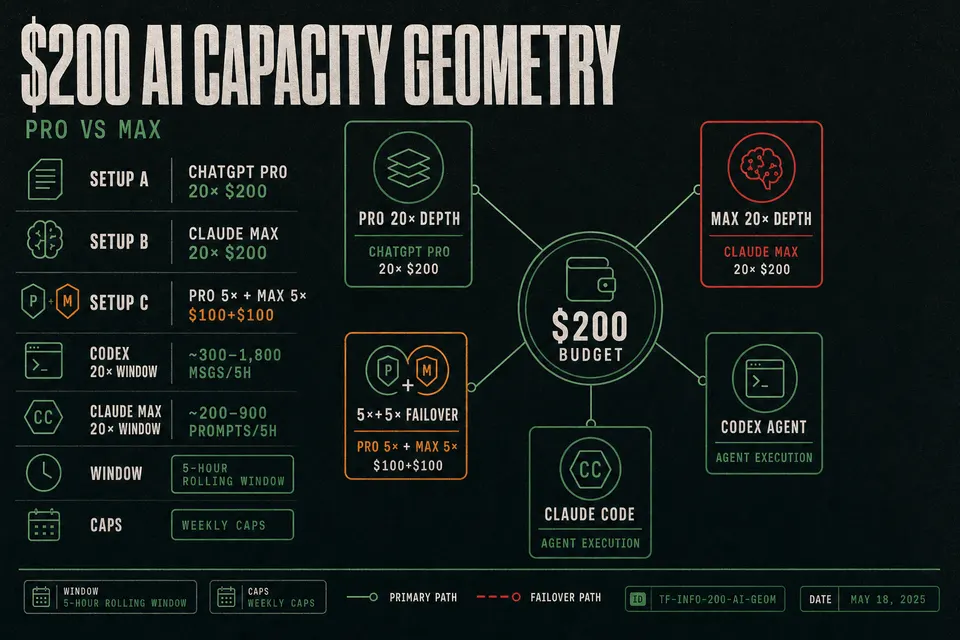
Compare ChatGPT Pro 20×, Claude Max 20×, and a $100+$100 split: capacity, rate limits, coding agents, and when depth beats failover for power users.
Power users now choose how to spend ~$200/month: ChatGPT Pro 20×, Claude Max 20×, or a Pro 5× + Max 5× split. Both vendors sell $100 (~5×) and $200 (~20×) individual tiers with the same features as their top stack—only usage multiplies. The real product is capacity geometry: all-in depth on one coding agent, or failover and model diversity at half burst headroom.
Update, 30 September 2026: OpenAI's side of this comparison changes on 30 October. ChatGPT Pro $200 drops from 20× to 10× Plus usage in Codex and ChatGPT Work; existing subscribers keep 20× until 29 October. Claude Max 20× is unchanged. OpenAI also added a $500 Pro tier with Ultrafast Codex. The tables below mark which OpenAI figures apply before and after the change.
Why $200 is the new power-user budget
Agentic tools changed the math. Claude Code, Codex (web, CLI, IDE), deep research, extended thinking, and large-context sessions burn far more than casual chat. Chat and agents often share one pool. Hitting a five-hour rolling window—or Claude’s additional weekly caps—mid-refactor is the productivity loss users report most. A full side-by-side of what those windows actually allow is in Claude Code vs OpenAI Codex usage limits.
Neither side is unlimited in practice. Claude Max is explicitly finite (session plus weekly limits). ChatGPT Pro feels very high for many chat models, yet still carries per-model allowances, Codex rate windows, and fair-use pauses. At $200 you buy continuity and multipliers, not a secret second brain.
Three setups at a glance
| Dimension | A. ChatGPT Pro $200 | B. Claude Max 20× | C. Pro 5× + Max 5× |
|---|---|---|---|
| Cost | $200 | $200 | $100 + $100 |
| Multiplier | ~20× Plus until 29 Oct, 10× from 30 Oct | ~20× Claude Pro | ~5× each side |
| Primary agent | Codex at highest consumer multipliers | Claude Code at highest consumer multipliers | Codex + Claude Code, each ~5× |
| Stack | Pro models, deep research, image/voice, memory, GPTs | Priority models, Cowork, Projects/Artifacts, long context | Both ecosystems |
| Limits | Rolling windows + credits; model-specific allowances | 5-hour rolling and weekly caps; shared across Claude.ai, Code, Cowork | Two independent clocks |
| “Unlimited?” | High/unlimited-feeling for many chat models; not for every model/agent path | No—finite but large | No on either side |
| Burst / failover | Max OpenAI depth; weak failover | Max Claude depth; weak failover | Medium depth both; strong brand failover |
| Main sacrifice | No Claude Code depth | No Codex / OpenAI multimodal depth | Half peak each side; two UIs and bills |
Capacity ranges (illustrative, load-dependent): Official Codex tables (the 20× figures, valid until 29 October) show Pro $200 local messages per ~5 hours roughly ~300–1,800 (high-end Sol-class) vs ~75–450 on Pro 5×; lighter Luna-class roughly ~1,000–5,600 vs ~250–1,400. Local messages and cloud tasks share that window; weekly limits may also apply; extra credits can extend work. Independent testing often cites Claude Max ~200–900 prompts per 5-hour window on 20× vs ~50–225 on 5×, plus weekly Sonnet/Opus-style caps—not Anthropic SLAs. Peak-hour tightening has been reported on Claude-heavy days.
Within each vendor, 5× and 20× share the same feature set; only the usage multiplier changes. A closer breakdown of those shared caps sits in Claude Code Max plan limits: 5x vs 20x.
What the 30 October change does to this choice
On the OpenAI side, the gap between A and C narrows. Until 29 October, the split's Pro 5× is a quarter of Pro $200's 20×. From 30 October it is half of 10×. The split still costs you Codex depth, but less of it, and it keeps full Claude failover. Claude-primary users are unaffected: B stays at 20×.
There is also now a tier above this budget. ChatGPT Pro $500 has OpenAI's highest allowance and is the only plan with Ultrafast, up to 8× faster GPT-6 Astra token generation in Codex. It is covered in ChatGPT Pro 500: What $500 a Month Buys.
Depth vs failover: the one decision rule
| If your pain is… | Buy… |
|---|---|
| “I need 6–8 hours of one agent on one codebase without switching” | The $200 tier on that agent (A or B) |
| “I die when one product rate-limits” | $100+$100 split even at lower per-side peak |
Single 20× maximizes Codex or Claude Code, one memory, one reset schedule, and ecosystem compounding (GPTs/connectors/voice or Projects/Artifacts/Cowork). Cost: single point of rate-limit failure and a weaker second opinion.
Split buys model diversity (Claude for architecture, careful refactors, long prose; OpenAI for sustained agent throughput, multimodal work, deep-research marathons), failover when a five-hour window dies, and a best-model-per-task “one-two punch.” Cost: less headroom on each side (a quarter of Max 20× on Claude; on OpenAI a quarter of Pro $200 until 29 October, then half), context-switch tax, and risk of underusing one $100.
Workflows in brief
- Heavy daily agentic coding: A or B 20× if one agent is primary; C if you already bounce Claude↔Codex. Large repos and extended thinking burn Max fast; Codex cost scales with context and speed modes.
- Architecture / hard bugs / careful refactors: Claude-heavy (B or C with Max primary).
- Long-form writing and client deliverables: Claude-primary (B or C); citation-heavy research may still want ChatGPT deep research.
- Deep research marathons: ChatGPT-primary (A or C) when tools and sustained access matter; Claude when long-doc quality dominates (weekly caps still bind).
- Mixed founder day (code + docs + research): C is the strongest default—if you route tasks deliberately.
- Occasional spikes only: Stay on $20 or one $100. Most people do not need $200.
Decision rules and checklist
- One primary tool all day → that vendor’s $200 tier.
- Hit limits ≥2–3 days/week on 5× of your primary → upgrade that side to its $200 tier before buying the other brand.
- Hit limits on both at 5×, or need a second opinion weekly → stay on split or accept credits/API overflow.
- Task routing (dual playbook): spec/design/prose → Claude; long autonomous coding, PR volume, multimodal, voice → ChatGPT/Codex; stuck → cross-critique.
Before you subscribe:
- Seven days of “would have hit limit” events on your current plan
- Named primary agent (Claude Code vs Codex) for >60% of AI time
- Pain is burst (need 20×) vs failover (need second 5×)
- Confirmed shared pools (chat + agent same bucket)
- Priced overflow credits/API vs jumping to 20×
- Billing path (web vs app store—store taxes can raise Claude’s effective price)
- Ecosystem must-haves (memory, voice, image, IDE, team sharing)
Hidden costs and lock-in (short list)
Highest-impact gotchas: shared chat+agent pools; Opus / extended thinking draining Claude sessions faster than light chat; peak-hour Claude tightening; API double-pay if an env key bills outside the subscription; unused second $100 on a split you never failover to; fair-use pauses even on Pro. Google's AI Ultra tier adds a third option to weigh alongside these two; see Google AI Ultra vs Claude Max vs ChatGPT Pro. Screenshot Settings → Usage for a week—neither vendor publishes public p50/p90 quota telemetry.
Lock-in follows habits: memory/Projects/GPTs stick to where context already lives; daily Claude Code or Codex points to 20× that agent; voice/image lean ChatGPT; long-context/artifacts/Cowork lean Claude. Split reduces model lock-in but increases process lock-in. Single 20× increases data and habit lock-in. Individual Max/Pro may be the wrong SKU if you need team admin. Whether Claude Max is worth it now that Fable 5 runs inside it full time is covered in Claude Max after Fable 5 became a permanent fixture.
Who should buy what
| Reader profile | Prefer | Avoid |
|---|---|---|
| Full-time Claude Code, hits Max 5× often | B Max 20× | Split if you never open ChatGPT |
| Full-time Codex / PR volume | A Pro $200 (10× from 30 Oct), or Pro $500 if speed is the bottleneck | Max 20× “just because coding” |
| Alternates agents; hates downtime | C 5×+5× | 20× single until one side dominates |
| Writing + research, light coding | C or Claude 20× + cheap OpenAI | Pro $200 only |
| Already on Max 5× and Plus; only Claude burns | Upgrade Claude to 20×; keep cheap OpenAI—or Pro 5× as overflow | Blind $200+$200 stack |
| Cannot name a weekly limit event | Stay $20 / one $100 | Any $200 plan |
Default for developers, technical founders, and heavy knowledge workers already on one premium plan: if ≥70% of AI time is one agent and limits bite, buy that vendor’s $200 tier. If work is roughly 40/60 or hard stops are frequent, take the $100+$100 split. Re-evaluate after 30 days of Usage screenshots.
At $200 the rational choice is the $200 tier on your primary agent when continuity on one stack is the bottleneck, and 5×+5× when diversity and rate-limit failover are the bottleneck. Feature lists are largely parity within each vendor’s ladder. Whether that geometry is worth $200 a month at all is the freelancer math worked out in whether premium AI plans pay off for freelancers. What you are really buying is capacity geometry and ecosystem depth.
Related reading
- ChatGPT Pro $100 vs $200 vs $500: Usage Limits Explained (2026)
- Individual AI Subscription Power Plans Comparison 2026: The Complete $6–$300 Decision Matrix for Solo Developers
- How to Monitor AI Rate Limits Across ChatGPT, Claude, and Cursor: A Practical Playbook
- Claude Max 100 vs 200: Same Features, 5× vs 20× Usage