Compare Cursor Pro, Pro+, and Ultra pricing for agent coding. Learn credit pools, overage math, when Ultra beats overages, and when Teams seats win.
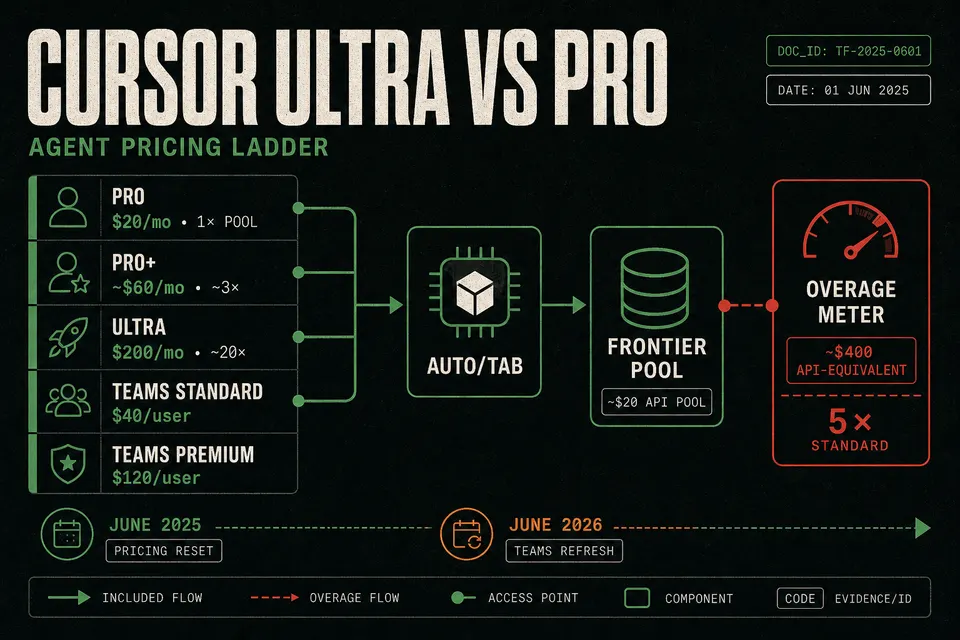
Agent-heavy developers on Cursor no longer face a simple “500 fast requests” ceiling. Since the mid-2025 pricing reset, individual plans run on credit pools priced against public API rates; Auto and Tab stay generous on paid tiers; and multi-step agents can drain a month’s frontier budget in days. Cursor recommends Pro+ for daily agent users and Ultra for agent power users, with Teams when collaboration and controls matter. Anthropic runs a similar ladder: see Claude Max 100 vs 200, same features at 5x vs 20x usage. The ladder is Pro ($20) → Pro+ (~$60, ~3× usage) → Ultra ($200, ~20× Pro usage)—and plan choice is now a capacity and predictability decision, not a feature checklist. (List prices below are monthly; annual billing commonly lands near ~20% off—e.g. Pro ~$16/mo effective—confirm live checkout.)
How the credit model works
Every paid individual plan includes a monthly pool of model usage. Manual frontier models (Sonnet-class, GPT-class, Gemini, Opus-class, and similar) draw that pool at public API rates. After the pool is gone, on-demand usage continues and is billed in arrears at cost—no advertised penalty markup—unless you set a spend limit. Pro includes roughly $20 of frontier/API-priced inference per month. GitHub Copilot uses a similar credit system; see what $10 vs $39 actually buys on Copilot Pro vs Pro+.
Auto and Tab are treated as generous on paid plans. Auto generally does not drain the frontier credit pool (it routes to capacity-efficient models); verify the live dashboard, as billing details can evolve. Tool-call limits that once constrained agent loops were lifted with the Pro rework. Around the June 2025 rollout, unclear messaging produced bill shock for some users; Cursor clarified pricing, improved dashboard visibility, and offered refunds for surprise charges.
Illustrative medians from that clarification: Pro’s ~$20 pool covered on the order of 225 Sonnet 4, 550 Gemini, or 650 GPT 4.1 “requests” under median token usage. Those are not SLAs—agent sessions with long context and repeated tool use burn several request-equivalents each.
Illustrative secondary math (not a Cursor SLA): a scoped agent task on the order of ~40k input + 4k output tokens can land near ~$0.03 on Composer 2.5, ~$0.07 in Auto, and ~$0.18 on a frontier-class model. Under that unit, Pro’s pool is roughly a hundred-plus frontier tasks of that size—not full-day multi-agent marathons.
Pro vs Pro+ vs Ultra at a glance
| Dimension | Pro | Pro+ | Ultra |
|---|---|---|---|
| List price | $20/mo | ~$60/mo | $200/mo |
| Relative credits | 1× (~$20 API pool) | ~20× (often framed as ~$400 API-equivalent; user reports sometimes higher) | |
| Auto / Tab | Generous / effectively unlimited; Auto typically outside frontier pool | Same | Same |
| Overage | On-demand at API rates after pool; optional spend limit | Same | Same (less frequent if pool holds) |
| Official fit | Light–moderate frontier / agent-curious | Daily agent users | Agent power users |
| Features | Frontier models, MCP, skills, hooks, cloud agents; Bugbot usage-based | Same core stack, larger pool | Same core stack + priority access to new features (widely reported) |
Core agent capabilities sit on Pro and up. Ultra’s main differentiator beyond capacity is priority on new features. Everything else is how much compute you can burn before the meter starts. Chinese labs have taken a different approach to that meter; see how token plans are reinventing coding-agent costs.
Real-world agent thresholds
- Mostly Tab + Auto, occasional frontier: Pro often lasts the full month. Developers in India can start lower with Cursor Start at ₹649 a month.
- Daily agents mixing Auto and Sonnet-class, scoped tasks: Pro often pressures mid-month; Pro+ is the usual sweet spot.
- Full-time multi-step agents, multi-file horizons, frequent MAX or Opus-class work: Pro+ can still overage; Ultra becomes the predictability play.
- Sustained large overages on Pro: stepping the tier is usually cheaper than living on metered overages if you actually fill the larger included pool.
Order-of-magnitude framing (editorial estimate only, not a Cursor SLA): at roughly $0.15–$0.50 per frontier-heavy agent loop and ~20 working days, light Auto-first days fit Pro; mixed daily loops lean Pro+; sustained heavy multi-step / MAX work pushes Ultra or Teams Premium. Oversized “whole repo” payloads and long chat histories multiply cost faster than raw request counts suggest.
When is Cursor Ultra cheaper than Pro overages?
Use effective monthly cost:
Plan price + max(0, actual API spend − included pool)
If frontier overages on Pro sustainably exceed ~$40/month, Pro+ often wins: you pay roughly $40 more and receive roughly $40 more included. If sustained API-equivalent spend sits in the ~$200–$400 range (or higher) after Pro+, Ultra’s flat $200 for ~20× Pro usage is usually cheaper and more predictable than open metered overages. Stacking multiple personal Pro accounts is not supported—Cursor sells only through its official site; unauthorized multi-account abuse can lead to suspension.
Ultra is predictability insurance for full-time agent coding. If you can stay mostly in Auto/Composer and reserve frontier models for hard problems, a lower tier plus discipline still wins.
When Teams seats beat personal Ultra
June 2026 Teams pricing refreshed Standard and introduced Premium:
- Teams Standard: $40/user/month ($32 annual), improved included usage, dual pools (first-party Auto/Composer-style vs third-party API).
- Teams Premium: $120/user/month ($96 annual), 5× Standard usage; Cursor expects the first-party pool on Premium to cover a heavy agent month for roughly 99% of users.
- Seats can be mixed.
Prefer personal Ultra when you are solo, need the largest individual pool, and do not need SSO, shared rules, or admin analytics. Ultra fits into a wider $6–$300 AI subscription decision matrix for solo developers. Prefer Teams when company billing, SAML/OIDC SSO, team privacy mode, shared marketplace for rules/skills, usage analytics, spend alerts, or agentic review with team context matter. A few power users on Premium plus many Standard seats is usually cleaner than putting everyone on Ultra-class individual plans. Standard alone is not automatically Ultra-sized for the heaviest individuals—those outliers need Premium seats or controlled on-demand usage.
Monitoring habits and decision matrix
Highest-leverage habits: watch included vs on-demand (and first-party vs third-party pools on Teams); set a hard spend limit; default Auto/Composer 2.5 for routine work and reserve frontier/MAX for hard problems; scope context with @file/@function, close irrelevant tabs, and use .cursorignore; collect two full billing cycles of data before upgrading. Buy only from the official site.
| Profile | Recommendation |
|---|---|
| Auto-first, rare overages | Stay Pro |
| Exhausts week 2–3, ~$20–$50 overages | Pro+ |
| Daily multi-step agents, Pro+ still overages or creates anxiety | Ultra |
| Full-time agent product builder wanting flat predictability | Ultra |
| Eng lead, 3+ devs, governance required | Teams Standard + Premium for outliers |
| Solo on a corp laptop needing SSO only | Teams Standard even if usage is Pro-like |
| Sustained ~$200–$400+ API-equivalent per month | Ultra beats Pro+ + overages |
Bottom line
Measure two months of frontier versus Auto usage. Stay on Pro when Auto carries the load. Move to Pro+ when Pro overages become structural. Tracking that threshold is easier with a practical playbook for monitoring AI rate limits across ChatGPT, Claude and Cursor. Choose Ultra when Pro+ still overages or predictability is the job. Switch to Teams when SSO, admin, analytics, or mixed seats matter more than a single person’s maximum credits. Prefer Auto and scoped context as the first cost lever; use Ultra for full-time agent coding—and Teams when the team, not the token bill, is the real unit of work.