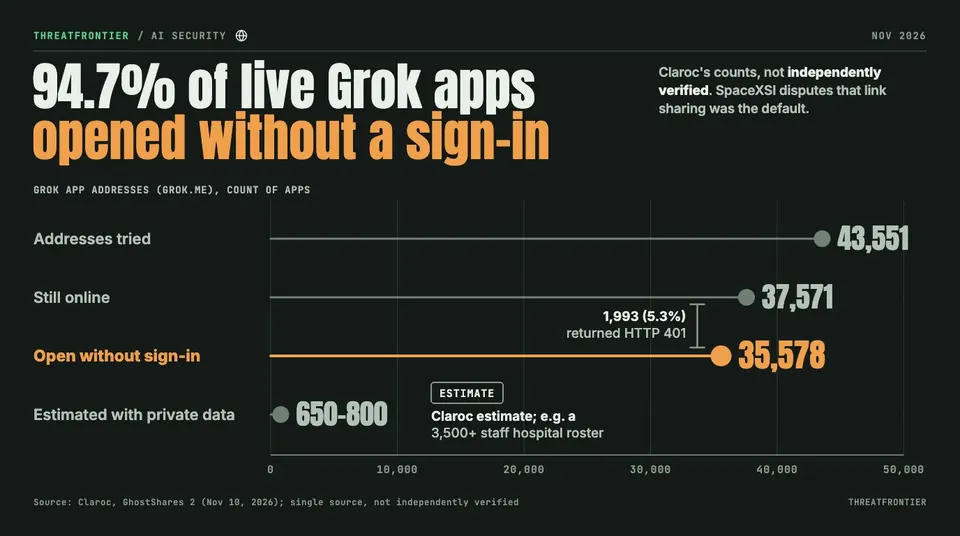
Claroc says 35,578 live grok.me apps loaded for anyone and 650–800 hold private data. SpaceXSI disputes the default; here is how to lock yours down.
Security firm Claroc says 35,578 of the 37,571 live apps it reached on grok.me, the hosting domain of Grok's chat-based app builder, opened for anyone without a sign-in when it tested on November 8, 2026. That is 94.7%. Claroc estimates that 650–800 of those apps hold private data; its examples include a hospital staff roster of 3,500+ people. Every figure here is Claroc's own and has not been independently verified. SpaceXSI, the company formerly called xAI, disputes Claroc's account of the sharing default. If you or your staff have published anything with Grok's app builder, check who can open it today.
No CVE applies. This is a configuration and design problem: apps were published to a public hostname with link sharing, and the hostnames were discoverable.
What Claroc found
Claroc's "GhostShares 2" research, published November 10, tried 43,551 Grok app addresses. (A Cloud Security Alliance note says the enumeration listed 43,601 hostnames; Claroc does not explain the gap, and this article uses Claroc's count.) Of the 37,571 still online, 35,578 (94.7%) loaded with no sign-in and 1,993 (5.3%) returned HTTP 401.
About 1 in 10 of the open apps held internal business or personal data, and about 2% were rated high or critical. Claroc reached the 650–800 range by extrapolating from an AI model's triage of private-looking pages plus manual review of a random sample. Treat it as an estimate.
Claroc names 30 other organisations among the app owners: 26 with more than 1,000 employees, 6 in the Fortune 500, 18 based in the US and 12 spread across 11 other countries. Its examples include the 3,500-plus hospital staff roster, an ICU briefing, and a timesheet app whose script held 18 plain-text passwords.
Twenty-four of the open apps were built by SpaceXSI and X staff. Claroc lists an onboarding plan, a sales territory map covering 594 accounts and an advertising proposal for a U.S. federal agency. SpaceXSI took the 24 staff apps down after the report. Other users' apps stayed up.
How the apps were found
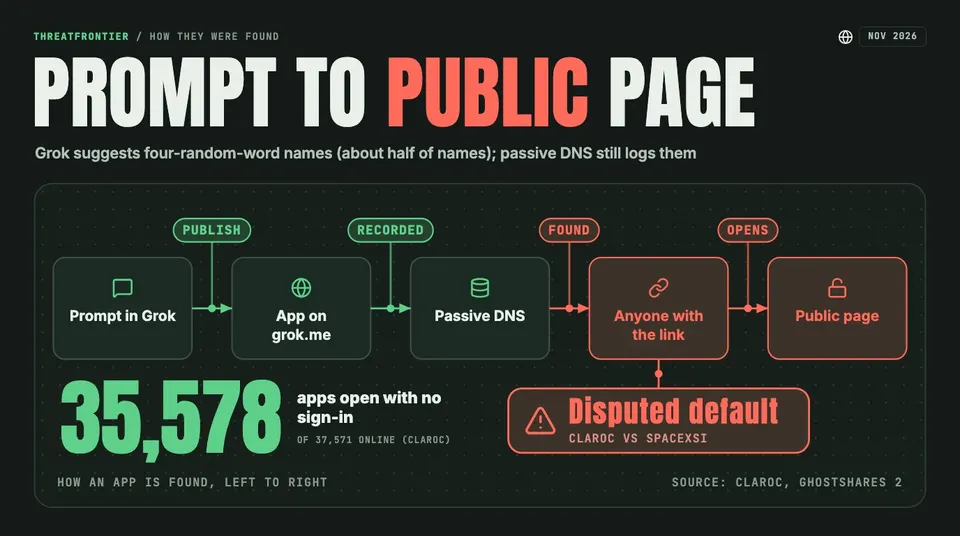
How Claroc found open Grok apps: the hostname is discoverable through passive DNS, and the share setting decides whether a visitor needs to sign in. SpaceXSI disputes that link sharing was the default.
Each app is served at its own <name>.grok.me hostname. Passive DNS services record hostnames as they are looked up, and those datasets can be searched by pattern, so an app is findable once anyone has visited it. Grok suggests names made of four random words, and about half the names Claroc saw were of that form. Claroc says the random names do not help once the hostnames sit in a passive DNS dataset.
Claroc also found a logic flaw in an app it built itself. The generated Google and X sign-in code added whoever signed in to the team before checking team membership, so any outside account could read, edit and delete records. Sign-in on its own did not protect the data.
Claroc says the fix works where it is used: on its own two test apps, setting access to Only you returned 401 to a stranger, and unpublishing took the app offline within seconds.
The disputed default
Claroc says that in the paid account it used, the publish panel had Anyone with the link already selected, ahead of the other access choices.
SpaceXSI's position, as relayed by Claroc and The Hacker News, is that apps stay private until the creator shares them. It says publishing takes several steps, including an access choice, a legal disclaimer and a final Publish click, and that employee accounts default to Only you.
Both sides agree nothing is public before the builder clicks Publish. The dispute is whether the step that sets the audience protects builders well enough when link sharing is the option already selected. According to The Hacker News, the chat-based app builder opened to all Grok plans on August 19, 2026, which gave non-developers a fast path from a prompt to a public page.
Lock-down checklist for builders and security teams
- Find your apps. List every app you or your team published on grok.me, and ask staff which AI app builders they use. Grok is unlikely to be the only one in use.
- Look from outside. Open each app in a private browser window while signed out. If it loads, so can anyone who finds the hostname.
- Narrow the audience. Set any app with internal or personal data to Invited users or Only you, then confirm a signed-out visitor gets an error page.
- Test sign-in with a stranger's account. Sign in with an account outside your organisation. If it gets in, the app needs a real access list that is checked after sign-in.
- Read the shipped code. Anything the browser downloads is public. Search app scripts for names, emails, passwords and API keys, and move secrets out.
- Keep regulated data out. Do not publish health, HR or customer records to anyone with the link, even briefly.
- Unpublish orphans. Take down apps with no clear owner or purpose. Claroc saw unpublishing take effect within seconds.
- Ask the vendor. The Cloud Security Alliance suggests asking AI app vendors about default access settings, organisation-only sharing, audit logs of published apps and admin takedown.
Caveats and context
This is single-source research. Claroc is a commercial security firm, the sensitivity figures come from sampling and extrapolation, and the Cloud Security Alliance says it did not verify the Grok-specific numbers. SpaceXSI's statements are known only as reported by Claroc and The Hacker News.
It is also a separate issue from the earlier report that xAI's Grok Build coding agent silently uploaded entire repositories. The pattern is familiar from PixelLeak, where AI coding agents pushed 13,000 internal screenshots to public GitHub repos: the tool's publishing path decides who sees the output, and builders rarely check it.