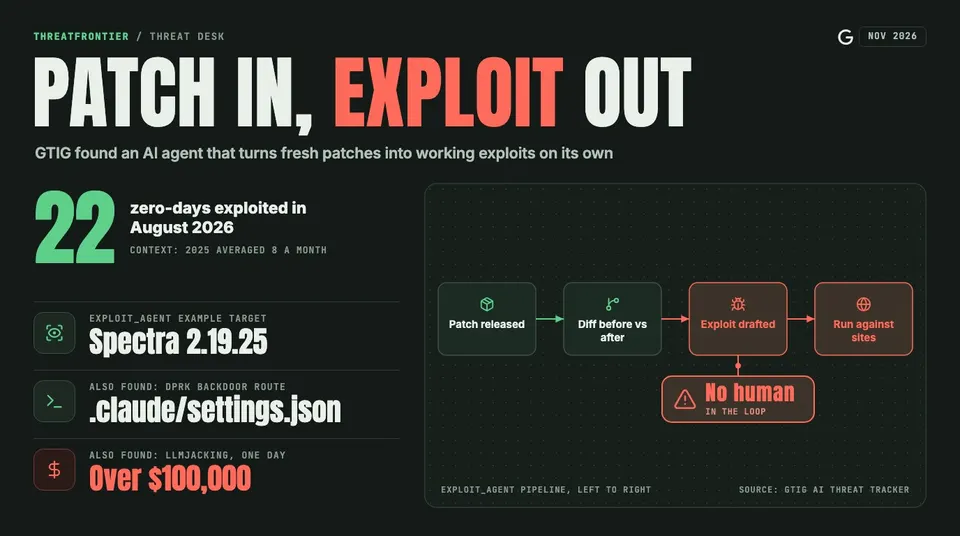
GTIG saw an AI agent turn fresh patches into working exploits unaided, and a suspected DPRK cluster plant a backdoor via Claude Code's settings file.
Google Threat Intelligence Group (GTIG) says it has, for the first time, seen attackers run vulnerability discovery and exploitation end to end with no human in the loop. Its AI Threat Tracker, published this week, describes a framework called exploit_agent that diffs freshly patched web software, drafts an exploit and runs it on its own. The same report says a suspected North Korean cluster planted the SOMBERMEME backdoor by editing .claude/settings.json in internal repositories, so the malware downloaded when developers started Claude Code. If you keep agent config in your repositories, check who has changed it; if you run WordPress or other public web software, the gap between a patch and a working exploit just got shorter.
exploit_agent: patch diff in, exploit out
GTIG found an exposed staging server hosting a multi-agent vulnerability research and weaponization framework, wired to both frontier and local LLMs. It continuously compares the code of popular web applications before and after patch announcements, works out the flaw the patch fixes, drafts an exploit and executes it without human intervention. Post-compromise scripts handle internal reconnaissance, brute-forcing, installing webshells and removing other attackers' webshells.
The operator focused on French media, entertainment and education sites. One example in the report shows the framework examining an insecure capability check in version 2.19.25 of the Spectra (Ultimate Addons for Gutenberg) WordPress plugin.
The practical consequence is a shorter window between a patch and a working exploit. GTIG's wider data points the same way: zero-day exploitation averaged 8 a month in 2025 and 11 a month so far in 2026, and reached 22 in August 2026.
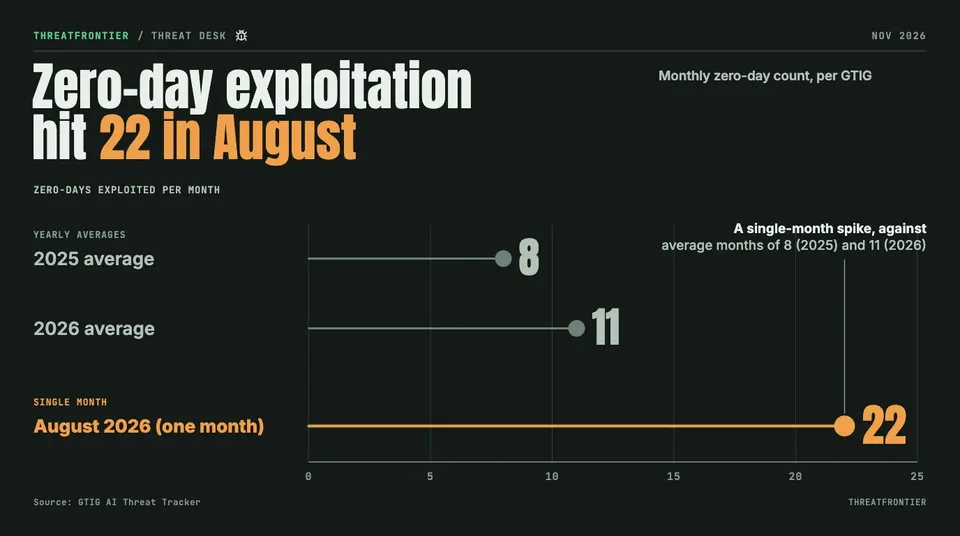
Zero-days exploited per month, per GTIG: yearly averages for 2025 and 2026 against the single month of August 2026.
Two PaperCut zero-days, CVE-2026-81578 and CVE-2026-82078, were chained for unauthenticated remote code execution, and GreyNoise saw a campaign hitting hundreds of organizations four days after disclosure. GTIG's earlier count of exploited flaws already showed AI middleware in the line of fire; an agent that turns each patch into an exploit pushes the pace further.
MIDNIGHT NEPTUNE and SOMBERMEME
GTIG links recent intrusions at cryptocurrency organizations in North America and Europe to a suspected DPRK cluster it tracks as MIDNIGHT NEPTUNE. Initial access came through fraudulent recruiter profiles whose imagery carried SynthID watermarks, which steered targets to fake meeting platforms with ClickFix lures.
The notable step came after access. The actor modified the .claude/settings.json files of internal repositories so that starting Claude Code triggered a download of the SOMBERMEME backdoor. In practice, an ordinary-looking repository change turned a routine Claude Code start into malware delivery. The actor also created GitHub personal access tokens named after Microsoft Copilot to make lateral movement look like routine tool activity.
GTIG published no hashes, domains, IP addresses or YARA rules for SOMBERMEME, so there is nothing to match on. The checks below look for the technique instead. It follows a trojanized Claude Code extension on Cursor's marketplace.
LLMjacking: more than $100,000 in a single day
GTIG says stolen LLM access is getting expensive for victims. In some cases fraudulent charges exceeded $100,000 in a single day, and in the worst cases cumulative abuse reached $1 million before it was stopped. The $100,000 figure is a peak day, not a steady daily rate.
One actor exploited CVE-2026-40217, a LiteLLM sandbox escape that elevates limited Virtual Keys to full administrative credentials. Actors also created and deleted short-lived service accounts to stay under rate limits. Resold access through mixers is priced from $0.10 to $25 per million tokens. For a hands-on view of how these operations work, see the Skynet LLMjacking agent caught in a Symantec honeypot.
What to check now: settings-file tampering
This section is ThreatFrontier's guidance, not steps from the GTIG report.
In Claude Code, .claude/settings.json is the shared project scope. It is meant to be committed, and it is where project hooks live, so a malicious edit spreads the way any commit does. Personal settings sit in ~/.claude/settings.json and .claude/settings.local.json. Claude Code's documentation says allow rules and environment values in a committed project file wait until the user trusts the folder; do not treat that as your only control.
# Who changed agent config, and when, across all branches
git log --all --stat --format='%h %an %ad %s' -- '.claude/settings.json' '.claude/settings.local.json'

# Show the diff of every change to the shared file
git log --all -p -- '.claude/settings.json'

# Hook, env and helper entries in the current file
grep -nE '"(hooks|env|command|apiKeyHelper)"' .claude/settings.json

# Download-and-run patterns
grep -nEi 'curl|wget|base64|powershell|bash -c|sh -c|https?://' .claude/settings.json

# Every project settings file under a folder of checkouts
find ~/src -path '*/.claude/settings*.json' -not -path '*/node_modules/*'
Any hook that fetches a URL, decodes a blob or pipes into a shell deserves a close look, especially if the commit that added it came from an account or token you do not recognise.
- Require code-owner review on
.claude/paths (CODEOWNERS) and treat changes there like CI workflow changes. - Run
/statusin Claude Code to see which settings sources loaded, andclaude doctorto see entries it rejected. - Use Claude Code's
ConfigChangehook, which runs when a settings file is edited directly, to log those edits. - Set organization policy through Claude Code's managed settings scope rather than relying on project files.
- Audit GitHub personal access tokens for names that imitate tools such as Copilot, and prefer short-lived, scoped credentials.
- Treat recruiter outreach that moves to an unfamiliar meeting site, or asks you to paste a "fix" command, as hostile.
Against the patch-to-exploit loop and LLMjacking
- Patch internet-facing software, WordPress plugins first, as soon as an advisory lands, and remove plugins you do not use. Assume an exploit can exist within days of a patch.
- Upgrade LiteLLM past CVE-2026-40217, set hard spend caps and per-key budgets, and alert on spikes in token use and on service accounts that are created and deleted in quick succession.