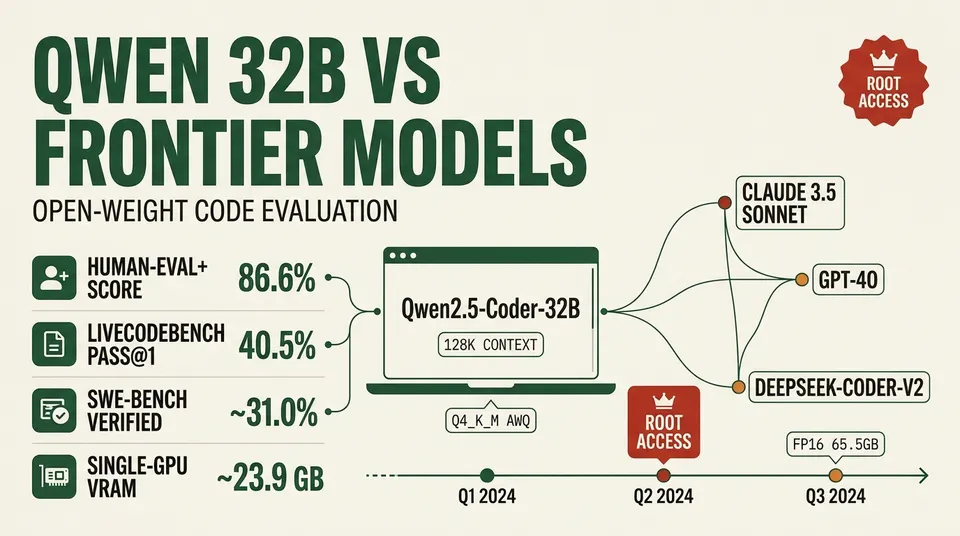
Compare Qwen2.5-Coder-32B with Claude 3.5 Sonnet and GPT-4o. Explore benchmark results, local hardware sizing, TCO analysis, and enterprise coding deployment.
The rapid progression of open-weight artificial intelligence has brought local large language models into direct competition with proprietary software development platforms. Engineering organizations navigating rising API expenses and stringent data sovereignty mandates are increasingly evaluating whether mid-sized open-weight models—specifically Alibaba’s flagship Qwen2.5-Coder-32B and the broader 30B-parameter tier—can realistically displace hosted frontier services such as Anthropic’s Claude 3.5 Sonnet and OpenAI’s GPT-4o in production environments.
The quantitative evidence reveals a nuanced operational reality: while Qwen's flagship coding weights match or surpass base GPT-4o on isolated synthetic benchmarks and single-file modifications, they trail Claude 3.5 Sonnet by 10 to 13 percentage points on complex, multi-file repository refactoring. For engineering leaders and security architects, deploying these models locally eliminates code exfiltration risks and unlocks uncapped automated agent loops, but demands deliberate hardware sizing and defensive prompt scaffolding.
Quantitative Performance: Synthetic Mastery vs. Real-World Gaps
On synthetic code generation and localized syntax completion, Qwen2.5-Coder-32B demonstrates state-of-the-art capability among open weights. On the EvalPlus HumanEval+ benchmark, the model records an 86.6% pass rate, exceeding Claude 3.5 Sonnet's 83.5% and GPT-4o's 80.5%. Similarly, on LiveCodeBench (Pass@1), Qwen posts 40.5%, closely tracking Claude 3.5 Sonnet's 41.2% while outpacing DeepSeek-Coder-V2 (35.8%).
The divergence widens when evaluating repository-level reasoning and multi-step agent workflows. On SWE-bench Verified, vanilla execution yields approximately 31.0% for Qwen 32B, compared to 49.0% to 55.2% achieved by Claude 3.5 Sonnet within standard agent scaffolding. When paired with specialized scaffolding harnesses such as SWE-Master, Qwen reaches 61.4%, demonstrating that the underlying weights possess significant latent capability when augmented with robust search-and-repair frameworks.
| Benchmark / Metric | Qwen2.5-Coder-32B-Instruct | Claude 3.5 Sonnet | GPT-4o | DeepSeek-Coder-V2 (236B MoE) |
|---|---|---|---|---|
| Aider Code Editing (Diff format) | 71.4% – 72.2% | 84.2% | 71.4% – 72.9% | 72.9% |
| Aider Code Editing (Whole file format) | 72.9% | 84.2% | 72.9% | 73.7% |
| Aider Diff Format Compliance | 94.0% – 94.7% | 99.2% | 96.2% – 99.2% | 97.7% |
| HumanEval+ (EvalPlus) | 86.6% | 83.5% | 80.5% | 81.1% |
| LiveCodeBench (Pass@1) | 40.5% | 41.2% | 34.2% | 35.8% |
| SWE-bench Verified (Standard Agent) | ~31.0% | 49.0% – 55.2% | 38.8% – 41.0% | ~38.0% |
| Native Context Window Support | 128K | 200K | 128K | 128K |
A critical operational metric is syntax and format compliance. In automated diff generation within tools like Aider, Qwen 32B outputs malformed SEARCH/REPLACE blocks or mismatched indentation between 5.3% and 6.0% of the time. Claude 3.5 Sonnet maintains a formatting failure rate below 0.8%, requiring significantly fewer retry loops during automated code mutations.
Hardware, Quantization, and Serving Topologies
The 32B architecture utilizes Grouped Query Attention (GQA) with 64 layers, 40 query heads, and 8 key-value heads. Unquantized FP16 weights consume 65.5 GB of VRAM, mandating enterprise-grade accelerators. A similar 24GB hardware blueprint applies broadly across other 27B-class open-weight models. Quantization compresses the model into accessible hardware envelopes:
| Precision Level | Model Weights | KV Cache (32K Context) | Total VRAM Needed | Target Hardware Envelope |
|---|---|---|---|---|
| FP16 / BF16 | 65.5 GB | 8.0 GB (FP16) | ~76.0 GB | 2x RTX 4090 (48GB) / 1x A100 (80GB) |
| Q8_0 | 34.8 GB | 8.0 GB (FP16) | ~45.3 GB | 1x NVIDIA L40S (48GB) |
| Q5_K_M | 22.5 GB | 8.0 GB (FP16) | ~33.0 GB | 2x RTX 3090 / Mac Studio 64GB |
| Q4_K_M / AWQ 4-bit | 18.4 GB | 4.0 GB (FP8) | ~23.9 GB | 1x NVIDIA RTX 3090/4090 (24GB) |
At Q4_K_M or AWQ 4-bit, the model fits into a single 24 GB GPU paired with an FP8 quantized Key-Value cache. For local multi-developer workloads, serving through vLLM guarantees continuous batching and PagedAttention efficiency:
# Production vLLM serving configuration for local team access
python3 -m vllm.entrypoints.openai.api_server \
 --model Qwen/Qwen2.5-Coder-32B-Instruct-AWQ \
 --tensor-parallel-size 1 \
 --gpu-memory-utilization 0.95 \
 --max-model-len 32768 \
 --kv-cache-dtype fp8 \
 --port 8000
Local runtimes like Ollama default to a 2,048-token context window (num_ctx 2048). Deploying IDE extensions without explicitly setting context to 16384 or 32768 results in silent prompt truncation, causing code editing success rates to plunge from 71.4% to 51.9%.
Real-World Engineering: Workflows, FIM, and Failure Modes
Native Fill-In-The-Middle (FIM) support via dedicated tokens (<|fim_prefix|>, <|fim_suffix|>, <|fim_middle|>) enables low-latency ghost-text code completions:
# Native Fill-In-The-Middle prompt construction
prompt = f"<|fim_prefix|>{code_before}<|fim_suffix|>{code_after}<|fim_middle|>"
While Time-To-First-Token (TTFT) reaches 30–40 ms on an RTX 4090, throughput sits between 28 and 34 tokens per second. In production IDE workflows, pairing a lightweight 7B model (~70 t/s) for inline completions with the 32B model for conversational refactoring delivers optimal ergonomics.
Critical Edge-Case Failure Vectors
- Diff Truncation: In files exceeding 200 lines, the model frequently replaces untouched intermediate logic with placeholder comments such as
// ... keep existing implementation ..., breaking automated linters and patch utilities. - Framework Hallucination: When generating code for rapid-release frameworks (such as Next.js Server Actions or Pydantic v2), the model occasionally blends legacy syntax with current API signatures.
- Insecure Defaults: Raw completions tend to use weak random generators or omit input sanitization unless explicitly constrained by defensive system instructions:
# INSECURE: Default raw generation pattern
def generate_session_token():
 import random, string
 return ''.join(random.choices(string.ascii_letters + string.digits, k=32))

# SECURE: Required hardened pattern
def generate_session_token_secure():
 import secrets
 return secrets.token_urlsafe(32)
Total Cost of Ownership: Self-Hosted vs. Hosted APIs
The financial viability of self-hosting open weights hinges entirely on token consumption patterns and compliance boundaries rather than simple compute savings.
| Deployment Architecture | Upfront CapEx | Monthly OpEx | Annual TCO (20 Devs) | Exfiltration Risk |
|---|---|---|---|---|
| Claude 3.5 Sonnet API (Prompt Caching) | $0 | $410 – $540 | ~$4,925 – $6,480 | Low (Zero-Retention Terms) |
| Commercial Managed SaaS (Cursor / Copilot) | $0 | $780 – $800 | $9,360 – $9,600 | Low (Enterprise Terms) |
| Dedicated Cloud GPU (1x NVIDIA L40S 48GB) | $0 | $620 | $7,440 | Zero (VPC Isolated) |
| On-Premise Workstations (2x Dual RTX 4090) | $9,000 | $231 (Power/Cooling) | $5,772 (3-Yr Amortized) | Zero (100% Air-Gapped) |
For standard interactive IDE assistance consuming under 100 million tokens monthly, managed frontier APIs remain more cost-effective than provisioning dedicated cloud infrastructure. However, self-hosted 32B deployments become economically superior under high-volume automated CI/CD bug-fixing loops running hundreds of millions of monthly evaluation tokens, or in regulated environments where external source code transmission is legally restricted.
Strategic Decision Framework
Qwen2.5-Coder-32B establishes a new benchmark for open-weight engineering capability, delivering enterprise-grade code generation within a compact 24 GB hardware envelope. For air-gapped systems and token-dense autonomous testing pipelines, local deployment offers unmatched control and data sovereignty. Nevertheless, organizations prioritizing complex multi-file refactoring with minimal maintenance overhead will find frontier cloud models continue to deliver the highest developer productivity.