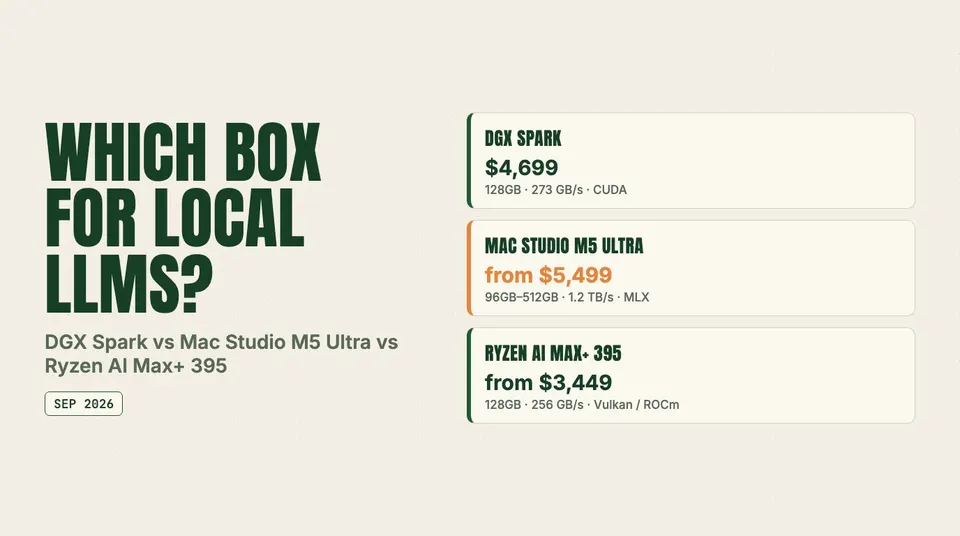
Price per GB, memory bandwidth, prefill vs decode on gpt-oss-120b, clustering and software stacks: which unified-memory desktop fits your local LLM work.
The short answer: buy a Ryzen AI Max+ 395 (Strix Halo) box if you want the cheapest 128GB of unified memory and mostly chat with mixture-of-experts models. Buy a DGX Spark if your work is long-context, agentic or CUDA-bound, because it prefills prompts around five times faster than Strix Halo in the same llama.cpp test. Buy a Mac Studio M5 Ultra if decode speed on big models is the priority and you can pay Apple's memory prices. Its 1.2 TB/s of memory bandwidth is more than four times what either of the others has.
This guide was last checked against NVIDIA's DGX Spark spec page and developer-forum price notice, Apple's Mac Studio tech specs, AMD's Variable Graphics Memory documentation, the llama.cpp DGX Spark benchmark thread, and the reviews and retailer listings cited below on September 24, 2026. We did not benchmark these machines ourselves. Every speed figure below comes from a named source, and the methods differ between sources.
Quick summary
- Cheapest 128GB: Strix Halo. The Framework Desktop is $3,449 with 128GB (you add your own SSD), and the GMKtec EVO-X2 is $3,499.99 with a 1TB drive.
- Best prefill and software support: DGX Spark, at $4,699 list since February 2026. It runs CUDA, vLLM, SGLang and TensorRT-LLM, and has a 200 Gbps ConnectX-7 port for clustering.
- Fastest decode and the most memory: Mac Studio M5 Ultra. It starts at $5,499 with 96GB. 256GB needs the upgraded chip, and 512GB arrives in late October at a price Apple hasn't announced.
- The caveat: the M5 Ultra started shipping on September 22, 2026, and there are no independent, reproducible LLM benchmarks for it yet. Its speed advantage here is inferred from bandwidth and from older Ultra chips.
The spec sheet that matters for LLMs
Local inference comes down to three numbers. Memory capacity decides which models fit. Memory bandwidth sets the ceiling on decode speed (tokens per second while the model writes). Compute sets prefill speed (how fast it reads your prompt). All three boxes share one memory pool between CPU and GPU, so "VRAM" means "whatever the GPU is allowed to address."
| DGX Spark | Mac Studio M5 Ultra | Ryzen AI Max+ 395 box | |
|---|---|---|---|
| Price (US) | $4,699 list (Founders Edition) | $5,499 (96GB / 1TB) | $3,449 Framework (128GB, no SSD) · $3,499.99 GMKtec EVO-X2 (128GB / 1TB) |
| Unified memory | 128GB LPDDR5x | 96GB, 256GB, 512GB (late Oct) | 128GB LPDDR5X-8000 |
| GPU-addressable | Most of the 128GB | Most of the pool (macOS reserves some) | 96GB on Windows via VGM; up to 112GB per AMD, set via GTT on Linux |
| Memory bandwidth | 273 GB/s | 1.2 TB/s | 256 GB/s theoretical (256-bit bus) |
| AI compute claim | Up to 1 PFLOP FP4 | 64- or 80-core GPU, 32-core Neural Engine | Radeon 8060S iGPU |
| Storage | 4TB NVMe | 1TB base, up to 16TB | Varies by vendor |
| Clustering | ConnectX-7, 200 Gbps; NVIDIA supports up to 4 units | RDMA over Thunderbolt 5 (macOS Tahoe 26.2+) | Ethernet or USB4 only |
| Main software | CUDA, vLLM, SGLang, TensorRT-LLM | MLX, llama.cpp (Metal) | llama.cpp (Vulkan / ROCm), LM Studio |
| Power | 240W power supply; 140W GB10 TDP | 480W max continuous (Apple spec) | ~80–120W system, per Compute Market |
Sources: NVIDIA DGX Spark product page and developer-forum price notice (Feb 25, 2026); Apple Mac Studio tech specs; AppleInsider and Engadget on M5 Ultra pricing; AMD's Variable Graphics Memory FAQ and Ryzen AI Max+ developer article; Compute Market's Strix Halo buyer's guide (prices updated Sept 22, 2026).
NVIDIA's $4,699 is list; pi3g's September 2026 price check found the cheapest US unit on Amazon at $4,999.99, sold by Micro Center. The Framework Desktop's 128GB board launched at $1,999 and hit $3,449 after memory-shortage increases. Every box here costs more than it did a year ago.
Price per usable gigabyte
If your question is "what is the cheapest way to hold a 100B-plus model in memory," do the division.
| Configuration | Price | Memory | $ per GB | Bandwidth per $1,000 |
|---|---|---|---|---|
| Framework Desktop, Max+ 395 | $3,449 (+ SSD) | 128GB | ~$27 | ~74 GB/s |
| GMKtec EVO-X2, Max+ 395 | $3,499.99 | 128GB | ~$27 | ~73 GB/s |
| DGX Spark Founders Edition | $4,699 | 128GB | ~$37 | ~58 GB/s |
| Mac Studio M5 Ultra, base | $5,499 | 96GB | ~$57 | ~218 GB/s |
| Mac Studio M5 Ultra, 256GB | $10,799 | 256GB | ~$42 | ~111 GB/s |
The $10,799 figure is our own sum of AppleInsider's reported upgrade prices: $5,499 base, plus $1,300 for the 36-core CPU and 80-core GPU chip (Apple's spec page says 256GB and 512GB require it), plus $4,000 to go from 96GB to 256GB, with the base 1TB SSD. Engadget's review unit, the same machine with 2TB, was $11,299.
On Windows, Strix Halo's effective price per GPU-usable gigabyte is higher: $3,449 buys 96GB of VRAM there, about $36 per GB, which is the same as the Spark. Run Linux and you get most of the 128GB back.
The Mac is the most expensive per gigabyte and by far the cheapest per unit of bandwidth. That trade decides most of this comparison.
Decode speed: bandwidth sets the ceiling
When a model generates tokens, it streams its active weights from memory for every token. Tokens per second roughly tracks bandwidth divided by bytes read per token. That is why Spark (273 GB/s) and Strix Halo (256 GB/s) land close together on decode, and why the Mac should pull clearly ahead.
The standard reference model is OpenAI's gpt-oss-120b in MXFP4. It is a mixture-of-experts model that fits in about 61 GiB, so it runs on all three boxes. Here are the published figures, with where each came from:
| Source | Machine | Runtime | Prefill (tok/s) | Decode (tok/s) |
|---|---|---|---|---|
| llama.cpp DGX Spark thread (ggerganov), current table | DGX Spark | llama.cpp CUDA, build b6761 | 2,173 (pp2048, empty context) | 60.4 (tg32) |
| Same thread, 32K tokens already in context | DGX Spark | same | 1,127 | 42.0 |
| Hardware Corner, launch-week comparison | DGX Spark | llama.cpp | 1,723 (pp2048) | 38.6 (tg32) |
| Hardware Corner, same comparison | Strix Halo | llama.cpp | 340 (pp2048) | 34.1 (tg32) |
| Framework community tracking thread, Aug 2025 | Strix Halo | llama.cpp Vulkan (AMDVLK) | 449 (pp512) | 33.1 (tg128) |
| Jingkai He's TIL write-up | Strix Halo (Framework Desktop) | llama.cpp Vulkan (RADV) | not reported | ~50 |
| llama.cpp gpt-oss guide | M2 Ultra, 76-core GPU (older reference) | llama.cpp Metal | 1,245 (pp2048) | 79.7 (tg128) |
| No independent data yet | Mac Studio M5 Ultra | — | — | — |
How to read this table without fooling yourself:
- The numbers aren't all measured the same way. pp512 and pp2048 differ, tg32 and tg128 differ, the llama.cpp builds span a year, and Vulkan driver choice (AMDVLK vs RADV) alone can double Strix Halo's prefill. Only the two Hardware Corner rows form a true head-to-head.
- Software moves both. The llama.cpp Spark thread went from about 38 to 60 tok/s decode; Strix Halo results climbed from the low 30s to around 50.
- Context depth hurts everyone. The Spark's decode drops from 60 to 42 tok/s once 32K tokens sit in the KV cache. Long agent sessions live at that end.
The honest decode summary: Spark and Strix Halo are in the same class, somewhere in the 34–60 tok/s range on gpt-oss-120b depending on software and context. The Mac should be faster. An M2 Ultra at 800 GB/s already posted about 80 tok/s decode in llama.cpp's own guide, and the M5 Ultra has 1.2 TB/s. That is an inference from bandwidth, not a measurement. Wait for reproducible M5 Ultra numbers before you pay for the difference.
Prefill: the number agent users should care about
Decode is what you watch in a chat window. Prefill is what you wait for when a coding agent pastes 40,000 tokens of repository context into every turn. There, compute matters more than bandwidth, and the Spark's Blackwell GPU is in a different class from Strix Halo's integrated Radeon.
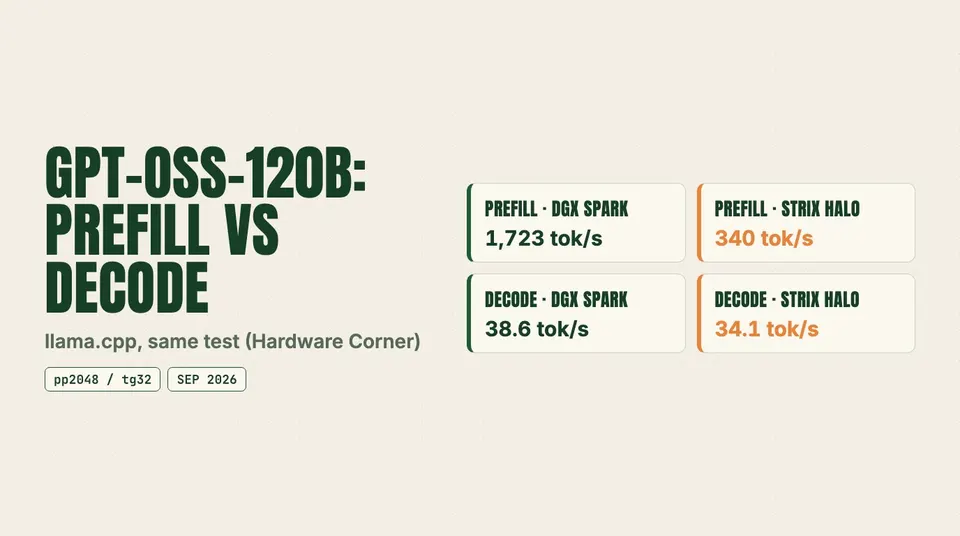
llama.cpp, same test (Hardware Corner)
In Hardware Corner's same-method comparison, the Spark prefilled gpt-oss-120b at 1,723 tok/s against Strix Halo's 340. That is about five times faster. For a 32K-token prompt, that is roughly 20 seconds on the Spark against over a minute and a half on Strix Halo, before the first output token appears. Multiply that by every turn of an agent loop and it dominates your day.
Apple's older Ultra chips sat between the two (the M2 Ultra posted 1,245 tok/s at pp2048). The M5 generation adds neural accelerators to each GPU core, which may close the gap, but there's no public, reproducible M5 Ultra prefill number yet.
If you mainly run Claude Code-style agents against a local model, prefill matters more than any other number in this article. For how the hosted alternatives compare, see our coding-agent CLI comparison.
Which model sizes each box suits
Use the VRAM math in our does-it-fit calculator guide: at 4-bit, weights take a little over half a byte per parameter, and the KV cache comes on top.
| Model class | Strix Halo (96–112GB usable) | DGX Spark (128GB) | Mac Studio M5 Ultra |
|---|---|---|---|
| 20–35B dense or MoE | Fits easily; fast | Fits easily; fast | Fits in 96GB; fast |
| gpt-oss-120b and other ~100B MoE | Fits; usable chat speed | Fits; strong prefill | Fits in 96GB with less room for KV cache |
| 70B dense at 4-bit | Fits; slow decode (bandwidth-bound) | Fits; slow decode | Fits; noticeably better decode |
| ~200B class at 4-bit | Tight or no; AMD cites up to 128B params on Windows | NVIDIA cites up to 200B params for inference | Needs the 256GB config |
| 400B+ class | No | Cluster 2–4 units (NVIDIA cites up to 700B across 4) | 512GB config (late Oct) or a Thunderbolt 5 cluster |
Dense 70B models are where 256–273 GB/s hurts most, because every token reads all the weights. On the 128GB boxes, run mixture-of-experts models. Our best local models for DGX Spark list applies almost unchanged to a 128GB Strix Halo on Linux.
Clustering: the Spark's real differentiator
Each DGX Spark has a ConnectX-7 NIC at 200 Gbps. NVIDIA officially supports linking up to four units to run models of up to 700B parameters. That gives a Spark owner a scaling path: buy one now, add a second for tensor parallelism later. Our Spark cluster sizing guide covers two- and four-node layouts, and the three-Spark DeepSeek V4.1 Flash build shows what that looks like in practice.
Macs can cluster too. macOS Tahoe 26.2 added RDMA over Thunderbolt 5, and MLX uses it for tensor parallelism through its JACCL backend. The M5 Ultra has four Thunderbolt 5 ports rated at up to 120 Gb/s. The cost is the problem: two 256GB M5 Ultras run well over $20,000.
Strix Halo has no comparable interconnect. llama.cpp RPC over Ethernet works, but plan on one box being the whole machine.
Software stack
- DGX Spark: CUDA. It ships with NVIDIA's Ubuntu-based DGX OS and runs vLLM, SGLang, TensorRT-LLM and NIM containers, plus llama.cpp and Ollama. For fine-tuning, PyTorch work or anything headed to NVIDIA servers, nothing else here matches it. It is Arm64 Linux, so expect the occasional x86-only package to fight you.
- Mac Studio: MLX and llama.cpp. MLX is Apple's own framework and usually leads on Apple Silicon; llama.cpp's Metal backend is the portable option. LM Studio and Ollama wrap both. Our MLX vs llama.cpp breakdown goes through which to use when. Training and CUDA-only research code are weak spots.
- Strix Halo: Vulkan first, ROCm second. llama.cpp's Vulkan backend is the reliable path on both Windows and Linux. ROCm works on Linux and keeps improving, but expect to follow community toolbox builds and kernel-parameter guides. It is also the only one that doubles as a Windows gaming PC, with the 96GB GPU-memory cap that comes with Windows.
Noise, power and living with it
The Spark ships with a 240W power supply, and its GB10 chip is rated at 140W. The Mac Studio's maximum continuous power is 480W per Apple. In Engadget's review, the fan was only audible under a gaming load. Strix Halo mini PCs draw roughly 80–120W at the wall according to Compute Market's guide, but cooling and fan noise vary by vendor, so read a noise-focused review of the specific model before you buy. None of the three needs a dedicated circuit or a server closet, which is the main thing they have over a multi-GPU tower like our RTX PRO 6000 build.
Which should you pick?
The budget tinkerer running chat and RAG locally. Get a 128GB Strix Halo box and install Linux so the GPU can address around 110GB. You get gpt-oss-120b at usable chat speed for about $3,500, and it doubles as a normal x86 PC.
The developer running coding agents against a local model. Get the DGX Spark. Long prompts are the bottleneck in agent loops, and a roughly 5x prefill advantage over Strix Halo shows up on every turn. CUDA also means vLLM and SGLang, with proper batching when several agents share one box.
The ML engineer who fine-tunes or will deploy to NVIDIA servers. Get the DGX Spark. Same CUDA stack, same containers, and a clustering path via ConnectX-7.
The person who wants the biggest models on one quiet desk. Get the Mac Studio M5 Ultra with 256GB, or wait for 512GB in late October. It's the only single box here that holds a 200B-plus model at 4-bit with room for context, and its bandwidth gives it the best decode speed on paper. Our earlier Mac Studio vs dual RTX 5090 shootout covers the discrete-GPU alternative at similar money.
Someone who is mostly on hosted models anyway. Price the hardware against subscriptions and API credits first. Our Ollama Cloud vs OpenRouter vs OpenCode Go comparison shows what the same open models cost to rent, and $4,699 buys a lot of tokens.
If you can wait a month: NVIDIA's RTX Spark (N1X) desktops and laptops from Asus, Dell, HP, Lenovo, MSI and Microsoft are due in October with up to 128GB of unified memory, per The Shortcut. NVIDIA has not announced prices, and their bandwidth and Linux support are still unconfirmed, so don't count them as a cheaper Spark yet.
Caveats
- The M5 Ultra is two days into shipping, so every performance statement about it here is inferred from specs or older chips.
- Prices are moving because of the DRAM shortage. All three vendors have raised prices in 2026, and street prices can be higher than list.
- The 112GB GPU figure for Strix Halo is AMD's number. Actual usable memory on Linux depends on your kernel's GTT and TTM settings.
FAQ
Is the DGX Spark faster than a Mac Studio for local LLMs?
On prefill the Spark beats older Ultra chips (1,723–2,173 tok/s on gpt-oss-120b vs 1,245 for an M2 Ultra). On decode the Mac should win: 1.2 TB/s vs 273 GB/s, and even the M2 Ultra posted about 80 tok/s against the Spark's 38–60. Independent M5 Ultra benchmarks aren't out yet.
DGX Spark vs Strix Halo: is the Spark worth about $1,200 more?
It is if you use long prompts or need CUDA. In Hardware Corner's same-method test, the Spark prefilled about 5x faster (1,723 vs 340 tok/s) while decode was close (38.6 vs 34.1 tok/s). For short chat sessions on MoE models, Strix Halo gives you most of the experience for about 73% of the price.
How fast is the Ryzen AI Max+ 395 on gpt-oss-120b?
Published figures range from about 33 to about 50 tok/s decode in llama.cpp, depending on the Vulkan driver, ROCm version and build. Prefill ranges from about 340 tok/s (pp2048) to about 450 tok/s (pp512). It fits in about 61 GiB, so 96GB of Windows VRAM is enough.
Can Strix Halo use all 128GB for the GPU?
Not on Windows. AMD's Variable Graphics Memory tops out at 96GB there. On Linux, the GPU can address system memory through GTT, and AMD cites up to 112GB allocatable on a 128GB system. Community guides recommend a minimal BIOS carve-out and letting GTT handle the rest.
What is the best DGX Spark alternative?
For the same 128GB for less money, it's a Strix Halo box: $3,449–$3,649.99 for the models cited here. For more bandwidth and memory, it's a Mac Studio M5 Ultra. For much more compute in a tower, it's an RTX PRO 6000 Blackwell workstation. NVIDIA's own RTX Spark machines arrive in October, but they haven't been priced yet.
How much does the Mac Studio M5 Ultra cost with 256GB?
Using AppleInsider's reported upgrade prices, the cheapest 256GB configuration is $10,799 with a 1TB SSD, because 256GB requires the 36-core CPU and 80-core GPU chip. Engadget's 2TB review unit was $11,299. Apple hasn't priced the 512GB option, which is due in late October.