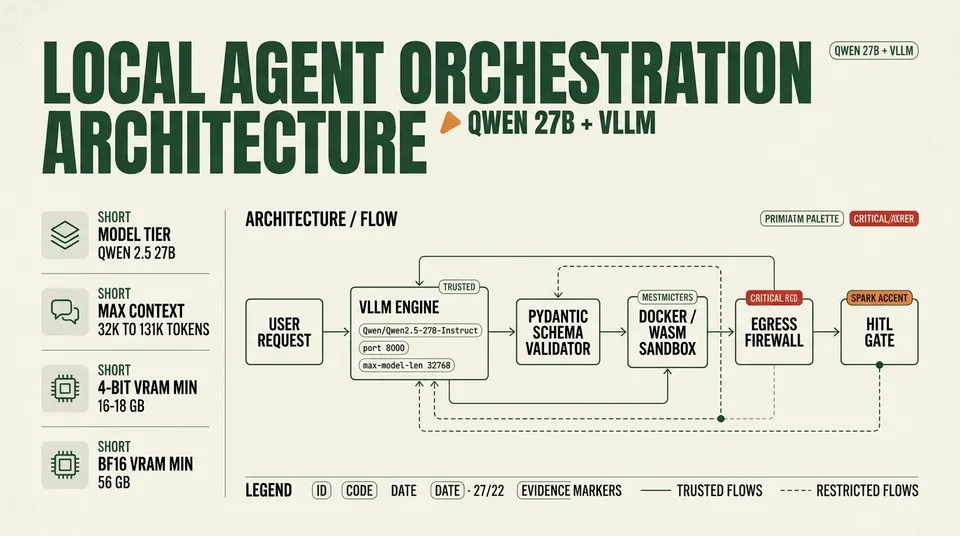
Learn how to deploy autonomous agents locally with Qwen 27B and vLLM. Master tool-calling, grammar-constrained decoding, LangGraph, and enterprise guardrails.
Enterprise engineering teams are increasingly deploying self-hosted open-weights models to power internal automation, ETL pipelines, and security triage workflows. Data privacy mandates, unpredictable cloud API latency, and recurring token costs have made local inference a strategic priority. Within this landscape, the 27-billion parameter tier—exemplified by Qwen 27B—has emerged as the optimal balance for enterprise hardware: it runs on single-GPU workstations while matching the multi-turn function calling performance of earlier proprietary models. For deeper sizing data, see high-concurrency inference sizing and benchmarks for Qwen 27B.
Building production-ready autonomous agents on local infrastructure requires mastery over token templates, grammar-constrained decoding, defensive execution loops, and sandboxed runtimes.
1. Native Function Calling Mechanics and Token Architecture
Agentic function calling relies on structured serialization within the model's ChatML token template. Function definitions are injected as JSON Schema objects inside the system prompt's # Tools block. When the model invokes a capability, it wraps the call in explicit control tokens:
- Invocation Delimiters: The model generates arguments enclosed in
<tool_call>\n{"name": "func_name", "arguments": {...}}\n</tool_call>. - Execution Injection: The application executes the function locally and returns the result wrapped inside
<tool_response>\n{...}\n</tool_response>.
To eliminate malformed JSON payloads, modern inference engines integrate context-free grammar (CFG) decoders like xgrammar and outlines. Grammar-constrained decoding dynamically masks vocabulary logits at each sampling step, assigning negative infinity ($-\infty$) to any token that violates the target JSON Schema. This enforces strict type safety, required keys, and enum constraints directly at the logit level.
2. High-Throughput Serving via vLLM and Ollama
vLLM provides an OpenAI-compatible endpoint with native tool parsing and PagedAttention memory management. For how it compares to alternatives, see SGLang vs vLLM vs TensorRT-LLM: choosing a production inference engine.
python3 -m vllm.entrypoints.openai.api_server \
 --model Qwen/Qwen2.5-27B-Instruct \
 --tensor-parallel-size 1 \
 --max-model-len 32768 \
 --enable-auto-tool-choice \
 --tool-call-parser hermes \
 --gpu-memory-utilization 0.90 \
 --port 8000
The --tool-call-parser hermes (or qwen) flag instructs vLLM to parse internal <tool_call> delimiters and stream standard OpenAI tool_calls response structures.
For rapid local prototyping, Ollama provides instant quantizations:
ollama run qwen2.5:27b
3. Pure Python Multi-Turn Execution Loop
The operational core of an agent is the multi-turn conversational loop, which submits prompts, executes tool calls, and returns structured data until the model finishes reasoning.
import json
from openai import OpenAI

client = OpenAI(base_url="http://localhost:8000/v1", api_key="EMPTY")

tools = [{
 "type": "function",
 "function": {
 "name": "query_database",
 "description": "Execute a read-only SQL query against the analytical DB.",
 "parameters": {
 "type": "object",
 "properties": {"sql": {"type": "string", "description": "The SELECT query"}},
 "required": ["sql"],
 },
 },
}]

def execute_tool(name: str, arguments: dict) -> str:
 if name == "query_database":
 return json.dumps({"rows": [{"user_id": 101, "status": "active", "tier": "enterprise"}]})
 return json.dumps({"error": f"Unknown tool: {name}"})

messages = [
 {"role": "system", "content": "You are an enterprise data assistant. Use provided tools when needed."},
 {"role": "user", "content": "Find the status of user ID 101 in our database."
]

while True:
 response = client.chat.completions.create(
 model="Qwen/Qwen2.5-27B-Instruct",
 messages=messages,
 tools=tools,
 tool_choice="auto",
 temperature=0.0
 )
 message = response.choices[0].message
 messages.append(message)

 if message.tool_calls:
 for tool_call in message.tool_calls:
 name = tool_call.function.name
 args = json.loads(tool_call.function.arguments)
 result = execute_tool(name, args)
 messages.append({
 "role": "tool",
 "tool_call_id": tool_call.id,
 "name": name,
 "content": result
 })
 else:
 print("Final Output:\n", message.content)
 break
4. Production Framework Integration: LangGraph
For complex state management and cyclic decision graphs, LangGraph interfaces cleanly with local vLLM endpoints via standard client bindings. Runtime authorization for these calls is its own discipline; see the agent control plane for MCP and AI tool-call authorization.
from langchain_openai import ChatOpenAI
from langchain_core.tools import tool
from langgraph.prebuilt import create_react_agent

@tool
def fetch_system_metrics(host: str) -> dict:
 """Fetch CPU and Memory metrics for a designated production host."""
 return {"host": host, "cpu_usage_pct": 24.5, "mem_usage_pct": 62.1}

llm = ChatOpenAI(
 base_url="http://localhost:8000/v1",
 api_key="EMPTY",
 model="Qwen/Qwen2.5-27B-Instruct",
 temperature=0.0
)

agent_executor = create_react_agent(llm, tools=[fetch_system_metrics])
result = agent_executor.invoke({"messages": [("user", "Check if server prod-node-04 is healthy.")]})
print(result["messages"][-1].content)
5. Defensive Reliability Engineering
Local agent workflows require active runtime validation to intercept hallucinations, schema mismatches, and execution deadlocks.
Pydantic Validation & Self-Correction
Tool arguments should always deserialize into strict Pydantic models before dispatch. That's one layer of a broader discipline; see structured output and constrained decoding for valid JSON from LLMs. If a ValidationError occurs, intercept the exception and feed the raw traceback back into the <tool_response> turn. Qwen models parse these error traces and consistently correct missing or malformed keys on the subsequent step.
Cycle Breaking and Infinite Loop Mitigation
Agents can stall in infinite loops when API calls return empty sets or ambiguous outputs. Implement an in-memory ring buffer tracking (tool_name, sha256(arguments)). When duplicate calls are detected consecutively, inject a steering directive urging the model to synthesize an alternative strategy, bounded by a hard ceiling of 5 to 8 iterations.
6. Security Guardrails for Autonomous Agents
Granting an automated model execution privileges requires strict architectural containment across the compute, network, and application layers. For a comparative look at agent security records, see OpenClaw vs Hermes Agent: features, local models and the security record.
| Security Vector | Potential Threat | Defensive Implementation |
|---|---|---|
| Arbitrary Code Execution | Prompt injection triggering os.system calls or shell exploits | Execute tools within ephemeral Docker containers or WebAssembly (Wasm) runtimes with read-only root filesystems. |
| SSRF & Data Exfiltration | Agent accessing cloud metadata (169.254.169.254) or internal subnets | Implement strict network egress filtering via iptables or eBPF, blocking all non-whitelisted private IP spaces. |
| AST Inspection | Dangerous imports inside generated script arguments | Parse Python code payloads with ast.parse, blocking forbidden modules (subprocess, socket, eval) before execution. |
| Privilege Escalation | Unintended mutations such as database deletions | Apply Human-in-the-Loop (HITL) checkpoints requiring explicit human confirmation on destructive functions. |
7. Production Hardware Sizing Reference
Deploying Qwen 27B requires selecting the appropriate precision and quantization target based on available VRAM and throughput goals. For a full hardware blueprint, see local deployment of 27B models: the 24GB hardware blueprint.
| Model Variant | Precision / Quantization | Min VRAM Required | Recommended Hardware Tier | Maximum Context Window |
|---|---|---|---|---|
| Qwen 27B Instruct | BF16 (Unquantized) | ~56 GB | 1x NVIDIA A100 / H100 (80GB) | 32,768 – 131,072 tokens |
| Qwen 27B Instruct | AWQ / GPTQ (4-bit) | ~16–18 GB | 1x RTX 3090 / 4090 / 5070+ | 32,768 tokens |
| Qwen 27B Instruct | GGUF (Q4_K_M) | ~17 GB | Apple Silicon (36GB+ RAM) / RTX 4080 | 32,768 tokens |
| Qwen 27B Instruct | GGUF (Q8_0) | ~29 GB | 2x RTX 3090 / 4090 / RTX A5000 | 32,768 tokens |
Combining 4-bit AWQ or 8-bit quantized weights with vLLM's grammar-guided decoding provides engineering teams with an enterprise-grade agent orchestration stack that is fully isolated, cost-effective, and robust.