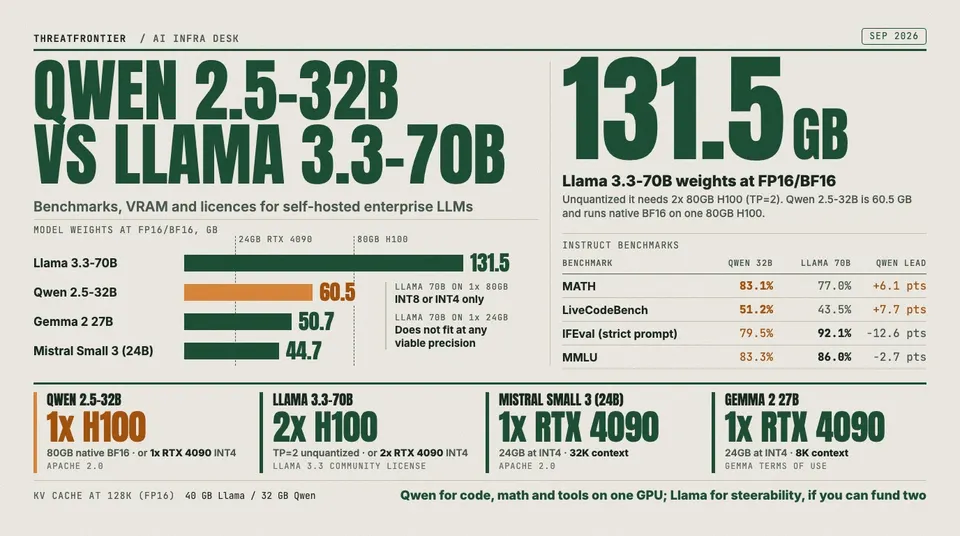
Compare Qwen 2.5-32B vs. Llama 3.3-70B on benchmarks, GPU VRAM sizing, and costs. Discover the best open-weight LLM architecture for enterprise AI deployments.
Enterprise artificial intelligence architecture has reached a pivotal inflection point where brute-force parameter scaling is yielding to compute efficiency and operational economics. As engineering organizations migrate from hosted proprietary APIs toward private, self-hosted infrastructure, foundation model selection requires balancing raw benchmark performance against local GPU memory limits, Key-Value (KV) cache footprints, and commercial licensing governance. Our broader survey of self-hosted open-weight stacks that actually replace ChatGPT covers which workloads are ready for that migration.
The open-weight ecosystem currently centers on a strategic architectural trade-off: Meta's flagship distilled 70-billion-parameter model versus Alibaba's dense 32-billion-parameter specialist, alongside specialized contenders from Google and Mistral. Choosing between a 27B-to-32B dense tier and a 70B-class flagship dictates whether production workloads require multi-node cluster orchestration or a single commodity enterprise accelerator.
Architectural Baseline and Baseline Specifications
The current generation of open-weight models reflects divergent engineering priorities across layer depth, attention mechanisms, and pretraining data curation.
| Parameter / Feature | Qwen 2.5-32B-Instruct | Meta Llama 3.3-70B-Instruct | Google Gemma 2-27B-IT | Mistral Small 3 (24B) |
|---|---|---|---|---|
| Developer / Lab | Alibaba Cloud | Meta AI | Google DeepMind | Mistral AI |
| Total Parameters | 32.5 Billion | 70.6 Billion | 27.2 Billion | 24.0 Billion |
| Architecture Type | Decoder-only Dense Transformer | Decoder-only Dense Transformer | Decoder-only Dense Transformer | Decoder-only Dense Transformer |
| Attention Mechanism | Grouped-Query Attention (GQA) | Grouped-Query Attention (GQA) | GQA + Alternating Sliding Window | Grouped-Query Attention (GQA) |
| Attention Heads (Q / KV) | 40 / 8 | 64 / 8 | 32 / 16 | 32 / 8 |
| Hidden Dimension / Layers | 5,120 / 64 layers | 8,192 / 80 layers | 4,608 / 46 layers | 5,120 / 40 layers |
| Pretraining Token Scale | Up to 18.0 Trillion | ~15.0 Trillion | 13.0 Trillion | Undisclosed (Dense Curation) |
| Native Context Length | 131,072 tokens (128K) | 131,072 tokens (128K) | 8,192 tokens (8K) | 32,768 tokens (32K) |
| Max Output Generation | 8,192 tokens | 8,192 tokens | 8,192 tokens | 8,192 tokens |
| Commercial License | Apache 2.0 | Llama 3.3 Community License | Gemma Terms of Use | Apache 2.0 |
Alibaba's Qwen 2.5-32B combines a 128,000-token native context window with permissive Apache 2.0 licensing, targeting algorithmic reasoning and dense structured generation. Meta's Llama 3.3 70B distills capabilities from its 405B predecessor into an 80-layer architecture optimized for complex steerability. Google's Gemma 2 27B introduces alternating local sliding-window (4,096 tokens) and global attention (8,192 tokens) to maximize parameter-to-memory throughput within an 8K ceiling, while Mistral Small 3 offers a 32,768-token intermediate window optimized for low-latency batch throughput.
Empirical Benchmarks: Quantitative Reasoning vs. Steerability
Standardized evaluations demonstrate that targeted synthetic data pipelines allow compact architectures to outperform larger models in mathematical and code generation tasks, whereas higher parameter weights maintain an advantage in strict multi-constraint execution.
| Benchmark Suite | Focus / Modality | Qwen 2.5-32B-Instruct | Llama 3.3-70B-Instruct | Google Gemma 2-27B-IT | Mistral Small 3 (24B) |
|---|---|---|---|---|---|
| MMLU (5-shot / CoT) | General Knowledge / Reasoning | 83.3% | 86.0% | 75.2% | 81.3% |
| MMLU-Pro (5-shot / CoT) | Complex Multi-step Reasoning | 69.0% | 68.9% | 55.5% | ~65.0% |
| GPQA Diamond (0-shot CoT) | Graduate-level Science | 49.5% | 50.5% | 38.4% | ~42.0% |
| MATH (4-shot / 0-shot CoT) | Formal Mathematical Proofs | 83.1% | 77.0% | 54.4% | 68.2% |
| GSM8K (8-shot / CoT) | Multi-step Arithmetic Reasoning | 95.9% | 95.8% | 90.4% | 91.5% |
| HumanEval (0-shot Pass@1) | Python Code Synthesis | 88.4% | 88.4% | 78.7% | 84.6% |
| LiveCodeBench (2305–2409) | Contamination-Free Code Stream | 51.2% | 43.5% | 31.8% | ~40.2% |
| IFEval (Strict Prompt) | Precise Constraint Adherence | 79.5% | 92.1% | 77.1% | 78.4% |
| Arena-Hard (Auto-Eval) | Chatbot Preference vs. GPT-4 | 74.5 | 77.2 | 57.5 | 69.8 |
Qwen 2.5-32B delivers notable efficiency in quantitative logic, leading Llama 3.3 70B across formal mathematics and uncontaminated coding evaluations. Conversely, Llama 3.3 70B leads in strict instruction following on IFEval, demonstrating superior handling of negative constraints, system instructions, and complex output schemas.
Hardware Sizing, Memory Math, and Local Quantization
Accurate infrastructure provisioning requires calculating both static weight footprints and dynamic runtime overhead, including the Key-Value (KV) cache and CUDA activation buffers:
$$\text{Total VRAM (GB)} = \frac{\text{Params (B)} \times (\text{Bits per Weight} / 8)}{1.074} + \text{KV Cache (GB)} + \text{Activation Buffer (~2 GB)}$$
$$\text{KV Cache per Token (Bytes)} = 2 \times \text{Layers} \times \text{KV Heads} \times \text{Head Dimension} \times \frac{\text{Bits per KV Token}}{8}$$
| Model | Parameters | FP16/BF16 (16-bit) | INT8 / AWQ / GPTQ | INT4 / Q4_K_M GGUF | KV Cache per 8K (FP16) | KV Cache per 128K (FP16) |
|---|---|---|---|---|---|---|
| Mistral Small 3 | 24.0B | 44.7 GB | 22.4 GB | 11.2 GB | 1.25 GB | 20.00 GB |
| Gemma 2 27B | 27.2B | 50.7 GB | 25.3 GB | 12.7 GB | 2.88 GB | N/A (8K Limit) |
| Qwen 2.5-32B | 32.5B | 60.5 GB | 30.3 GB | 15.1 GB | 2.00 GB | 32.00 GB |
| Llama 3.3-70B | 70.6B | 131.5 GB | 65.8 GB | 32.9 GB | 2.50 GB | 40.00 GB |
Hardware Deployment Profiles:
- Single Consumer GPU (1x 24GB RTX 4090 / 32GB RTX 5090): Runs Qwen 2.5-32B, Gemma 2 27B, or Mistral Small 3 at INT4 (
Q4_K_Mor AWQ). Llama 3.3 70B cannot fit within a 24GB memory pool at any viable precision. For Macs with the same memory, see the best open-weight models for a 24GB Apple Silicon Mac. - Dual Consumer GPU (2x 24GB RTX 4090): Accommodates Qwen 2.5-32B at INT8 or Llama 3.3 70B at INT4 (
EXL2/ 4.0 bpw). Because consumer GPUs lack physical NVLink interconnects, Tensor Parallelism (TP=2) over PCIe 4.0 incurs a 10% to 15% latency penalty on Time-to-First-Token. - Single Enterprise GPU (1x 80GB A100 / H100): Executes Qwen 2.5-32B in native unquantized BF16 with ~20 GB of headroom for dynamic KV caches under high concurrency. Llama 3.3 70B requires INT8 or INT4 quantization to fit within an 80GB pool.
- Dual Enterprise GPU (2x 80GB H100 NVLink, TP=2): The standard deployment tier for unquantized Llama 3.3 70B, supplying full FP16 weights alongside 128,000-token dynamic KV caches. For a general-purpose sizing tool across quantization formats, see our VRAM calculator for open-weight LLMs across quantization formats.
Context Economics and Enterprise RAG Scalability
A full 128K context request on Llama 3.3 70B requires 40 GB of VRAM solely for the KV cache at FP16, while Qwen 2.5-32B requires 32 GB. Our deep dive on why long context costs more VRAM than the model weights themselves walks through that arithmetic in full. Serving concurrent 128K queries in production demands deployment engines like vLLM or TensorRT-LLM with PagedAttention and FP8 KV caching, which halves memory overhead without degrading contextual retrieval fidelity. We cover that production engine architecture in depth in sizing high-concurrency inference for Qwen 27B.
# Production serving via vLLM: 128K context with FP8 KV cache
vllm serve Qwen/Qwen2.5-32B-Instruct \
 --tensor-parallel-size 1 \
 --max-model-len 131072 \
 --kv-cache-dtype fp8 \
 --gpu-memory-utilization 0.95
In contrast, Gemma 2 27B's hard 8,192-token architectural ceiling precludes direct full-document ingestion. Workloads built on Gemma 2 require dense retrieval architectures, using aggressive document chunking (300 to 500 tokens) paired with cross-encoder rerankers to fit within the 8K context limit.
Commercial Governance and Workload Selection
| License Type | Covered Models | User Scale / Attribution Restrictions | Enterprise Legal Friction |
|---|---|---|---|
| Apache 2.0 | Qwen 2.5-32B, Mistral Small 3 | Unrestricted commercial distribution; notice retention only | Zero Friction (Standard OSS approval) |
| Llama 3.3 Community | Meta Llama 3.3 70B | >700M MAU requires explicit license; "Built with Llama" attribution | Low-to-Medium Friction (Legal review of MAU clause) |
| Gemma Terms of Use | Google Gemma 2 27B | Permissive commercial use subject to Google Acceptable Use Policy | Low Friction (Standard compliance check) |
Final Selection Guidelines:
- Automated Coding Agents, SQL Generation, and Tool Calling: Qwen 2.5-32B-Instruct represents the optimal choice. Its quantitative benchmark lead, 128K context window, and Apache 2.0 license provide maximum operational utility on single-accelerator setups. Teams customizing it further can follow our production guide to fine-tuning 27B-32B LLMs on a single 24GB GPU with Unsloth and 4-bit QLoRA.
- Policy Enforcement, Complex Guardrails, and General Steerability: Llama 3.3-70B-Instruct remains the enterprise baseline. Its high instruction adherence provides dependable structured outputs across complex business rules, provided infrastructure budgets support dual-GPU deployment.
- High-Throughput Interactive Microservices: Mistral Small 3 (24B) provides the lowest time-to-first-token latency and high throughput on single-GPU hardware configurations.
- Short-Form Local Summarization: Google Gemma 2 27B delivers strong parameter-to-performance efficiency for bounded tasks operating strictly within an 8K context boundary.