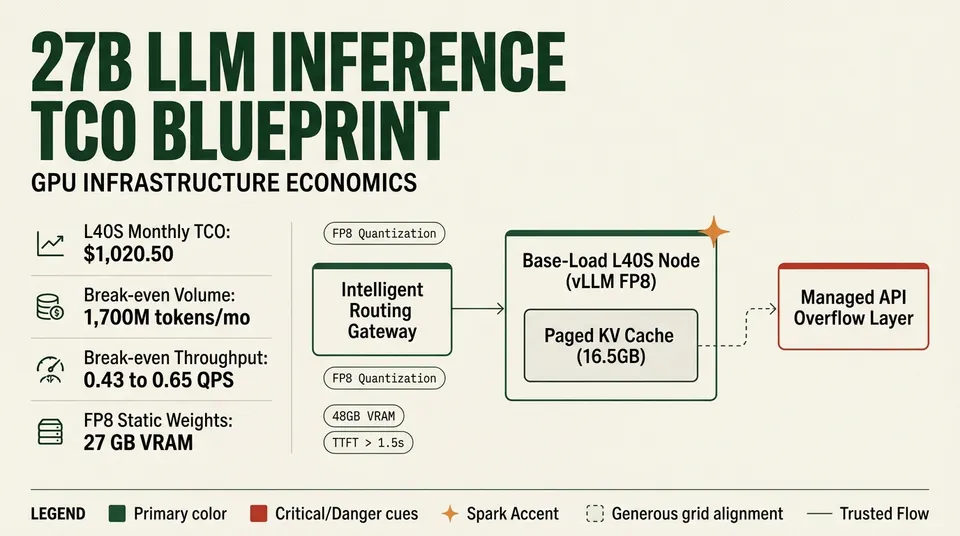
Compare 27B LLM inference costs: self-hosted GPUs vs managed APIs. Explore break-even metrics, FP8 VRAM math, L40S benchmarks, and total cost of ownership.
Engineering leadership faces a pivotal architectural decision when deploying production workloads on 27-billion-parameter open-weights models: continue absorbing usage-based fees from managed API providers or provision dedicated GPU infrastructure. With specialized GPU cloud rates falling and 8-bit (FP8) quantization enabling 27B-class architectures to run on single 48GB enterprise cards, the financial inflection point has shifted. Determining the optimal deployment model now hinges on sustained query concurrency, memory footprints, and infrastructure overhead.
The Unit Economics: Self-Hosted vs. Managed LLM API Cost
The 27B parameter tier—alongside adjacent 32B architectures—occupies a distinct operational sweet spot, delivering near-frontier intelligence on code generation, structured extraction, and complex reasoning while avoiding the multi-GPU tensor-parallel complexity required by 70B models. For a coding-focused 32B case, see Qwen2.5-Coder-32B evaluated for enterprise coding. For the broader mechanics of prefill, decode and KV-cache budgeting behind these numbers, see Inference Engineering: A Practical Primer.
The financial evaluation balances elasticity against capacity utilization:
- Managed APIs (Pay-as-you-go): Eliminate idle compute waste, hardware provisioning delays, and site reliability engineering (SRE) overhead, but introduce compounding marginal costs at scale.
- Self-Hosted Dedicated Compute: Establishes fixed, predictable monthly expenses and lower unit costs at high volume, but risks capital inefficiency if instances sit underutilized during off-peak hours.
On specialized GPU cloud providers offering an NVIDIA L40S at approximately $0.85 per hour, self-hosting breaks even with managed APIs at 1.1 to 1.7 billion tokens per month (a sustained throughput of 0.43 to 0.65 queries per second). On legacy hyperscalers, where compute leases, enterprise support, and egress push node costs above $2,200 monthly, break-even rises to 3.7 to 7.6 billion tokens per month (sustained 1.41 to 2.90 QPS).
Managed API Pricing Benchmarks and Scaling Realities
Managed inference providers monetize through per-million-token consumption rates, partitioned into prompt prefill (input) and token generation (output). Because production retrieval-augmented generation (RAG) workflows typically exhibit a 3:1 input-to-output token ratio, blended rates define actual operational expenditure.
| Provider | Input / 1M Tokens | Output / 1M Tokens | Blended Rate (3:1 Ratio) | Prompt Caching Discount | SLA & Enterprise Features |
|---|---|---|---|---|---|
| Fireworks AI | $0.20 | $0.80 | $0.350 | Yes (FireAttention) | Ultra-low TTFT, custom model hosting |
| Together AI | $0.30 | $0.90 | $0.450 | Yes | Dedicated endpoints, VPC peering |
| DeepInfra | $0.26 | $2.60 | $0.845 | Yes (Up to 50%) | SOC 2 Type II, dedicated clusters |
| OpenRouter (Aggregator) | $0.26–$0.40 | $0.90–$2.80 | $0.420–$1.000 | Provider dependent | Dynamic failover, multi-provider routing |
Managed endpoints offer immediate elasticity from zero to thousands of concurrent requests without cold starts. How those managed providers compare beyond the big aggregators is covered in Serverless GPU Inference Compared. However, sustained workloads such as continuous data extraction pipelines or autonomous background agents rapidly encounter steep marginal cost curves.
Hardware Blueprints and VRAM Mathematics for 27B Serving
Assessing self-hosted feasibility requires modeling static weights alongside dynamic memory overhead:
$$\text{Total VRAM} = \text{Model Weights} + \text{KV Cache} + \text{Activation Memory} + \text{CUDA Runtime}$$
At 16-bit precision (BF16), a 27B model consumes 54 GB of VRAM for static weights alone, demanding an 80GB GPU or a two-card tensor-parallel setup. In FP8 (8-bit precision), static weight allocation drops to 27 GB, allowing the full model and an expansive key-value (KV) cache pool to fit inside a single 48GB GPU such as the NVIDIA L40S.
# Production vLLM engine launch on a single NVIDIA L40S (48GB)
python3 -m vllm.entrypoints.openai.api_server \
 --model google/gemma-2-27b-it \
 --quantization fp8 \
 --kv-cache-dtype fp8 \
 --gpu-memory-utilization 0.92 \
 --max-model-len 8192 \
 --max-num-seqs 64 \
 --port 8000
With Grouped Query Attention (GQA), the FP8 KV cache requires 0.5 to 0.6 MB per 1,000 context tokens. A deeper sizing and benchmark breakdown for this model class is in High-Concurrency Inference for Qwen 27B. Allocating 16.5 GB to the paged KV cache accommodates 64 concurrent requests averaging 4,096 tokens without triggering memory thrashing or request queuing.
| Instance / GPU Setup | Total VRAM | Precision Mode | Monthly Lease (Specialized vs AWS) | Batched Throughput | Production Suitability |
|---|---|---|---|---|---|
| 1x NVIDIA A10G (24GB) | 24 GB | INT4 / AWQ | ~$730 / mo (AWS g5) | ~180 tok/s | Low: Quantization degradation, restricted KV cache. |
| 2x NVIDIA L4 (48GB) | 48 GB | FP8 (TP=2) | ~$1,168 / mo (AWS g6) | ~400 tok/s | Moderate: Inter-GPU interconnect bottleneck (PCIe Gen4). |
| 1x NVIDIA L40S (48GB) | 48 GB | FP8 / AWQ | $620 / mo vs $1,423 / mo (AWS g6e) | ~800–1,200 tok/s | High: Optimal price-to-performance for single-node serving. |
| 1x NVIDIA A100 (80GB) | 80 GB | BF16 / FP8 | $1,606 / mo vs $3,285 / mo (AWS) | ~1,500–2,200 tok/s | High: 2.0 TB/s memory bandwidth, native BF16 execution. |
| 1x NVIDIA H100 (80GB) | 80 GB | FP8 (TRT-LLM) | $2,336 / mo vs $3,577 / mo (AWS p5) | ~3,500–5,000 tok/s | Elite: Maximum throughput density, minimal TTFT. |
Total Cost of Ownership and Break-Even Modeling
True self-hosted total cost of ownership (TCO) incorporates hardware leasing, storage, networking, and platform operations:
$$\text{TCO} = C_{\text{compute}} + C_{\text{storage}} + C_{\text{egress}} + C_{\text{devops}} + C_{\text{idle_overhead}}$$
Factoring in persistent NVMe storage and amortized MLOps engineering time ($400 to $1,000 per node monthly), the fully loaded cost establishes clear break-even volumes across API rate tiers.
| Deployment Configuration | Total Monthly TCO | Break-Even @ $0.35/1M (Fireworks) | Break-Even @ $0.60/1M (DeepInfra/Together) | Break-Even @ $0.90/1M (Aggregators) | Minimum Break-Even QPS |
|---|---|---|---|---|---|
| 1x L40S 48GB (Specialized Cloud) | $1,020.50 | 2,915M tokens | 1,700M tokens | 1,133M tokens | 0.43 – 0.65 QPS |
| 1x A100 80GB (Specialized Cloud) | $2,006.00 | 5,731M tokens | 3,343M tokens | 2,228M tokens | 0.85 – 1.27 QPS |
| 1x H100 80GB (Specialized Cloud) | $2,736.00 | 7,817M tokens | 4,560M tokens | 3,040M tokens | 1.16 – 1.74 QPS |
| 1x L40S 48GB (AWS G6e On-Demand) | $2,223.50 | 6,352M tokens | 3,705M tokens | 2,470M tokens | 0.94 – 1.41 QPS |
| 1x H100 80GB (AWS P5 Dedicated) | $4,577.00 | 13,077M tokens | 7,628M tokens | 5,085M tokens | 1.94 – 2.90 QPS |
Hidden Operational Costs and SLA Risks
Engineering teams evaluating self-hosted infrastructure must account for operational drag factors that inflate effective unit costs:
- Traffic Asymmetry and Idle Waste: Enterprise traffic concentrated during business hours drops overall utilization to roughly 28% if nodes run 24/7, tripling effective per-token compute costs.
- Autoscaling Cold Starts: Pulling 27 GB of weights from object storage into GPU memory takes 120 to 300 seconds, requiring baseline "warm" capacity to avoid request timeouts.
- MLOps Maintenance: Driver compatibility, kernel compilation, continuous batching optimization, and metric pipelines require dedicated engineering time, adding $3,000 to $6,000 monthly across a cluster. Picking the right serving engine to minimize that overhead is covered in SGLang vs vLLM vs TensorRT-LLM.
- Network Egress Fees: Outbound traffic on major hyperscalers adds $0.05 to $0.09 per GB ($150 to $350 monthly at 5 billion tokens), whereas specialized clouds waive egress charges.
Data Governance and the Strategic Routing Framework
Financial calculations interact directly with compliance mandates, data sovereignty boundaries, and architecture requirements:
| Operational Dimension | Managed API Aggregators | Dedicated Self-Hosted VPC |
|---|---|---|
| Data Privacy & Retention | Governed by contractual Zero Data Retention (ZDR) SLAs over shared multi-tenant infrastructure. | Complete physical isolation; payload data remains strictly inside private network boundaries. |
| Regulatory Compliance | Dependent on third-party vendor SOC 2 audits, HIPAA BAAs, and regional availability. | Direct administrative control over KMS key encryption, IAM policies, and access audit logs. |
| Dynamic LoRA Serving | Limited or billed at substantial markups for dedicated fine-tuned weight hosting. | Native multi-LoRA dynamic execution on single vLLM instances at zero marginal infrastructure cost. |
| Lifecycle Management | Vulnerable to upstream provider downtime, unexpected breaking changes, and model deprecation. | Full version pinning with deterministic internal service-level agreements. |
The Production Standard: Hybrid Burst-Routing
For mature engineering organizations, the most financially robust architecture combines dedicated base-load compute with managed API overflow:
- Base-Load Layer: Provision a single NVIDIA L40S node running FP8-quantized 27B weights on vLLM to serve steady baseline traffic up to 800 tokens per second (~0.8 QPS) at a fixed run rate of ~$1,020 monthly.
- Burst Overflow: Route transient traffic spikes and batch processing exceeding queue thresholds (>1.5s Time-To-First-Token) to managed APIs (such as Together AI, Fireworks AI, or DeepInfra) through an intelligent routing gateway.
This hybrid model captures the low unit economics of dedicated silicon during steady-state processing while utilizing managed elasticity during demand spikes, shielding organizations from both idle compute waste and unbudgeted API scaling. The same self-hosted-vs-subscription tradeoff shows up in developer tooling too, as in Claude Code Pricing & Token Economics.