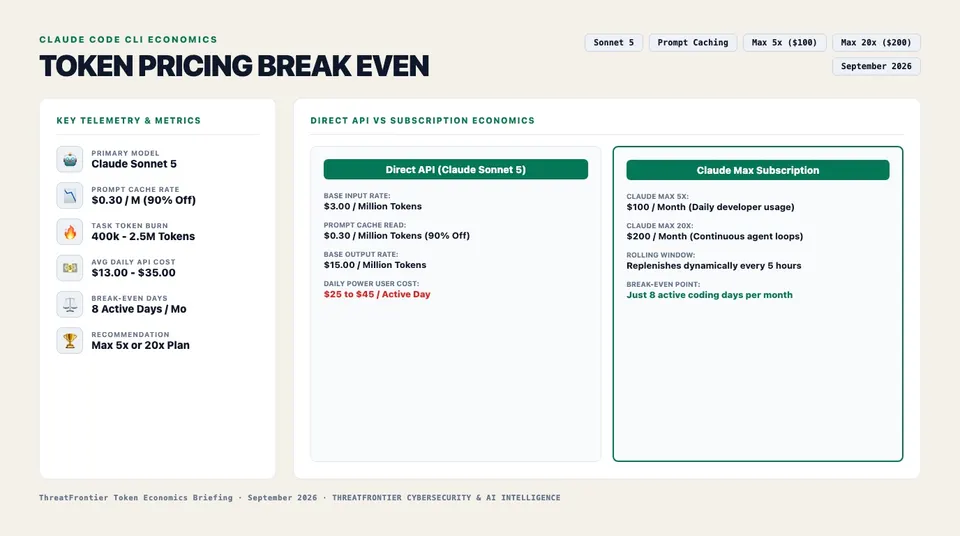
Claude Code CLI burns 400k to 2.5M tokens per task. We analyze subscription tiers (Pro, Max 5x, Max 20x) vs direct API pricing with prompt caching.
The release of Anthropic's Claude Code command-line interface (CLI) has triggered a fundamental reassessment of software engineering economics. Unlike conventional web conversational interfaces or passive IDE completion extensions, Claude Code operates as an autonomous agentic loop directly inside the developer's terminal. It inspects local git repositories, executes bash commands, runs test suites, interprets compiler errors, and mutates source files across complex multi-step workflows.
However, autonomy comes at an immense computational cost. Because an agentic workflow repeatedly feeds its compounding execution history, tool outputs, and repository context back into the model on every single turn, Claude Code burns between 400,000 and 2,500,000 tokens for a single non-trivial engineering task. For individual developers and engineering leadership, this velocity creates a critical financial question: Should teams utilize Anthropic's subscription plans—Claude Pro ($20/mo), Claude Max 5x ($100/mo), or Claude Max 20x ($200/mo)—or connect their own Anthropic Console API keys under direct pay-as-you-go billing?
To answer this, we analyze the microeconomics of Claude Code's token consumption, model the exact impact of Anthropic's prompt caching architecture, and provide a quantitative break-even matrix for engineering organizations.
1. Anatomy of an Agentic Turn: Why Claude Code Burns Millions of Tokens
In standard chat interfaces, token consumption scales linearly with conversation length. In an agentic CLI loop, token consumption scales exponentially due to continuous context re-hydration.
When a developer prompts Claude Code with a task—such as "Refactor session management to support Redis clustering and add unit tests"—the CLI constructs a dense operational envelope:
- System Prompt & Tool Definitions: Operational instructions governing tool use (bash, file read/write, glob, grep) consume 8,000 to 14,000 tokens before any project data is evaluated.
- Environment & Repository Mapping: The agent inspects
git status, directory structures, manifests (package.json,Cargo.toml), and guidelines (CLAUDE.md), injecting 15,000 to 45,000 tokens. - Execution & Observation Feedback: When the agent runs shell commands (
cargo test,npm test), standard output and error traces are appended to context. - Multi-File Mutation Cycles: Modifying interrelated files requires re-transmitting the entire conversation history and prior tool outputs on each turn.
Turn 01: [System + Tools + Repo Context] + User Prompt (35k tokens)  --> Agent Plan (800 tokens)
Turn 02: [Prior Context] + Tool: FileRead (36k tokens)               --> Agent Thought (400 tokens)
Turn 03: [Prior Context] + File Content (55k tokens)                 --> Tool: FileEdit (1,200 tokens)
Turn 04: [Prior Context] + Tool: Bash (npm test) (58k tokens)        --> Test Output (15k tokens)
Turn 05: [Prior Context + Stack Trace] (74k tokens)                  --> Fix Implementation (2,000 tokens)
...
Turn 20: [Accumulated History across 20 Turns] (165k tokens/turn)    --> Final Commit & Clean Pass
By Turn 20, a single turn requires over 160,000 input tokens just to generate a 50-line patch. Over a multi-step task of 15 to 30 turns, cumulative input token volume easily exceeds 1.5 million tokens.
2. The Economic Savior: Prompt Caching Mechanics
If every token in an agentic loop were billed at standard rates, running Claude Code would be commercially unviable. Direct API access to Claude Sonnet 5 costs $3.00 per million input tokens and $15.00 per million output tokens. Ingesting 1.5 million uncached input tokens across a 20-turn session would cost $4.50 in input fees alone, with total task costs exceeding $6.50.
Anthropic solves this bottleneck through Prompt Caching. Because the prefix of the conversation (system instructions, tool declarations, project manifests, and early turns) remains identical between sequential API calls, context is checkpointed in memory:
+------------------------------------+------------------+--------------------+
| Pricing Component (Sonnet 5)     | Base Rate        | Effective / 1M     |
+------------------------------------+------------------+--------------------+
| Standard Input Tokens              | 1.00x Base Rate  | $3.00 / M          |
| Prompt Cache Write (5-min TTL)     | 1.25x Base Rate  | $3.75 / M          |
| Prompt Cache Write (1-hour TTL)    | 2.00x Base Rate  | $6.00 / M          |
| Prompt Cache Read (Cache Hit)      | 0.10x Base Rate  | $0.30 / M (90% off)|
| Standard Output Tokens             | Uncached         | $15.00 / M         |
+------------------------------------+------------------+--------------------+
The Caching Break-Even Equation
A prompt cache write carries a 25% premium ($3.75/M vs. $3.00/M) for a standard 5-minute TTL. However, every subsequent read receives an instant 90% discount, dropping input costs to $0.30 per million tokens.
Mathematically, break-even is achieved almost immediately:
- Uncached Cost (2 calls of 100k tokens):
(100k * $3.00) + (100k * $3.00) = $0.60 - Cached Cost (1 write + 1 read):
(100k * $3.75) + (100k * $0.30) = $0.405
Prompt caching yields net savings after just 1.28 cache reads. In a 20-turn Claude Code session where turns occur every 15 to 45 seconds, the cache hit rate reaches 92% to 96% of total input tokens. This drops the effective cost of a 1.5M-token task from over $6.00 down to $0.85 to $1.40.
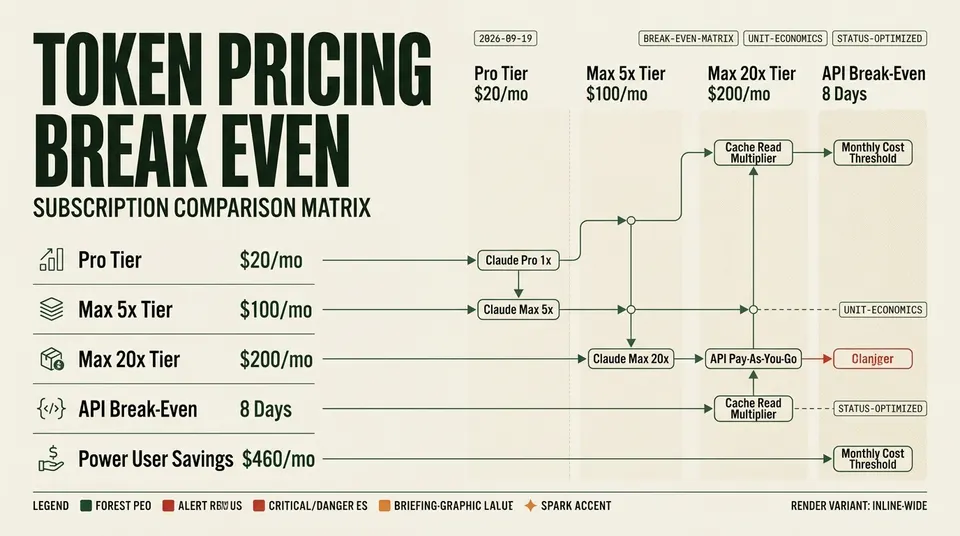
Figure 1: Architectural and benchmark overview for Claude Code Pricing & Token Economics: Subscription vs. Pay-As-You-Go API.
3. Subscription Tiers: Pro vs. Max 5x vs. Max 20x
Anthropic offers Claude Code access bundled into its monthly subscription plans. Unlike API billing, subscriptions charge a fixed monthly fee and enforce dynamic rolling-window rate limits governed by a 5-hour cycle.
+-------------------+-----------------+-----------------------+-----------------------+
| Plan Tier         | Monthly Cost    | Rate Limit Multiplier | Viable Agent Velocity |
+-------------------+-----------------+-----------------------+-----------------------+
| Claude Pro        | $20 / month     | 1x Baseline           | 15–25 turns / 5 hours |
| Claude Max 5x     | $100 / month    | 5x Baseline           | 75–125 turns / 5 hours|
| Claude Max 20x    | $200 / month    | 20x Baseline          | 300–500 turns/ 5 hours|
| Direct API        | Pay-as-you-go   | Org Tier (RPM/TPM)    | Uncapped Concurrency  |
+-------------------+-----------------+-----------------------+-----------------------+
Claude Pro ($20/month): The Evaluation Tier
For Claude Code, Claude Pro is strictly an evaluation tier. Because the agent consumes tens of thousands of tokens per turn, an engineer running a non-trivial debugging session hits the 5-hour limit within 45 to 90 minutes (15 to 25 complex turns), locking them out until the window clears.
Claude Max 5x ($100/month): The Individual Contributor Sweet Spot
At $100 per month, Claude Max 5x provides five times the capacity of Claude Pro within any 5-hour window (~75 to 125 complex agent turns). For an engineer who uses Claude Code intermittently throughout the day alongside meetings and manual coding, Max 5x provides ample headroom.
Claude Max 20x ($200/month): The Autonomous Powerhouse
Claude Max 20x provides twenty times baseline capacity (300 to 500 complex turns per 5-hour window). This tier is built for developers running continuous execution loops. During intense 8-hour sprint days with dozens of automated test-and-repair cycles, Max 20x absorbs heavy workloads without latency degradation or lockouts.
4. Break-Even Analysis: Subscription vs. Direct API
To decide between a fixed subscription and pay-as-you-go API keys, engineering teams must evaluate their monthly usage patterns against empirical benchmark costs.
Anthropic telemetry estimates that an active developer using Claude Code averages roughly $13 per active coding day in direct API consumption (assuming high cache hit rates with Sonnet 5). For power users conducting heavy refactoring, daily API spend averages $25 to $45.
+------------------------------------+------------------+------------------+------------------+
| Usage Profile                      | API Daily Spend  | 22-Day API Total | Optimal Choice   |
+------------------------------------+------------------+------------------+------------------+
| Light (1-2 tasks/day, 5 days/mo)   | $3.50 / day      | $17.50 / month   | Pay-As-You-Go API|
| Part-Time (2-4 tasks/day, 10 d/mo) | $8.00 / day      | $80.00 / month   | Pay-As-You-Go API|
| Standard Full-Time (Avg Developer) | $13.00 / day     | $286.00 / month  | Claude Max 5x    |
| Heavy Sprint (Power Engineer)      | $30.00 / day     | $660.00 / month  | Claude Max 20x   |
| Multi-Agent Parallel Loops         | $65.00 / day     | $1,430.00 / month| Claude Max 20x*  |
+------------------------------------+------------------+------------------+------------------+
*Subject to single-user concurrency fair-use policies.
Key Break-Even Thresholds:
- The $100 Max 5x Break-Even: At $13 per active day, Claude Max 5x pays for itself after just 8 active coding days per month ($104 in API equivalence). For developers using Claude Code two or more days per week, Max 5x is mathematically superior to direct API billing.
- The $200 Max 20x Break-Even: For intensive users spending $25 per day, Claude Max 20x reaches break-even in 8 working days ($200 in API equivalence). Over a 22-day working month, a power user saves $350 to $460 per month compared to direct API invoicing.
- When Direct API Remains Superior: Direct API billing is superior for developers using Claude Code fewer than 5 days per month (<$50/mo spend) and for automated CI/CD bots or PR review pipelines requiring organization-level concurrency controls.
5. Token Optimization Playbook: Cutting API Costs by 60%
For teams operating on direct API billing or seeking to avoid subscription rate limits, four tactical optimizations reduce token consumption by 50% to 70%:
- Context Pruning via
/compact: When sessions exceed 15 turns, early tool outputs consume cached read tokens on every subsequent turn. Running/compactsummarizes history, discards dead outputs, and slashes ongoing per-turn read costs by up to 75%. - Session Isolation with
/clear: Maintaining a single session across multiple tasks inflates context unnecessarily. Running/clearafter completing a task resets the context prefix to minimal baseline hydration. - Repository Guardrails (
CLAUDE.md): KeepCLAUDE.mdunder 300 lines, focused strictly on build commands, test commands, and critical rules. Bloated prose incurs caching and read fees on every single turn. - Selective Subagent Routing: Delegate mechanical searches and greps to smaller models like Claude Haiku 4.5 ($1.00/M input, $5.00/M output), reserving Claude Sonnet 5 for reasoning-dense code generation.
6. Strategic Verdict: Choosing the Optimal Billing Path
When selecting a billing strategy for Claude Code, engineering leaders should deploy a tiered allocation:
- Deploy Pay-As-You-Go API for junior engineers, exploratory evaluations, part-time contributors, and automated CI/CD pipelines where usage is variable, headless, or below 8 active days per month.
- Deploy Claude Max 5x ($100/mo) as the standard fleet tier for full-time developers. At $100 per seat, it eliminates API bill anxiety, covers daily development rhythms, and provides immediate cost arbitrage over the $286/month average API spend.
- Deploy Claude Max 20x ($200/mo) for lead architects, infrastructure specialists, and power developers running continuous autonomous loops, capturing up to $450/month in net compute savings while eliminating sprint lockouts.