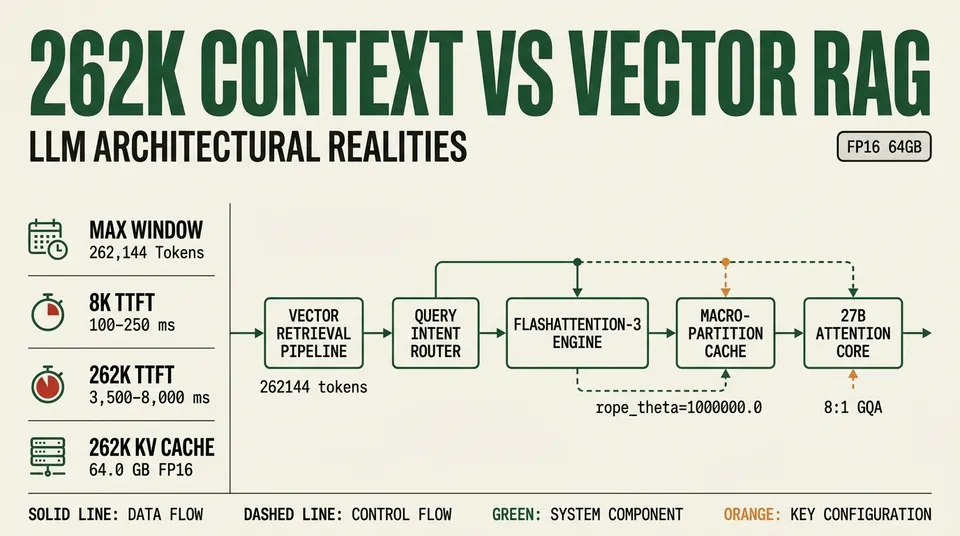
Compare Qwen 3.8 27B's 262K context window to vector RAG. Analyze KV cache VRAM limits, multi-hop reasoning decay, and hybrid enterprise AI architectures.
Enterprise artificial intelligence architecture has reached a pivotal crossroads. With open-weight models such as Qwen 3.8 27B delivering native sequence support up to 262,144 tokens—roughly 200,000 words or a 600-page document corpus—platform engineering teams are questioning the necessity of traditional retrieval-augmented generation.
The initial appeal is compelling: bypass vector database maintenance, eliminate fragile text-chunking heuristics, and ingest entire document repositories directly into active attention memory.
Yet production deployments expose a severe divergence between theoretical context windows and operational hardware physics. Brute-force context stuffing encounters hard limits in key-value cache memory allocation, time-to-first-token latency, and multi-hop reasoning fidelity. Evaluating the 262K context window of Qwen 3.8 27B against production RAG architectures reveals why unconstrained context ingestion cannot entirely displace structured retrieval.
Technical Mechanics: Attention Scaling at 262K Tokens
Processing sequences exceeding a quarter-million tokens within a 27-billion-parameter architecture requires specialized positional encodings and memory-efficient attention layouts.
Standard Rotary Position Embeddings (RoPE) suffer from catastrophic perplexity spikes when extrapolated beyond their pre-training window. Modern 27B architectures address this by elevating the base rotary frequency $\theta$ from $10^4$ to $10^6$ (rope_theta = 1000000.0), suppressing high-frequency decay across extended distances. This is paired with YaRN (Yet another RoPE extensioN), which applies non-uniform dimension interpolation and temperature scaling to prevent attention distribution flattening.
Memory scalability at this depth relies on Grouped-Query Attention (GQA). In standard configurations with 64 layers, 40 Query heads, and 8 Key-Value heads (an 8:1 ratio with head dimension $D_{head}=128$), GQA reduces active KV cache footprint by 80% compared to legacy Multi-Head Attention. That's why context length ends up costing more VRAM than the model weights themselves, a dynamic explained in detail in why context length costs more VRAM than your model weights.
# KV cache allocation formula for 27B GQA architecture
def compute_kv_cache_bytes_per_token(layers=64, kv_heads=8, head_dim=128, precision_bytes=2):
 # Key and Value tensors require 2x multiplier
 return 2 * layers * kv_heads * head_dim * precision_bytes

# FP16 precision: 256 KB per token | FP8 precision: 128 KB per token
bytes_per_token_fp16 = compute_kv_cache_bytes_per_token(precision_bytes=2)
Benchmark Realities: Synthetic Recall vs. Multi-Hop Reasoning
While single-needle retrieval benchmarks suggest flawless long-context performance, real-world multi-document reasoning tells a different story.
In synthetic Needle-in-a-Haystack (NIAH) tests, the model achieves over 99.5% recall across the full 262K sequence. However, single NIAH evaluations merely test whether attention weights can detect an isolated, out-of-distribution keyword string inserted into uniform text.
When evaluated against multi-hop benchmarks such as RULER and BABILong—which require tracking multiple interconnected variables across disparate sections—effective reasoning length degrades significantly beyond 32K to 64K tokens. As irrelevant filler text surpasses 80% of the active context, attention weights disperse, resulting in a 15% to 35% drop in extraction accuracy compared to a focused 8K retrieval prompt. Sizing and concurrency benchmarks for production-grade serving engines are covered in high-concurrency inference for Qwen 27B.
Infrastructure Footprint: Memory, Latency, and Concurrency
The computational cost of processing 262,144 tokens escalates sharply when mapped to enterprise GPU infrastructure.
$$\text{KV Cache Size} = 2 \times L \times N_{kv} \times D_{head} \times S \times \text{BytesPerElement}$$
| Metric / Configuration | Traditional RAG (8K Context) | Extended Window (64K Context) | Native Ultra-Long (262K Context) |
|---|---|---|---|
| Model Weights (FP8) | ~27 GB | ~27 GB | ~27 GB |
| KV Cache Footprint (FP16) | 2.0 GB | 16.0 GB | 64.0 GB |
| KV Cache Footprint (FP8) | 1.0 GB | 8.0 GB | 32.0 GB |
| Total VRAM (BF16 Weights + FP16 KV) | 56.0 GB (1x 80GB GPU) | 70.0 GB (1x 80GB GPU) | 118.0 GB (2x 80GB GPUs) |
| Total VRAM (FP8 Weights + FP8 KV) | 28.0 GB (1x 80GB GPU) | 35.0 GB (1x 80GB GPU) | 59.0 GB (1x 80GB GPU) |
| H100 Stream Capacity (FP8) | ~50 concurrent streams | ~6 concurrent streams | 1 stream (Batch Size = 1) |
| Time-to-First-Token (TTFT) | 100–250 ms | 800–1,500 ms | 3,500–8,000 ms |
On an NVIDIA H100 SXM5 GPU using FlashAttention-3, an 8K prompt processes in 100 to 250 milliseconds. Ingesting 262K raw tokens inflates prefill latency to between 3.5 and 8 seconds before generation begins. Furthermore, a single FP16 request at 262K consumes 64 GB of VRAM solely for its KV cache, reducing single-GPU concurrency to a single user stream unless aggressive prompt caching or FP8/INT4 quantization is applied.
Hybrid Architectures: Selective Long-Context RAG
Enterprise deployments increasingly avoid the binary choice between narrow 8K retrieval and 262K brute-force ingestion, converging instead on hybrid patterns. That convergence is part of a broader shift toward production RAG architecture that actually works at scale.
Pattern 1: Macro-Partitioning (Large-Chunk RAG)
Instead of dividing documents into narrow 300-word snippets that sever narrative structure, ingestion pipelines index macro-partitions—entire chapters, architectural specs, or legal filings (3,000 to 8,000 tokens each). The retrieval engine extracts the top 8 to 12 complete sections (~30K to 60K tokens), feeding rich, contiguous context into the model while operating within its peak reasoning band. Whether that extracted set gets a second scoring pass before reaching the model is what reranking in a RAG pipeline is for.
Pattern 2: Dynamic Query Routing
A lightweight classifier inspects query intent to optimize compute expenditure:
- Specific Factoid Queries: Routed to standard 8K dense retrieval, preserving sub-second latency and minimal token consumption.
- Thematic & Comparative Queries: Routed to the 262K context window for multi-document synthesis.
Security and Governance in Ultra-Long Windows
Massive context windows expand the enterprise threat surface beyond traditional perimeter filters:
- Many-Shot Jailbreaking: Adversaries distribute hundreds of synthetic dialogue examples across 100K+ tokens to systematically dilute system safety prompts. Mitigation requires periodic system prompt re-anchoring and context masking.
- Deep Haystack Injections: Malicious instructions hidden at token depths exceeding 100,000 inside tabular metadata evade basic regex filters, necessitating lightweight asynchronous sanitization models prior to prompt assembly.
- Cross-Tenant Data Bleed: Loading multi-document collections into a single prompt risks exposing privileged information. Strict document-level Role-Based Access Control (RBAC) must execute before context construction.
- Guardrail Compute Exhaustion: Running secondary safety classifiers over 262K input tokens creates extreme GPU overhead. Production systems deploy chunk-parallelized safety screening to prevent resource starvation.
Architectural Decision Framework
Selecting between pure vector retrieval, raw 262K context ingestion, and hybrid pipelines depends on corpus scale, latency budgets, and reasoning complexity.
| Dimension | Pure Vector RAG (8K Context) | Hierarchical Hybrid (30K–64K Context) | Brute-Force Long Context (262K) |
|---|---|---|---|
| Searchable Corpus | Unbounded (Billions of tokens) | Unbounded (Filtered to ~50K) | $\le 262\text{K tokens}$ (~600 pages) |
| Infrastructure Setup | Vector DB, Chunking ETL, Embeddings | Vector/Graph Index + LC Serving | Direct storage ingestion |
| Inference Cost Factor | Baseline (0.01x) | Moderate (0.25x–0.40x) | High (1.00x) |
| Multi-Hop Reasoning | Low (Risk of missing context) | High (Full structural visibility) | Moderate (Attention dispersion) |
| Concurrent Users / H100 | 40–60 streams | 8–12 streams | 1–2 streams |
| Auditability & Citations | Deterministic passage IDs | Section/Chapter attribution | Probabilistic in-prompt extraction |
Native 262K open-weight models do not eliminate retrieval architecture; they redefine it. Qwen 3.8 27B's companion release, setting new multimodal benchmarks for enterprise vision workflows, shows where that redefinition is heading next. By transitioning enterprise systems from fragile micro-chunk retrieval to macro-partition hierarchical synthesis, engineering teams preserve multi-hop reasoning accuracy while avoiding the crippling compute and latency penalties of brute-force context stuffing.