Alibaba launches Qwen3.8-27B, an open-weight hybrid model combining linear attention with GQA to deliver frontier coding, OS control, and agent performance.
Alibaba Cloud has officially released Qwen3.8-27B, a dense 27-billion-parameter foundation model engineered for autonomous coding, visual operating system control, and multimodal reasoning on enterprise hardware. By abandoning uniform quadratic self-attention in favor of a 64-layer hybrid architecture that pairs linear-attention Gated DeltaNet with Gated Grouped-Query Attention, the model achieves a native 262,144-token context window—architecturally expandable to 1,000,000 tokens—while significantly reducing Key-Value memory overhead.
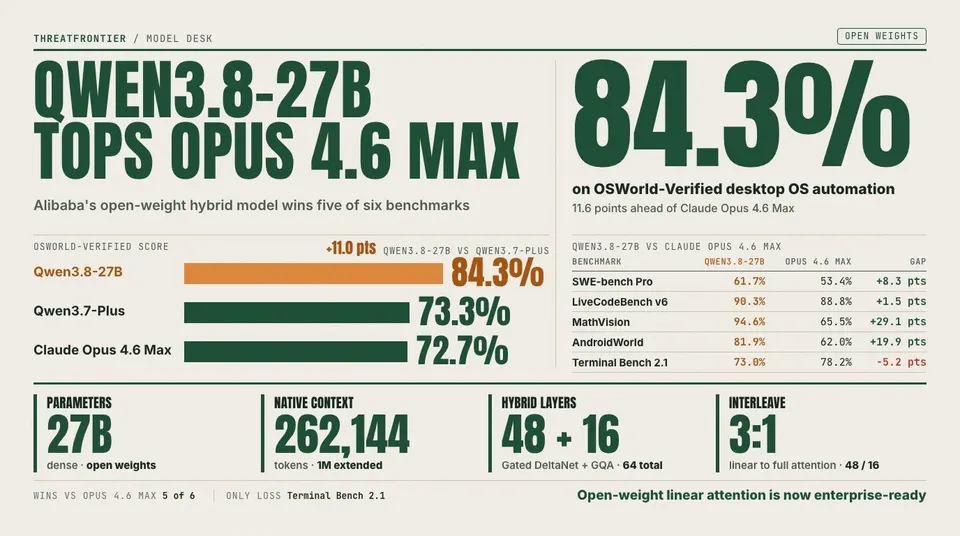
In standardized benchmark evaluations, Qwen3.8-27B sets new records for open-weight systems, registering 61.7% on SWE-bench Pro, 84.3% on OSWorld-Verified, 90.3% on LiveCodeBench v6, and 94.6% on MathVision. Its document and vision results are broken down in Qwen 3.8 27B multimodal benchmarks for enterprise vision. These marks surpass several tier-one proprietary cloud endpoints, fundamentally altering the economics of multi-turn software development and workflow automation by enabling cost-effective, self-hosted deployment on standard enterprise infrastructure.
Hybrid Linear Attention Solves the Long-Context Bottleneck
The primary limitation when executing recursive agent loops across extended context windows (256,000 to 1,000,000 tokens) is the quadratic compute scaling and explosive Key-Value (KV) cache memory footprint inherent to standard softmax attention. Qwen3.8-27B circumvents this barrier by adopting a 3:1 interleaving layout across its 64 hidden layers, combining 48 linear-attention Gated DeltaNet layers with 16 Gated Grouped-Query Attention (GQA) layers.
| Architectural Parameter | Specification | Engineering Function |
|---|---|---|
| Total Parameters | 27B Dense (28B tensor storage) | Fits within single-node enterprise and prosumer GPUs |
| Hidden Dimension ($d_{model}$) | 5,120 | High-capacity multimodal token representation |
| Layer Interleaving | 16 Blocks $\times$ (3 DeltaNet + 1 GQA) | Linear memory scaling paired with periodic associative recall |
| Native / Extended Context | 262,144 / 1,000,000 tokens | Full codebase indexing and multi-hour multimodal ingestion |
| Intermediate FFN Dimension | 17,408 (SwiGLU) | $\sim 3.4 \times d_{model}$ non-linear parameter expansion |
| Inference Acceleration | Multi-Token Prediction (MTP) | 1.8× to 2.5× speculative decoding speedup without a draft model |
The Gated DeltaNet sub-layers rely on a recurrent linear state matrix governed by input and forget gates, executing token generation updates in constant $O(1)$ memory complexity. To prevent the associative retrieval decay characteristic of pure recurrent networks, every fourth layer introduces a full GQA layer (24 query heads, 4 key-value heads). The model also integrates native Multi-Token Prediction (MTP) heads, which forecast multiple consecutive tokens simultaneously during pretraining. This mechanism enforces forward-looking semantic planning and accelerates production inference by 1.8× to 2.5× via native speculative decoding.
Benchmark Performance: Outperforming Closed Frontier Endpoints
Evaluated across standardized harnesses at a 256,000-token context ceiling, Qwen3.8-27B demonstrates competitive performance across software engineering, desktop operating system control, and multimodal reasoning. Chinese labs are converging on similar hybrid attention designs, as seen in GLM 5.3 Flash vs DeepSeek V4 Flash.
| Benchmark Evaluation | Domain / Task Modality | Qwen3.8-27B | Qwen3.7-Plus | Claude Opus 4.6 Max | Delta vs. Opus |
|---|---|---|---|---|---|
| OSWorld-Verified | Desktop OS Automation | 84.3% | 73.3% | 72.7% | +11.6% |
| SWE-bench Pro | Autonomous Repo Debugging | 61.7% | 57.6% | 53.4% | +8.3% |
| LiveCodeBench v6 | Competitive Code Generation | 90.3% | 89.6% | 88.8% | +1.5% |
| MathVision | Visual STEM Reasoning (w/ CI) | 94.6% | 90.3% | 65.5% | +29.1% |
| AndroidWorld | Mobile Device Automation | 81.9% | 81.0% | 62.0% | +19.9% |
| Terminal Bench 2.1 | Raw CLI & Terminal Control | 73.0% | 64.0% | 78.2% | -5.2% |
On OSWorld-Verified, which benchmarks autonomous mouse and keyboard actions across open-ended operating systems, Qwen3.8-27B achieved 84.3%, surpassing Claude Opus 4.6 Max by 11.6 percentage points. That gap has shaped Anthropic's own roadmap, where the rumored Opus 5 is aimed at matching, not beating, Fable 5. In autonomous repository engineering, its 61.7% resolution rate on SWE-bench Pro illustrates an ability to navigate complex directory trees, locate regressions, and generate functional patches in isolated test environments.
Fine-Grained Thinking Controls for Recursive Agent Loops
Qwen3.8-27B features a dual-mode reasoning architecture that allows engineering teams to dynamically balance execution latency, token expenditure, and reasoning depth through three core runtime controls: Alibaba's separate Flash-Next line pushes that active-parameter efficiency even further, as benchmarked in Qwen 3.8 Flash Next vs DeepSeek V4 Flash.
enable_thinking: Toggles structured internal chain-of-thought within `` tags. When disabled, the model switches to low-latency instruction-following mode, suitable for fast text extraction and classification.reasoning_effort: Acceptsxhigh,medium, orlowpresets to regulate reasoning search depth. Setting the engine toxhighunlocks deep multi-step exploration and self-correction cycles essential for complex code refactoring, whereasmediumbalances speed and precision for conversational tasks.preserve_thinking: Determines whether historical chain-of-thought traces are retained in context across multi-turn sessions. Maintaining previous reasoning paths ensures logical continuity during protracted agent executions while preventing KV cache recomputation overhead.
Enterprise Deployment and Hardware Economics
The compact 27-billion-parameter profile enables diverse deployment options spanning local edge workstations to distributed datacenter clusters. A third-party build, Prism ML Ternary Bonsai 2 27B, squeezes it to 5.9GB at 1.76 bits per weight.
| Precision / Quantization | Memory Footprint | Recommended VRAM (Context 256k–1M) | Target Hardware Architecture |
|---|---|---|---|
| BF16 / FP16 | $\sim 54\text{ GB}$ | $80\text{ GB} - 160\text{ GB}$ | $1 \times \text{NVIDIA A100/H100 (80GB)}$ or $2 \times \text{A100}$ |
| FP8 (vLLM / SGLang) | $\sim 27\text{ GB}$ | $48\text{ GB} - 80\text{ GB}$ | $1 \times \text{NVIDIA RTX 6000 Ada}$ or $1 \times \text{A100 (80GB)}$ |
| INT4 / AWQ / GPTQ | $\sim 15\text{ GB}$ | $24\text{ GB} - 48\text{ GB}$ | $1 \times \text{NVIDIA RTX 4090 / RTX 5090 (24GB)}$ |
| GGUF (Q4_K_M) | $\sim 16.5\text{ GB}$ | $32\text{ GB} - 64\text{ GB}$ Unified RAM | Apple Silicon ($\ge 36\text{GB}$) or Workstation CPUs |
Serving frameworks including vLLM and SGLang natively support Qwen3.8-27B with tensor parallelism and chunked prefill. Sizing that deployment for real production traffic is the subject of high-concurrency inference for Qwen 27B. Through Multimodal YaRN (mRoPE) configuration overrides, enterprise deployments can extend sequence lengths up to the 1-million-token boundary. High-concurrency agent workflows running under SGLang benefit from RadixAttention prefix caching, ensuring rapid turnaround across repetitive, multi-turn tool invocations.
Strategic Shift Toward On-Premises Agentic Sovereignty
The launch of Qwen3.8-27B reshapes enterprise AI strategy. For organizations operating under stringent regulatory frameworks—such as defense, healthcare, and financial services—the ability to deploy frontier-grade software agents within air-gapped Virtual Private Clouds eliminates third-party data leakage risks.
Economically, self-hosting high-volume agent workflows eliminates volatile, per-token API charges that range from $15 to $75 per million tokens on proprietary cloud platforms. By delivering near-flat memory scaling via Gated DeltaNet, leading multimodal benchmark scores, and flexible open weights, Qwen3.8-27B establishes open-source linear attention as an enterprise-ready alternative to proprietary cloud models. Alibaba has already confirmed the next generation is in training, targeting far larger scale — see Qwen 4's 10-trillion-parameter Apsara roadmap.