Explore how Alibaba's Qwen3.8-Flash-Next and Z.ai's GLM-5.3-Flash cement the 3:1 linear-recurrent hybrid architecture era for ultra-long context AI inference.
Within a 24-hour window in late August 2026, two leading open-weight AI research teams—Z.ai and Alibaba’s Qwen division—independently released next-generation flagship models: GLM-5.3-Flash and Qwen3.8-Flash-Next.
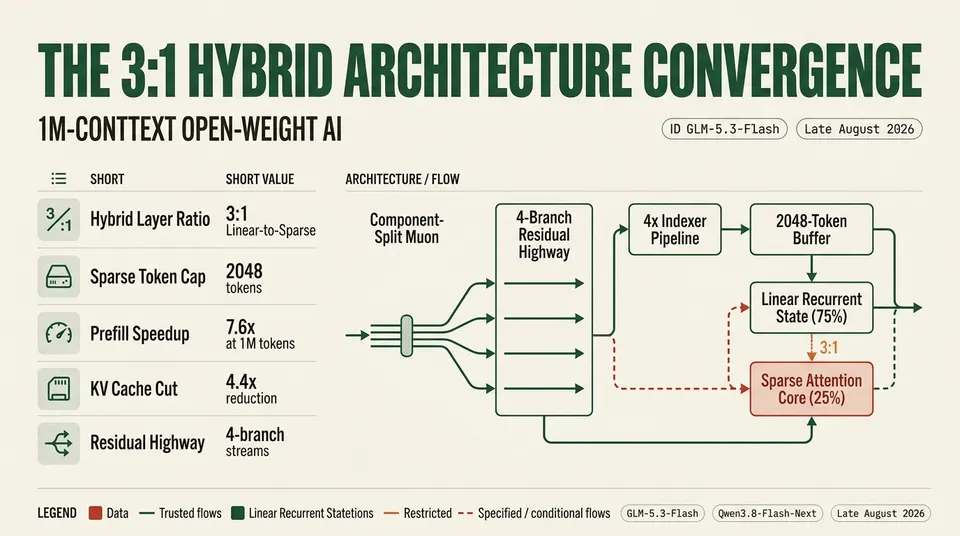
Operating on separate tracks, both labs converged on a nearly identical design to dismantle the memory-bandwidth wall and quadratic computational bottlenecks of million-token contexts. Rather than scaling monolithic transformers, both architectures implement a 3:1 linear-recurrent hybrid stack, fixed-budget sparse context indexing capped at 2048 tokens, four-branch widened residual streams, and component-split Muon optimization. This simultaneous pivot signals an industry-wide transition away from standard dense attention in ultra-long-context modeling.
Architectural Comparison Matrix
While sharing high-level structural principles, each model targets a distinct operating envelope. GLM-5.3-Flash serves as an 18-billion active parameter multimodal engine, whereas Qwen3.8-Flash-Next operates as a 6-billion active parameter testbed for the upcoming Qwen4 series.
| Architectural Dimension | Z.ai GLM-5.3-Flash | Alibaba Qwen3.8-Flash-Next |
|---|---|---|
| Total Parameters | 320 Billion | 125 Billion (+ 51B auxiliary n-gram table) |
| Active Parameters / Token | 18 Billion | 6 Billion |
| Layer Stack Layout | 45 layers (34 Linear : 11 Sparse MLA) | 48 layers (36 Gated DeltaNet : 12 QSA) |
| Hybrid Layer Ratio | ~3:1 (34:11) | Exactly 3:1 (36:12, repeating [3×GDN + 1×QSA]) |
| Linear Attention Core | Kimi Delta Attention (per-channel decay) | Gated DeltaNet (per-head decay) |
| Sparse Attention Core | Multi-Head Latent Attention (MLA) | Grouped-Query Attention (GQA inside QSA) |
| Context Indexing Engine | IndexPool: 4x pooled key vectors $\rightarrow$ Top-2048 tokens | Micro-Block QSA: Top-512 4-token blocks $\rightarrow$ 2048 tokens |
| Native Context Length | 1,000,000 tokens | 262,144 tokens (extensible to 1M via YaRN) |
| Residual Backbone | 4-branch Manifold-Constrained Hyper-Connections | 4-branch Gated Residual (read/write scalar gates) |
| Positional Embeddings | NoPE (qk_rope_head_dim = 0) | RoPE Retained (NoPE dropped after RLHF failure) |
| Optimizer Strategy | Component-Split Muon | Component-Split Muon + AdamW; no warmup |
| Inference Acceleration | 3x attention FLOP cut, 4.4x KV cache reduction | 7.6x prefill speedup, 4.9x decode speedup at 1M |
| Serving Economics | $0.15 input / $0.50 output per 1M tokens | Open weights (Apache 2.0 / native vLLM & SGLang) |
The 3:1 Blueprint: Recurrent Delta Rules and 2048-Token Indexing
Standard transformers force key-value (KV) cache memory to scale linearly $O(N)$ with sequence length, quickly exhausting GPU High Bandwidth Memory during million-token inference.
To eliminate this overhead across 75 percent of the network, both models delegate the majority of layer depth to recurrent linear attention. Instead of caching historical KV pairs, these layers compress sequence history into fixed-dimension hidden states via recurrent delta update rules:
$$S_t = S_{t-1} + \beta_t (v_t - S_{t-1} k_t) \otimes k_t^T$$
The engineering divergence lies in gating granularity. Z.ai’s Kimi Delta Attention (KDA) implements per-channel decay gating, allowing vector-dimension forgetting rates within an attention head. Alibaba’s Gated DeltaNet (GDN) uses per-head decay gating, reducing memory bandwidth traffic with minimal loss in state tracking. Both teams identified the 3:1 ratio as the Pareto frontier: 1:1 configurations consumed excessive memory, while 7:1 ratios degraded multi-document synthesis.
For the remaining 25 percent of layers executing full softmax attention, both models enforce a hard cap of 2048 active tokens, decoupling compute from sequence length:
- GLM’s IndexPool: Compresses four consecutive indexer key vectors into one via learned pooling before running dot-product scoring, fetching the top 2048 tokens.
- Qwen’s Micro-Block QSA: Aggregates tokens into 4-token micro-blocks, scoring and routing the top 512 blocks (2048 tokens total) into grouped-query attention.
On NVIDIA Blackwell GB300 NVL72 hardware, this sparse indexer design delivers up to 7.6x faster prefill and 4.9x lower decode latency at 1M tokens compared to dense baselines.
Widened Residual Streams, FP8 Stability, and Muon Optimization
Scaling models to extreme context windows exposes vulnerabilities in classic single-stream residual backbones ($x_{l+1} = x_l + F_l(x_l)$), which suffer from activation spikes and representation bottlenecks.
Both architectures replace the single highway with four parallel streams:
- GLM-5.3-Flash applies Manifold-Constrained Hyper-Connections (mHC), constraining inter-branch projections to maintain stable geometric manifolds.
- Qwen3.8-Flash-Next implements a Gated Residual stream using element-wise read gates and scalar write gates, removing inter-branch matrix multiplications entirely. This dampening of activation outliers enables native FP8 residual storage without numerical overflow.
During training, both groups utilized the Muon optimizer (Momentum Orthogonalized by Newton-Schulz iterations) for 2D weight updates. Because standard architectures fuse projection weights (such as packed QKV tensors or SwiGLU projections), running Muon directly over fused matrices forces orthogonalization across distinct linear transformations. Both teams de-fused all compound projection weights into discrete 2D tensors prior to orthogonalization, applying AdamW exclusively to 1D vectors, embedding tables, and router gating heads. Sizing a box for either model's weights comes down to quantization format, covered in NVFP4 vs FP8 vs MXFP4: the quantization guide. Qwen also eliminated initial batch-size warmup schedules, saving 18.8 percent of optimizer training steps.
Contrasting Design Choices: Positional Embeddings and MiniMax's Dissent
The primary architectural split between the two models concerns positional encoding within sparse attention layers.
Z.ai eliminated Rotary Positional Embeddings in GLM-5.3-Flash (qk_rope_head_dim = 0), relying on NoPE (No Positional Embeddings). Because recurrent linear layers process tokens sequentially, temporal order is preserved in the recurrent state and propagated forward, allowing pure content-based retrieval. In contrast, Alibaba retained RoPE in Qwen3.8-Flash-Next. While NoPE matched pre-training loss parity in Qwen's ablations, it caused severe stop-generation collapse during post-training reinforcement learning (RLHF/DPO), with agents looping indefinitely instead of emitting end-of-sequence tokens. Its numbers against a DeepSeek rival are in Qwen 3.8 Flash Next vs DeepSeek V4 Flash.
 3:1 Hybrid Architecture Camp Pure Softmax Dissent
 (Z.ai GLM-5.3 / Alibaba Qwen3.8) (MiniMax M2 / M3)
 ┌────────────────────────────────────┐ ┌───────────────────────────────────┐
 │ 75% Recurrent Linear Layers │ │ 100% Pure Softmax Attention │
 │ 25% Indexed Sparse Attention │ vs │ Dynamic Sparse Attention (MSA) │
 │ Bounded 2048-Token Budget │ │ Avoids lossy linear state history │
 └────────────────────────────────────┘ └───────────────────────────────────┘
Standing against the entire hybrid paradigm is MiniMax, which published empirical findings demonstrating that linear attention mechanisms introduce fundamental limits in long-horizon reasoning. We benchmark GLM-5.3-Flash separately against a DeepSeek rival in GLM 5.3 Flash vs DeepSeek V4 Flash. MiniMax’s research shows that while linear recurrent layers excel at perplexity benchmarks and needle-in-a-haystack lookups, they exhibit measurable degradation in multi-hop cross-document reasoning and state tracking beyond 32K context. Consequently, MiniMax developed MiniMax Sparse Attention (MSA), preserving 100 percent softmax attention across all layers by skipping unselected token blocks rather than compressing history into recurrent states.
Enterprise Deployment Framework
The contrasting trade-offs of these releases provide clear deployment boundaries for systems architects:
- Select Qwen3.8-Flash-Next (6B active): Ideal for high-concurrency agent loops, IDE auto-completion, and local multi-tenant deployments where token latency and raw throughput dictate infrastructure costs. Ant Group's Ling 3.0 Flash targets sub-100ms latency for similar workloads.
- Select GLM-5.3-Flash (18B active): Tailored for repository-level codebase synthesis, multimodal document extraction, and complex enterprise tool-use across native million-token prompts.
- Retain Pure Softmax (MiniMax MSA / Dense): Recommended for formal verification, multi-step symbolic logic, and multi-hop legal analysis where recurrent state compression poses hallucination risks.
The simultaneous convergence of Z.ai and Alibaba on the 3:1 hybrid standard demonstrates that the trade-off between infinite context and computational efficiency has reached architectural maturity, fundamentally resetting open-weight inference economics. Running either model locally on a Mac comes down to runtime choice: see MLX vs llama.cpp on Apple Silicon.