DeepSeek launches DeepSeek-V4.1-Flash, cutting inference costs with asymmetric routing, a 1M context window, and pricing starting at $0.15 per million tokens.
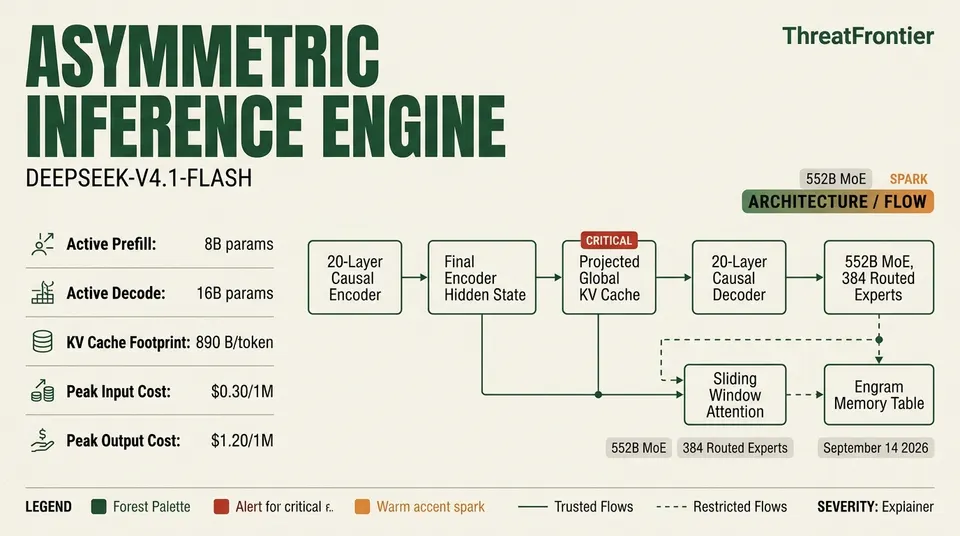
DeepSeek has officially launched DeepSeek-V4.1-Flash, a 552-billion-parameter multimodal Mixture-of-Experts (MoE) model that fundamentally resets enterprise inference economics. Built on an asymmetrical Causal-Encoder-Decoder (CED) architecture, the model activates just 8 billion parameters during input prefill and 16 billion parameters during autoregressive token generation. By coupling this decoupled routing mechanism with hardware-level Key-Value (KV) cache compression, DeepSeek delivers peak API pricing of $0.30 per million input tokens and $1.20 per million output tokens—dropping to $0.15 and $0.60 during off-peak windows—alongside cache-hit read rates as low as $0.003 per million tokens.
The release marks a rare inflection point in frontier model strategy. DeepSeek-V4.1-Flash matches or surpasses its predecessor flagship, the 1.6-trillion-parameter DeepSeek-V4-Pro, across primary software engineering, terminal execution, and competitive programming benchmarks. In response, DeepSeek has initiated the immediate deprecation of V4-Pro, redirecting legacy enterprise API calls directly to V4.1-Flash. For enterprise technical leaders, the architecture delivers unprecedented efficiency for long-context agentic workflows while presenting steep physical barriers to on-premises self-hosting.
The Asymmetrical Causal-Encoder-Decoder
Standard autoregressive Transformer decoders evaluate context with uniform computational depth across every layer, causing prefill overhead for an input sequence of length $N$ across $L$ layers to scale strictly as $\mathcal{O}(N \cdot L)$. DeepSeek-V4.1-Flash circumvents this bottleneck by splitting its 40 causal Transformer layers into an asymmetric Causal-Encoder-Decoder topology.
The first 20 layers operate as a dedicated causal encoder. During input ingestion, this encoder routes tokens through 1 shared expert and 6 activated experts out of 384 routed experts per MoE layer, executing with only 8 billion active parameters per token. The remaining 20 layers serve as the causal decoder, which expands routing capacity to activate 16 billion parameters per token during output generation.
Rather than requiring the decoder to build its global KV cache layer by layer from decoder hidden states, V4.1-Flash employs a global projection mechanism inspired by YOCO (You Only Cache Once) architectures. The global KV cache is projected directly from the final encoder layer hidden states ($H_{L/2}$). The decoder then relies on this projected global cache alongside localized Sliding-Window Attention (SWA). This design reduces prefill complexity to $\mathcal{O}(N \cdot L/2 + n_{\text{win}} \cdot L/2)$, cutting compute and memory bandwidth requirements in half during document ingestion and recursive agent execution.
Auxiliary architecture modules further optimize throughput: a 196-billion-parameter Engram Conditional Memory table enables constant-time, token-hash-indexed factual retrieval without inflating active parameters; Single-Pass Multi-Head Control (Mega-mHC) condenses residual stream mixing to $(2n + 2)d$ memory cycles; and DSpark speculative decoding accelerates output emission to approximately 200 tokens per second.
Cracking the Memory Wall: CSA2 and Bounded Replay
The primary constraint on concurrent long-context inference is the High Bandwidth Memory (HBM) consumed by the KV cache. The general arithmetic behind that constraint is covered in KV Cache Explained. DeepSeek-V4.1-Flash introduces Compressed Sparse Attention 2 (CSA2), combining Quantization-Aware Training in Open Compute Project (OCP) MXFP4 format (E2M1 representation with one E4M3 scale factor per 16 channels) with a tri-modal layer execution schedule:
- Full Mode: Computes fresh key-value projections and determines a restricted blockwise candidate pool.
- Reindex Mode: Reuses key-value tensors from prior layers while computing an independent indexer query vector ($Q_{\text{idx}}$) to score tokens within the candidate pool.
- Reuse Mode: Inherits projection tensors and sparse attention indices directly from preceding layers, eliminating indexing overhead.
To optimize persistent multi-turn storage, DeepSeek deployed SWA Bounded Replay. Standard engines serialize all attention states to NVMe drives to support prompt caching. Because sliding-window states have a receptive field strictly bounded by $n_{\text{win}}$, V4.1-Flash discards local SWA caches when offloading to host storage. Upon cache resumption, the engine recalculates only the trailing $n_{\text{win}}$ tokens on the fly.
These innovations compress the active runtime HBM footprint to 890 bytes per token—a 4-fold reduction compared to DeepSeek-V4-Flash (3,560 bytes/token) and a 437-fold cumulative reduction versus DeepSeek-V1 (~390,000 bytes/token)—while cutting persistent SSD cache volume by a factor of 8.
Inference Economics: Pricing and Margin Erosion
By dismantling the computational and memory overhead of long-context generation, DeepSeek has established a disruptive API pricing schedule. Peak hours run Monday through Friday (01:00–04:00 and 06:00–10:00 UTC), with all other windows receiving an automatic 50% discount.
Cross-Model Pricing Comparison (per 1 Million Tokens)
| Model Tier | Cache Hit Input (Peak / Off-Peak) | Cache Miss Input (Peak / Off-Peak) | Output Tokens (Peak / Off-Peak) | Context Window | Maximum Output | Public Concurrency |
|---|---|---|---|---|---|---|
| DeepSeek-V4.1-Flash | $0.006 / $0.003 | $0.30 / $0.15 | $1.20 / $0.60 | 1,000,000 | 384,000 | 2,500 |
| DeepSeek-V4-Pro (Retiring) | $0.044 / $0.022 | $1.32 / $0.66 | $3.96 / $1.98 | 1,000,000 | 384,000 | 500 |
| Anthropic Claude 3.7 Sonnet | $0.30 (cached) | $3.00 | $15.00 | 200,000 | 64,000 | Tiered |
| OpenAI GPT-4o Frontier | $1.25 (cached) | $2.50 – $5.00 | $10.00 – $15.00 | 128,000 | 16,384 | Tiered |
For enterprise agent systems executing iterative tool loops over large codebases, these unit rates dramatically alter viability. Anthropic answered similar pricing pressure by launching Claude Opus 5 and freezing Sonnet pricing. Running 1,000 sequential execution loops against a 200,000-token cached context costs roughly $0.60 under off-peak rates, compared to $30.00 to $75.00 across Western commercial APIs.
Benchmark Performance and Flagship Cannibalization
DeepSeek-V4-Pro relied on 1.6 trillion total parameters and 49 billion active parameters per token, incurring heavy infrastructure costs and capping public concurrency at 500 sessions. We covered V4-Pro's own launch and its peak-hour API surcharges in DeepSeek Upends AI Economics with V4 Pro. V4.1-Flash outperforms its predecessor across core benchmarks while supporting 2,500 concurrent connections.
Key Benchmark Comparison
| Benchmark | Frontier Flagship A | Frontier Flagship B | DeepSeek-V4-Pro (1.6T) | DeepSeek-V4.1-Flash (552B) |
|---|---|---|---|---|
| DeepSWE v1.1 (Resolved) | 74.0% | 73.0% | 62.7% | 74.2% |
| Terminal-Bench 2.1 (Pass@1) | 89.1% | 88.8% | 87.9% | 90.6% |
| Codeforces (Elo Rating) | — | — | 3,348 | 3,471 |
| GPQA Diamond (Pass@1) | 93.4% | 94.1% | 92.4% | 90.9% |
V4.1-Flash also posts competitive marks across secondary evaluations, including 54.8% on AutomationBench, 31.8% on Agent's Last Exam, 63.9% on Humanity's Last Exam (HLE) with tools, and 88.1% on CyberGym. Because the 552B model yields an 11.5% absolute improvement on DeepSWE while cutting serving expenses by up to 86%, DeepSeek has designated V4-Pro legacy infrastructure, transparently rerouting calls to the deepseek-flash engine starting September 14, 2026.
Agentic Capabilities: Native Vision and the 384K Output Boundary
V4.1-Flash integrates native visual comprehension through DeepSeek-ViT, trained jointly across 45 trillion multimodal tokens. The architecture uses 2D Rotary Position Embeddings (2D-RoPE) and a $3 \times 3$ pixel-unshuffle downsampling layer into a 2-layer MLP, interleaving image tokens directly into the sequence without secondary routing adapters. The visual pipeline achieves 95.6% on DocVQA, 77.9% on CVBench, and 56.5% on MMMU-Pro.
Complementing its multimodal input is an unprecedented 384,000-token maximum output boundary, far exceeding conventional 8,192-to-64,000 token ceilings. This expanded envelope prevents context fragmentation during complex autonomous engineering tasks. Agents can generate entire multi-file architectures, complete test suites, or extensive execution trace dumps in a single uninterrupted stream, eliminating brittle micro-chunked generation routines.
The On-Premises Paradox: The 2,000-GPU Barrier
While DeepSeek provides open weights under an MIT license, self-hosting presents formidable physical challenges. Although the model activates only 8B or 16B parameters per token, all 552 billion backbone parameters and the 196-billion-parameter Engram table—totaling 763 billion parameters in safetensors distribution—must remain resident in GPU memory.
Because token routing dynamically dispatches to any of the 384 experts, nodes require heavy Expert Parallelism (EP) and Pipeline Parallelism (PP). Inter-node all-to-all communication induces prohibitive latency without dedicated high-bandwidth interconnects like NVIDIA Quantum-2 InfiniBand. While a quantized FP4/FP8 checkpoint can boot across 16 to 32 enterprise GPUs (such as NVIDIA H100 or H200 accelerators) for experimental lab testing, production-grade serving with 1M-token contexts and high concurrency requires between 500 and 2,000 GPUs paired with high-performance distributed NVMe storage. For a smaller-scale self-hosted deployment path, see running DeepSeek V4.1 Flash on three DGX Sparks.
Operational Considerations and Enterprise Governance
Production migration is supported by deepseek-recipe, an open-source Rust framework with Python bindings that adapts OpenAI and Anthropic payloads to native streams. Reasoning latency is controlled via a numerical reasoning_effort scalar (1 to 100). Low settings (1–25) suppress thinking tokens to maximize throughput (~200 tokens/sec) for deterministic tasks, while maximum effort (100) expands reasoning tokens up to 2.5 times baseline for intricate logic problems.
Enterprise architects must manage three operational risks:
- Prefix Alignment: Realizing the $0.003/1M cache rate demands strict byte-level prefix determinism. Dynamic timestamps or mutable schemas break cache hits, triggering an immediate 50-fold cost jump to standard input rates ($0.15–$0.30/1M).
- Token Inflation: Operating at high
reasoning_effortwithout client-sidemax_tokensboundaries can trigger runaway chain-of-thought generation, offsetting unit-cost savings. - Data Residency: The managed API operates from Chinese data centers. Regulated workloads governed by GDPR, HIPAA, SOC 2, or ITAR require private cloud partitions or Western cloud aggregator hosting.
DeepSeek-V4.1-Flash demonstrates that frontier AI capability no longer depends on linear, brute-force scaling. Other labs are converging on similarly efficient Flash-class designs, as in Qwen3.8 Flash vs GLM 5.3 Flash. By decoupling prefill from generation and compressing cache memory, the architecture sets a new economic standard for enterprise AI infrastructure.