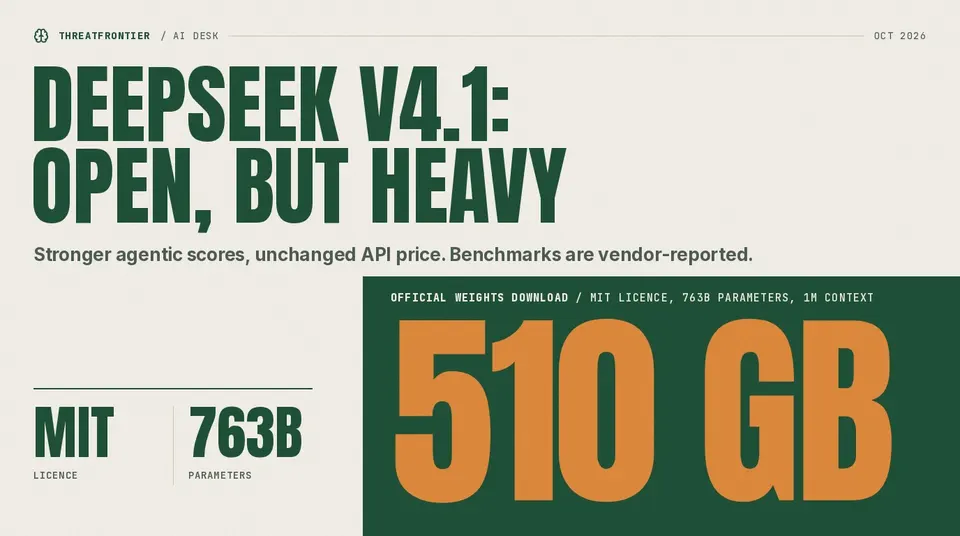
DeepSeek V4.1-Flash-1017 ships MIT weights, 1M context and unchanged API pricing. The official files are about 510 GB; all benchmarks are vendor-reported.
DeepSeek released DeepSeek-V4.1-Flash-1017 on 17 October 2026. It is a point update to V4.1 Flash with MIT-licensed open weights, a 1M-token context window and unchanged API pricing. Teams that call it through the API get the new model automatically under the alias deepseek-flash. Teams that want to run it themselves face a download of about 510 GB. Every benchmark figure below comes from DeepSeek's own model card and has not been independently reproduced.
What changed
DeepSeek's changelog says the API calling method and pricing are unchanged. The model card calls the release "a minor update" that cuts task execution time and output length. Its table puts the new model against its predecessor and against rivals, all vendor-reported:
| Benchmark | V4.1-Flash-1017 | V4.1-Flash | Opus 5 | GPT-5.6 Sol | GLM-5.3 | K3 |
|---|---|---|---|---|---|---|
| HLE, no tools | 42.6 | 36.8 | 56.3 | 44.5 | 42.0 | 43.5 |
| Terminal-Bench 4.0 | 42.3 | 31.2 | 51.8 | 39.9 | 37.9 | 12.6 |
| DeepSWE v1.1 | 77.0 | 74.2 | 74.0 | 73.0 | 66.9 | 67.5 |
| ProgramBench | 29.1 | 20.3 | 37.0 | 23.0 | 19.0 | 17.5 |
DeepSeek says it used the Claude Code harness for Terminal-Bench 4.0 and the Mini-SWE-V2 harness for DeepSWE v1.1. Harness choice moves these scores, so treat the table as a claim to test on your own repositories. Opus 5 leads on three of the four rows shown, and the 1017 model is ahead of it only on DeepSWE. The full card table is less one-sided: it also has the 1017 model ahead of Opus 5 on Automation-Bench (60.5 vs 50.3), Agents' Last Exam (35.4 vs 28.6) and Apex Bench v1.1 (72.1 vs 65.8), and gains over its predecessor on NL2Repo-Bench (68.2 from 65.4). The HLE figure of 42.6 has a text-only-subset variant of 44.0 on the card. All of it is DeepSeek's own measurement.
The model also takes images (the pricing page marks vision as supported for deepseek-flash). The card's vision rows are Chartography 83.0, BabyVision 92.5 and ZeroBench-main 51.0 (Pass@5 per the change log), again vendor-reported.
For comparison, our earlier coverage of V4 Flash 0731 described a 284B-parameter model with 13B active parameters and a DeepSWE score of 54.4 on an internal harness. Our September article on V4.1 Flash reported a 552B backbone plus a 196B Engram table, with 8B active during prefill and 16B during decode. Those figures are from our own earlier reporting and the components do not sum to the total, so rely on the 763.2B total from the safetensors metadata (Hugging Face API), which is identical to the September V4.1-Flash repository. The 1017 card does not restate active parameters.
Who can run 763B
The official repository is about 510 GB (our sum of the file listing). The config shows FP8 weights with FP4 experts, so it is already a low-precision release: the 4-bit community builds below save only about 15% (429-432 GB against 510 GB).
Our arithmetic, not a benchmark: if everything sits on GPU, 510 GB fits in four 141 GB H200s (564 GB) or an eight-GPU node with 80 GB per card (640 GB), leaving room for KV cache. One or two RTX 5090s, or a 128 GB unified-memory machine, cannot hold the official weights.
There is a second route. Our three-DGX-Spark build served the September V4.1-Flash weights, which have the same parameter count and tensor types, on three 121.7 GiB nodes by offloading roughly 189 GiB of Engram tables to NVMe. The 1017 config lists Engram layers too, so the same approach may apply, but we have not tested it on 1017.
Third-party builds appeared within hours. We did not test any of them, and none is endorsed by DeepSeek:
- LibertAIDAI NVFP4: 429 GB
- mlx-community oQ4e-mtp (MLX): 432 GB
- Baekpica VQ-GGUF: 317.6 GB repository
- LibertAIDAI EXL3 2.9bpw: 210.8 GB
- mlx-community also lists smaller MLX builds: 313.3 GB (oQ2e), 342.7 GB (oQ2.5e) and 379.9 GB (oQ3e)
By that arithmetic, the 313-432 GB MLX builds would fit a 512 GB unified-memory machine before KV cache, which is the realistic local target; nothing here fits 128 GB. We have not run any of them. An unsloth GGUF repository exists but held only a README when we checked. Quantisation costs quality, and no published evaluation of these builds against DeepSeek's table exists yet.
Provenance matters: Hugging Face search shows about 40 derivative 1017 repositories, including "abliterated" and "heretic" variants (for example mrfakename's and pqhaz's), which are safety-stripped on purpose.
Hosted prices
DeepSeek's own price for deepseek-flash is $0.15 per million cache-miss input tokens and $0.60 per million output tokens off-peak, doubling to $0.30 and $1.20 during peak hours (01:00-04:00 and 06:00-10:00 UTC, Monday to Friday, excluding Chinese public holidays). Cache hits cost $0.003 off-peak. Maximum output is 384K tokens. The legacy names deepseek-v4-flash and deepseek-v4-flash-vision-exp still work but are served by the 1017 model at the Flash price.
OpenRouter lists deepseek/deepseek-v4.1-flash-1017 at the same $0.15 and $0.60 with the same weekday surcharge windows, as of our check on 18 October. Prices there change, so recheck before committing a budget.
DeepSeek also opened a search and fetch API, each billed at $0.75 per 1,000 successful requests. Per the pricing page, server-side Search and Fetch calls made by DeepSeek Harness, Claude Code or Codex are free until per-request billing starts at 00:00 Beijing time on 1 November 2026, which is 16:00 UTC on 31 October.
What to do
- Coding plans: If your agent tool exposes
deepseek-flash(see our $10 open-model coding plans), rerun your own task suite before and after, because the alias now points at the new weights. DeepSeek recommends DeepSeek Harness 0.2.1-rc.1 or later. - Settings: Use temperature 1.0, top_p 1.0 and allow at least 256K output tokens, per the card.
- Self-hosting: Budget for about 510 GB of weights plus KV cache (a 512 GB unified-memory machine only with a community quantisation), or try the Engram-offload route. Check provenance of any community checkpoint: verify hashes and prefer safetensors over pickled formats.
- Search billing: Agents run through those harnesses will start incurring Search and Fetch charges from 16:00 UTC on 31 October.
- Chat template: The release ships no Jinja template. Use DeepSeek's reference encoder or the deepseek-recipe libraries, or tool-call parsing can break in third-party servers.