From 31 October, DeepSeek bills its Search and Fetch APIs per successful call. What that adds to an agent session, and how it compares with token prices.
DeepSeek will bill its Search and Fetch APIs at $0.75 per 1,000 calls for each endpoint, starting 31 October 2026 at 16:00 UTC (00:00 on 1 November, Beijing time). Until then, server-side Search and Fetch calls made through DeepSeek Harness, Claude Code and Codex are free for DeepSeek API users. Anyone running agents on the DeepSeek API with web tools switched on should budget for the change now. DeepSeek announced the price on 17 October alongside DeepSeek-V4.1-Flash-1017, which ThreatFrontier covered in DeepSeek V4.1-Flash-1017 ships MIT weights.
What is billed
The two endpoints are POST /v1/tools/search and POST /v1/tools/fetch on api.deepseek.com. Each costs $0.75 per 1,000 successful requests, or $0.00075 a call. DeepSeek's guide defines success narrowly: an HTTP 200 with a non-empty results array for Search, or page content for Fetch. Errors, empty searches and timeouts are not billed. The count parameter, which sets how many results come back, does not change the price.
Both endpoints are limited to 5 requests per second per account, tracked separately. Fetch also has a per-domain limit. Going over either returns HTTP 429.
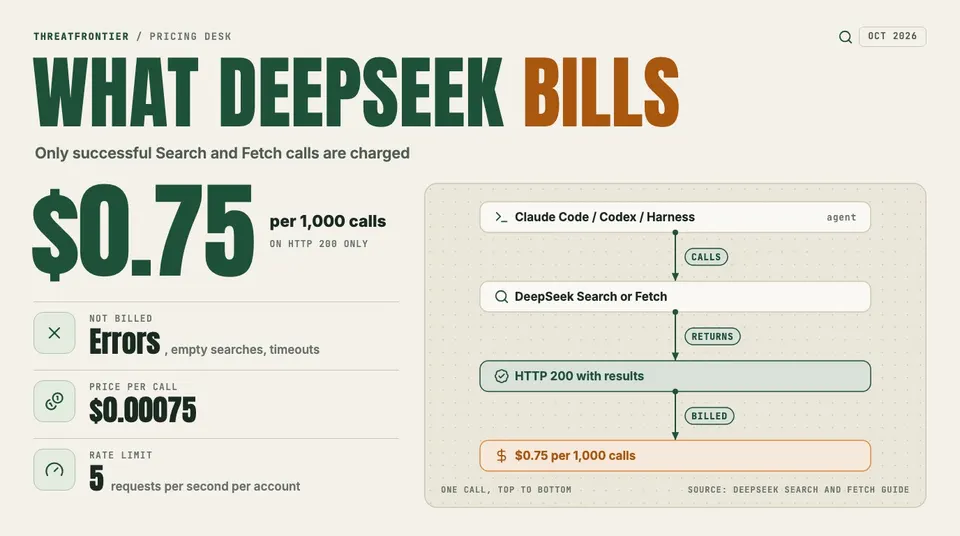
An agent's Search or Fetch call is billed at $0.75 per 1,000 only when it returns HTTP 200 with results; errors, empty searches and timeouts are free.
What a session costs
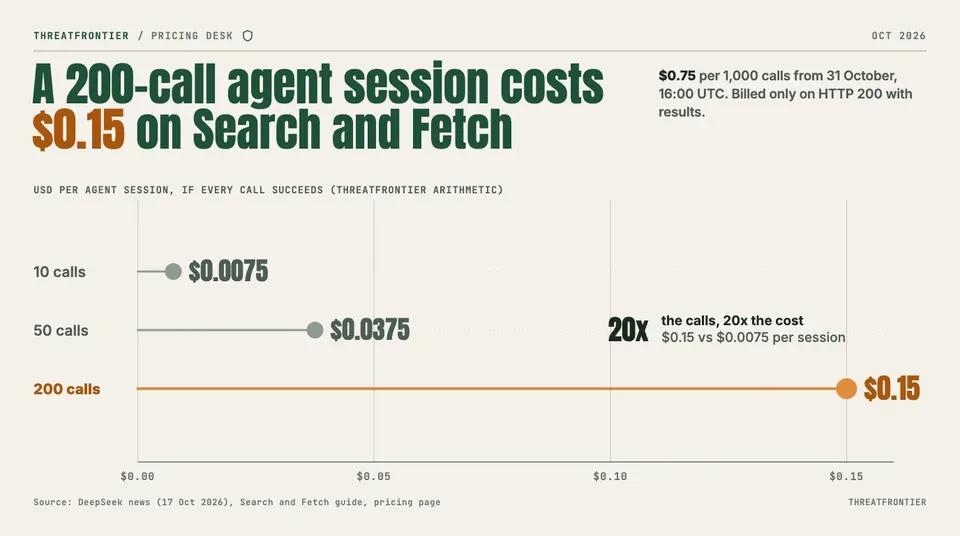
The figures below are ThreatFrontier's arithmetic, not DeepSeek's. They assume every call succeeds and is billed at $0.00075.
| Tool calls in a session | Cost |
|---|---|
| 10 | $0.0075 |
| 50 | $0.0375 |
| 200 | $0.15 |
Because Search and Fetch cost the same, the total depends only on the number of calls, not on how they split between the two. On the same assumption, an agent that makes 200 calls a session and runs 1,000 sessions a month adds $150 to the bill.
Compared with token prices
DeepSeek's pricing page lists deepseek-flash (V4.1-Flash-1017, 1M context) per million tokens. Off-peak: $0.003 input cache hit, $0.15 input cache miss, $0.60 output. Peak hours are 01:00 to 04:00 and 06:00 to 10:00 UTC on weekdays, excluding Chinese public holidays, and peak prices are double: $0.006, $0.30 and $1.20.
By ThreatFrontier's arithmetic, again assuming the call succeeds, one call at $0.00075 costs the same as about 5,000 cache-miss input tokens off-peak (2,500 at peak), or about 1,250 output tokens off-peak (625 at peak). So in a search-heavy session where the model replies briefly, the tool fee rather than the tokens can become the larger line. Asking for full page content does not change the call fee, but the text that comes back is billed as input tokens on top of it.
What to do
- Count Search and Fetch calls per session in your logs before 31 October, so you have a baseline.
- Use the 429 limits and your own caps to stop an agent looping on web calls.
- Request full page content only when the agent must read the page.
- Check which client makes the calls. The free window covers Harness, Claude Code and Codex, and billing starts at the same time for all of them.
- DeepSeek recommends Harness v0.2.1-rc.1 or later for the new model.
If you would rather pay a flat monthly fee than per call and per token, our roundup of flat-rate open-model coding plans compares what is on sale this month.