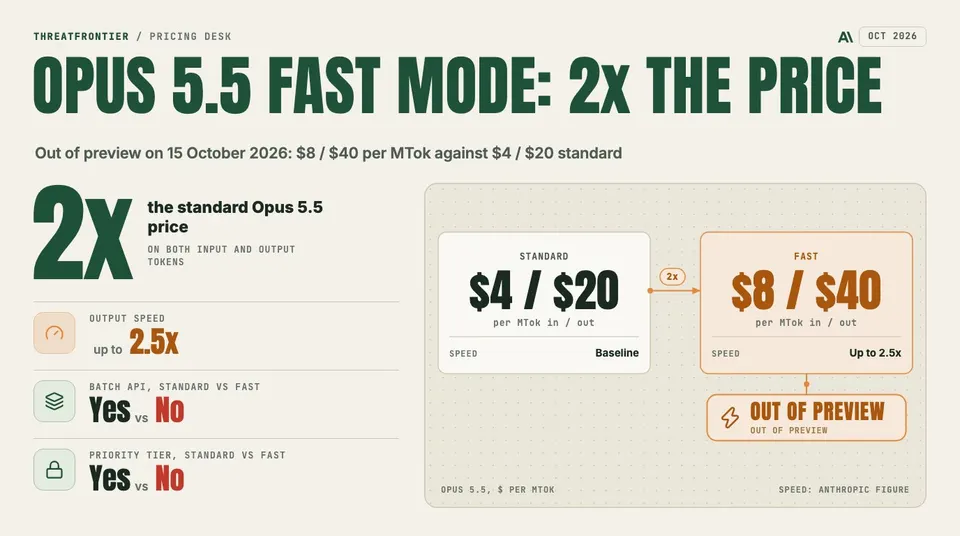
Anthropic made Opus 5.5 fast mode generally available on 15 October. It costs 2x standard for up to 2.5x output speed, but skips Batch and Priority Tier.
On 15 October 2026 Anthropic took fast mode for Claude Opus 5.5 out of research preview. Developers on the Claude API's Start, Build or Scale tiers can now set speed: "fast" on a request without asking for access or sending the fast-mode-2026-02-01 beta header; requests that still send the header keep working. The same day, fast mode for Opus 5.5 became available on Claude in Microsoft Foundry for Azure-hosted deployments. It costs twice the standard Opus 5.5 rate.
What it costs
Fast mode for Opus 5.5 is priced at $8 per million input tokens and $40 per million output tokens. Standard Opus 5.5 is $4 and $20, so fast mode is a flat 2x premium on both input and output. Anthropic says the fast price applies across the full context window, including requests over 200k input tokens, and that prompt caching multipliers stack on top of it.
| Model | Standard in/out | Fast in/out | Fast mode status |
|---|---|---|---|
| Opus 5.5 | $4 / $20 | $8 / $40 | Out of research preview |
| Opus 5 | $5 / $25 | $10 / $50 | Research preview |
| Opus 4.8 | $5 / $25 | $10 / $50 | Research preview |
Fast mode on Opus 5 and Opus 4.8 is also a 2x premium, but it stays in research preview: it still needs the beta header and access through your account manager or the waitlist. Fast Opus 5.5 at $8/$40 costs 20 percent less than fast Opus 5 or 4.8 at $10/$50, but more than standard Opus 5 or 4.8 at $5/$25.
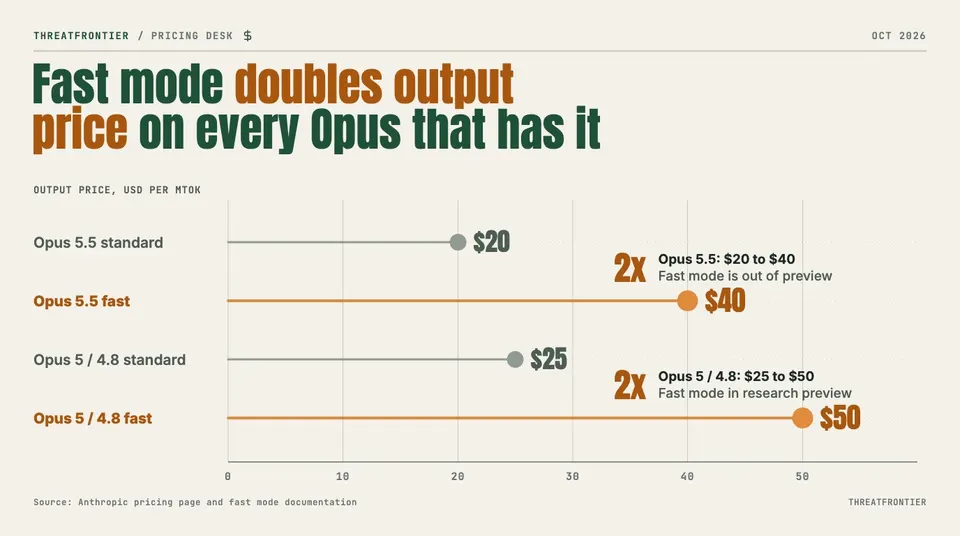
Output price per million tokens: fast mode doubles it on Opus 5.5 ($20 to $40) and on Opus 5 and 4.8 ($25 to $50).
What you get
Fast mode runs the same model with a faster inference configuration; Anthropic says intelligence and capabilities do not change. The gain is up to 2.5x higher output tokens per second. That is Anthropic's own figure, and we have not seen an independent benchmark of it. The speedup is in output tokens per second, not time to first token, so a request with a long prompt and a short answer gains little. Long streamed answers are where the difference shows.
Is the premium worth it?
Cost doubles, and output generation takes at best 40 percent of the standard time (1 divided by 2.5). As a worked example (ThreatFrontier's arithmetic from the published rates), a session with 50,000 input tokens and 15,000 output tokens costs about $0.50 at standard rates ($0.20 input plus $0.30 output) and about $1.00 in fast mode ($0.40 plus $0.60), before any caching.
Fast mode earns its price when a person is waiting for tokens to arrive: interactive coding assistants, agent loops where each step blocks the next, and chat surfaces with long answers. It is a poor fit for background pipelines, bulk summarisation and evals, where nobody waits. Those jobs should stay at standard speed, or go to the Batch API at $2/$10 per million tokens, a quarter of the fast-mode price; fast mode cannot be combined with Batch. For how Opus 5.5 usage counts against Claude subscription limits, see Claude Pro vs Max for Claude Code.
Trade-offs to plan for
- No Batch API, no Priority Tier. Fast mode is not available with the Batch API or with a Priority Tier commitment. It is also not currently available on Claude Platform on AWS.
- Cache misses on switching. Requests at different speeds do not share cached prefixes, so switching between fast and standard mid-session, including falling back after a rate limit, invalidates the cache. Standard Opus 5.5 cache hits cost $0.20 per million tokens, so losing a long cached context is a real cost. Our Sonnet 5.5 cache pricing piece covers when caching pays.
- A separate rate limit. Fast mode has its own rate limit, separate from standard Opus limits. Exceeding it returns a 429 with a
retry-afterheader. Capacity problems surface as 429 or 529 errors rather than a silent downgrade to standard speed, so you have to write the fallback yourself. - Evaluation tier. Fast mode is included by default on the Start, Build and Scale tiers; organizations on the Evaluation tier have to move up to one of them.
- Platform scope. On Microsoft Foundry it works only for Azure-hosted deployments, not deployments hosted on Anthropic. On the Claude API it also covers Managed Agents.
What to do
- Turn it on per request, for latency-sensitive, user-facing paths only.
- Decide your fallback: either wait out the 429 retry, or resend without
speedand accept the cache miss. - Watch spend on fast requests separately, since they bill at twice the standard rate.
- Keep batch and evaluation workloads on standard or Batch pricing.