Alibaba’s Qwen3.8-Flash-Next beats DeepSeek-V4-Flash on SWE-bench Pro with 6B active parameters. Explore full benchmarks, architecture, and enterprise TCO.
Alibaba has released Qwen3.8-Flash-Next, an open-weight 125-billion parameter mixture-of-experts model activating just 6 billion parameters per token while outperforming DeepSeek’s efficiency flagship across critical software engineering evaluations. In comprehensive Qwen 3.8 Flash Next vs DeepSeek V4 Flash benchmarks, Alibaba’s architecture previews the upcoming Qwen4 series and achieves a 62.5% resolution rate on SWE-bench Pro compared to DeepSeek-V4-Flash-0731’s 56.0%, despite deploying 53.8% fewer active parameters per token. The release marks a structural shift in open-weight foundation models, decoupling raw parameter memory from active per-token floating-point computation through static parameter offloading and hybrid linear recurrence.
Architectural Breakdown: Hybrid DeltaNet, QSA, and Static Parameter Offloading
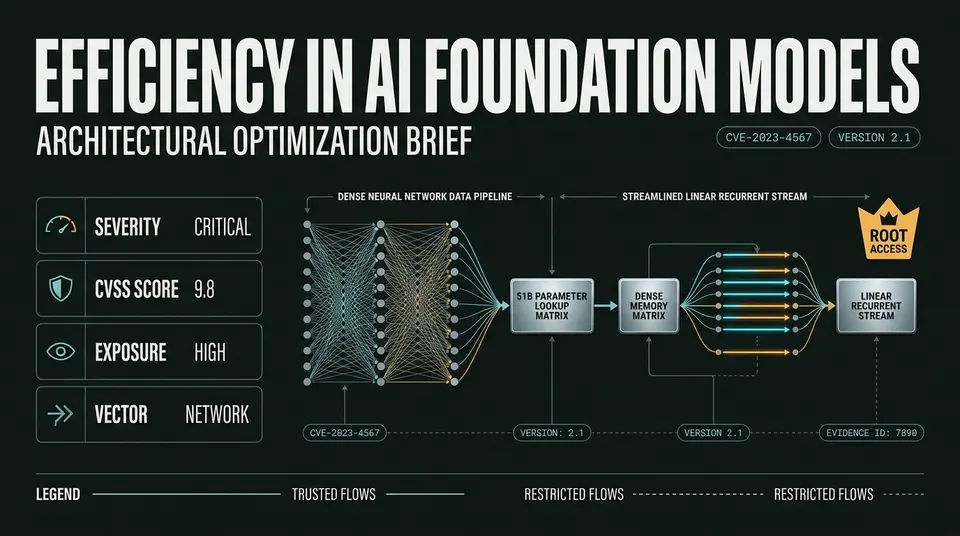
Standard mixture-of-experts (MoE) transformers rely on active feed-forward layers to extract lexical patterns, abstract syntax trees, and standard API calls from raw context. Qwen3.8-Flash-Next bypasses this early-layer computational tax by restructuring its 125B total parameter distribution: 51 billion parameters are allocated entirely to a static n-gram embedding table, leaving 74 billion parameters for its active MoE backbone.
This memory layer converts multi-token sequences, boilerplate syntax, and structural code constructs into high-dimensional representations via direct lookup. Offloading surface-level parsing allows the 6B active parameters to dedicate their floating-point operations entirely to higher-order causal planning and code execution.
Complementing this static lookup mechanism is a dual-tier sequence backbone:
- Gated DeltaNet Recurrence (70%–80% of Backbone): A linear attention mechanism updating a fixed-size recurrent state matrix $S_t \in \mathbb{R}^{d_{key} \times d_{val}}$ in $O(1)$ time per step: $$S_t = S_{t-1} + \beta_t (v_t - S_{t-1} k_t) k_t^T$$ DeltaNet eliminates the need to accumulate key-value (KV) cache entries across recurrent layers, removing quadratic memory scaling during prompt ingest.
- Micro-Block Qwen Sparse Attention (QSA, 20%–30% of Backbone): Directs dynamic attention onto fine-grained spatial blocks ($16 \times 16$ or $32 \times 32$ tokens). Global synchronization layers interleave every few blocks to maintain associative retrieval up to 1 million tokens.
In contrast, DeepSeek-V4-Flash-0731 pairs a 284B parameter pool (13B active) with dense Multi-Head Latent Attention (MLA). While MLA uses low-rank projections to compress KV caches, its quadratic scaling retains higher prefill latency across long prompt sequences. A closer look at that model's own agent benchmarks and enterprise security posture is available in DeepSeek V4 Flash's engineering architecture and security playbook.
Head-to-Head Benchmarks: Agentic Coding vs. Greenfield Synthesis
Empirical evaluations show a distinct divergence in model specializations. Qwen3.8-Flash-Next leads in iterative software engineering workflows and autonomous tool usage, while DeepSeek-V4-Flash maintains an edge in greenfield, whole-repository generation.
| Benchmark / Metric | Qwen3.8-Flash-Next | DeepSeek-V4-Flash-0731 | Delta / Significance |
|---|---|---|---|
| Total Parameters | 125B | 284B | 56.0% smaller memory footprint |
| Active Parameters / Token | 6B | 13B | 53.8% compute FLOP reduction |
| SWE-bench Pro (Resolved) | 62.5% | 56.0% | +6.5% lead in complex code patching |
| DeepSWE 1.1 | 58.7% | 54.4% | +4.3% lead in iterative bug localization |
| CoWorkBench (Multi-Turn) | 73.9% | 45.1% | +28.8% lead in agentic workflows |
| NL2Repo-Bench (Repo Synthesis) | 48.1% | 54.2% | -6.1% deficit in full repo generation |
| Prefill Latency @ 128K Context | ~3.2× faster | 1.0× (Baseline) | $O(N)$ linear recurrence speedup |
| KV Cache Footprint @ 128K | ~1.8 GB / stream | ~7.2 GB / stream | 75.0% memory bandwidth savings |
Qwen’s performance in SWE-bench Pro and CoWorkBench stems from DeltaNet's state retention. During multi-step debugging cycles—reading stack traces, searching codebases, applying diffs, and verifying unit tests—recurrent memory states preserve execution context across sequential turns without attention dilution.
DeepSeek-V4-Flash retains the lead on NL2Repo-Bench. Greenfield repository generation requires unconstrained token-to-token visibility across circular dependencies and complex module hierarchies. In global zero-shot synthesis, linear recurrence encounters state-compression limits, allowing DeepSeek’s dense MLA mechanism to maintain superior topological coherence across multiple files.
Production Realities: Serving Infrastructure on vLLM and SGLang
Deploying reasoning-focused models into high-concurrency production environments introduces distinct memory and runtime trade-offs. Qwen3.8-Flash-Next operates by default with an extended Chain-of-Thought trace, increasing generated token volume by 1.8× to 2.5×.
Standard Inference Trace:
Prompt (Context) ──────────────► Direct Code Generation

Preserved-Thinking Trace (Qwen3.8-Flash-Next):
Prompt (Context) ──► Internal Reasoning Trace ──► Tool Call ──► Structured Output
 └─ Cached via Radix Tree ─┘
In serving engines such as SGLang (via RadixAttention) and vLLM (via Automatic Prefix Caching), these structured reasoning paths unlock major efficiency gains. Because intermediate thinking traces remain immutable across multi-turn agent conversations, prefix cache hit rates reach 85% to 92%. Concurrently, DeltaNet’s linear sequence processing accelerates 128K token prompt ingest by 3.2× and slashes per-stream KV cache memory to 1.8 GB (versus 7.2 GB on DeepSeek), doubling concurrent batch capacity on fixed GPU clusters. How RadixAttention and PagedAttention actually compare on agentic workloads gets a dedicated vLLM vs SGLang benchmark breakdown.
Infrastructure Economics: Self-Hosting Footprint vs. Cloud Endpoints
The 125B parameter footprint of Qwen3.8-Flash-Next fundamentally alters cluster economics for enterprise engineering teams by lowering hardware thresholds and tensor parallelism requirements.
| Model Variant | Precision Format | Minimum GPU Configuration | Interconnect Requirement |
|---|---|---|---|
| Qwen3.8-Flash-Next (125B) | FP8 (Weights + Cache) | 2× NVIDIA H100 / H200 (80GB) | Single-node PCIe / NVLink |
| INT4 (AWQ / GPTQ) | 4× NVIDIA L40S / A100 (80GB) | Standard PCIe Gen4/Gen5 | |
| DeepSeek-V4-Flash (284B) | FP8 (Weights + Cache) | 8× NVIDIA H100 (80GB) | 8-Way SXM5 NVLink Domain |
| INT4 (AWQ / GPTQ) | 4× NVIDIA H100 (80GB) | High-Bandwidth NVLink Domain |
DeepSeek-V4-Flash requires a dedicated 8-GPU node running 8-way Tensor Parallelism for standard FP8 inference. In contrast, Qwen3.8-Flash-Next deploys across two H100 GPUs in FP8 or four L40S accelerators in INT4. For enterprise workloads processing upwards of 15 million tokens daily in automated testing and agentic pipelines, self-hosting Qwen3.8-Flash-Next delivers an estimated 62% reduction in Total Cost of Ownership (TCO) compared to public frontier API tiers. DeepSeek's own API pricing has been in flux too, with its V4 Pro launch introducing peak-hour API surcharges that reshape that math.
Enterprise Deployment Verdict
The performance boundaries between both architectures establish clear operational criteria for technical leadership:
Deploy Qwen3.8-Flash-Next for: Multi-turn autonomous coding agents, interactive debugger control loops, long-context log analysis, high-concurrency tool execution, and dual-GPU enterprise deployments.
Deploy DeepSeek-V4-Flash for: Greenfield whole-repository synthesis, monolithic architectural generation, and tasks requiring unconstrained pairwise attention across dense mathematical or complex syntactic graphs.
By demonstrating that a 6B-active hybrid recurrent architecture can surpass a 13B-active dense attention model across mission-critical software engineering benchmarks, Qwen3.8-Flash-Next confirms that the frontier of AI efficiency lies in memory-augmented linear recurrence rather than monolithic parameter scaling. It is not alone in that shift either: Qwen3.8-Flash and GLM-5.3-Flash's twin releases cement the 3:1 hybrid-architecture era.