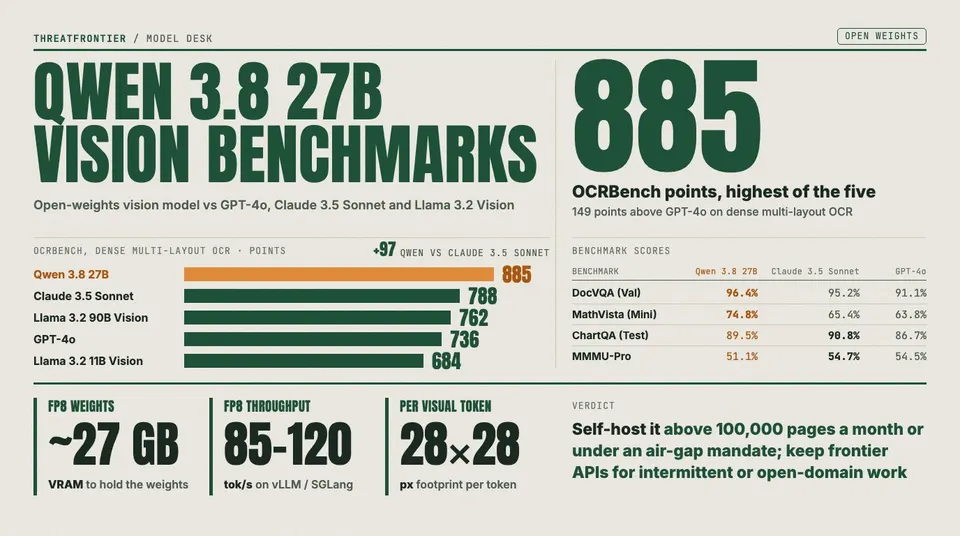
Explore Qwen 3.8 27B multimodal benchmarks, architecture, and deployment strategies. Learn how open-weights vision AI rivals proprietary enterprise APIs.
A decisive shift is reshaping enterprise machine learning as mid-sized, open-weights vision-language models match closed-source frontier APIs on document comprehension and dense visual reasoning. Empirical evaluations of the Qwen 3.8 27B multimodal architecture confirm that high-throughput document extraction, visual mathematics, and dense layout parsing no longer require routing sensitive enterprise data through proprietary third-party endpoints.
For organizations ingesting millions of invoices, technical schematics, and regulatory filings each month, proprietary vision APIs create steep economic and operational hurdles. The same model's agentic benchmarks are covered in Alibaba's Qwen3.8-27B open-weight hybrid model launch. Per-page API costs ranging from $0.005 to over $0.025 quickly compound at scale. Furthermore, strict compliance standards under GDPR, HIPAA, and SOC 2 frameworks often prohibit external transmission of protected health information and financial records. Operating at the 27-billion-parameter scale delivers the analytical depth of 70B-class models while running on standard single-node enterprise hardware.
Architectural Deep Dive: Dynamic Resolution and M-RoPE
Standard vision transformers historically relied on static resizing, forcing non-square images into uniform grids like $224 \times 224$ or $448 \times 448$ pixels. This distortion degrades fine typography, sub-8-point fonts, and dense table borders.
Qwen 3.8 27B eliminates static resizing by mapping raw visual inputs directly into variable token sequences governed by native aspect ratios:
$$\text{Visual Tokens} = \left\lceil \frac{\text{Height}}{28} \right\rceil \times \left\lceil \frac{\text{Width}}{28} \right\rceil$$
Native $14 \times 14$ patches pass through $2 \times 2$ spatial pooling, creating an effective $28 \times 28$ pixel footprint per visual token. Configurable pixel boundaries balance resolution against token overhead:
# Optimal dynamic pixel bounds for dense A4 document ingestion
min_pixels = 256 * 28 * 28 # ~200,704 pixels; prevents zero-padding waste
max_pixels = 1280 * 28 * 28 # ~1,003,520 pixels; preserves 8pt typography
To manage the quadratic complexity ($O(N^2)$) of full self-attention across high-resolution inputs, the Vision Transformer (ViT) implements Window Attention across $8 \times 8$ local windows, retaining global full attention on only four designated cross-layer anchor blocks.
Rather than flattening visual tokens into a 1D sequence, Multimodal Rotary Position Embedding (M-RoPE) decomposes positional frequencies across temporal and spatial axes:
$$\text{Position ID} = \left( t_{\text{time}},, h_{\text{height}},, w_{\text{width}} \right)$$
For static documents ($t=0$), the spatial coordinates $(h, w)$ preserve vertical and horizontal alignment across complex tables. This enables the model to output exact pixel-space bounding boxes without the quantization errors associated with normalized 0–1000 coordinate schemes. How that context window compares to vector RAG is covered in Qwen 3.8 27B vs vector RAG: the 262K token window.
Comprehensive Multimodal Benchmark Breakdown
Standardized evaluations demonstrate that Qwen 3.8 27B competes directly with proprietary frontier models across document OCR, visual mathematics, and scientific diagrams.
| Benchmark Suite | Evaluated Domain | Qwen 3.8 27B Flagship | Llama 3.2 11B Vision | Llama 3.2 90B Vision | Claude 3.5 Sonnet | GPT-4o (Omni) |
|---|---|---|---|---|---|---|
| DocVQA (Val) | Complex Document OCR & QA | 96.4% | 88.4% | 90.1% | 95.2% | 91.1% |
| OCRBench | Dense Multi-Layout OCR | 885 | 684 | 762 | 788 | 736 |
| OCRBench-v2 (En/Zh) | Multilingual Visual Text | 61.5 / 63.7% | 38.2 / 24.5% | 46.1 / 34.0% | 45.2 / 39.6% | 46.5 / 32.3% |
| ChartQA (Test) | Data Visualisation Extraction | 89.5% | 83.4% | 85.5% | 90.8% | 86.7% |
| MathVista (Mini) | Visual Mathematical Reasoning | 74.8% | 57.3% | 61.2% | 65.4% | 63.8% |
| MathVision (Full) | High-Level Geometric Diagrams | 38.1% | 20.4% | 27.6% | 38.3% | 30.4% |
| MMMU (Val) | Multi-Discipline Reasoning | 70.2% | 50.7% | 60.3% | 70.4% | 70.3% |
| MMMU-Pro | Robust Multimodal QA | 51.1% | 35.8% | 42.1% | 54.7% | 54.5% |
| AI2D (Test) | Scientific Diagram Analysis | 88.4% | 79.8% | 84.1% | 81.2% | 84.6% |
On document tasks, Qwen 3.8 27B establishes leading open-weights performance, scoring 96.4% on DocVQA—exceeding GPT-4o (91.1%) and Claude 3.5 Sonnet (95.2%). On OCRBench, its score of 885 points surpasses GPT-4o by 149 points, validating the benefits of uncompressed dynamic aspect ratio processing.
Document Intelligence: Structural Layout Extraction
High-throughput enterprise extraction requires preserving structural layout hierarchies alongside text content to support automated audit verification.
The model natively formats document hierarchies using an HTML schema embedded with data-bbox attributes for line-item coordinate grounding:
COMMERCIAL INVOICE

Item SKU

Unit Price ($)

A-99201

42.50
Production Deployment and Hardware Sizing
Deploying Qwen 3.8 27B in high-concurrency environments requires sizing memory allocations across model weights, KV caches, and inference runtimes. Full TCO math for that hardware is in enterprise inference economics: the TCO blueprint for 27B LLMs.
| Precision Format | Model Weight VRAM | KV Cache (32k Context) | Minimum Hardware Configuration | Expected Throughput |
|---|---|---|---|---|
| BF16 / FP16 | ~54 GB | ~16–22 GB | 1× A100/H100 (80GB) or 2× RTX 6000 Ada | 45–60 tok/s |
| FP8 (vLLM / SGLang) | ~27 GB | ~10–14 GB | 1× RTX 6000 Ada (48GB) or 2× RTX 3090/4090 (48GB total) | 85–120 tok/s |
| AWQ / GPTQ (4-bit) | ~15 GB | ~8–10 GB | 1× RTX 4090 / A5000 (24GB) | 60–90 tok/s |
| GGUF (Q4_K_M) | ~16 GB | Offloaded / Host RAM | Workstation / Apple Silicon / Dual GPU | 25–40 tok/s |
Key serving optimizations include:
- RadixAttention (SGLang): Caches KV states across recurring system prompts, schemas, and document templates, cutting prefill latency by up to 60%.
- Constrained Decoding: Integrates schema engines like Outlines or XGrammar to guarantee syntactically valid JSON output during automated database ingestion.
Edge Cases, Hallucinations, and Production Guardrails
Production workflows require targeted guardrails to mitigate common multimodal failure modes: Broader serving benchmarks for this size class are in high-concurrency inference for Qwen 27B.
| Failure Mode | Root Mechanism | Production Mitigation Strategy |
|---|---|---|
| Dense Table Row Slippage | Vertical drift on borderless 50+ row financial tables. | Slice high-density tables into overlapping horizontal strips; verify row indices. |
| Micro-Font Hallucination | Generative completion on blurred stamps or sub-6pt text. | Track token log-probabilities; route low-confidence segments to local OCR engines. |
| Coordinate Jitter | Sub-pixel rounding shifts bounding boxes by 5–15 pixels. | Snap predicted coordinates to edges detected via OpenCV contour filters. |
| Rotational Skew | Accuracy drops on inverted (90°/180°) or skewed mobile captures. | Normalize document orientation prior to inference using Hough transform filters. |
Strategic Production Verdict
Direct Recommendations
Deploy Qwen 3.8 27B when:
- Monthly processing volume exceeds 100,000 pages, where self-hosted FP8 deployments reduce extraction costs by 80% to 90% relative to proprietary APIs.
- Operational policies enforce strict compliance (PCI-DSS, HIPAA, GDPR) requiring fully air-gapped, on-premises execution.
- Downstream automation relies on coordinate-grounded visual extraction and structured HTML hierarchies.
Retain Frontier Proprietary APIs when:
- Ingestion demand is intermittent (<10,000 requests/month), making dedicated GPU provisioning economically unviable.
- Workflows require open-domain world knowledge, multi-step web browsing, and multi-turn creative interaction rather than deterministic visual data parsing.