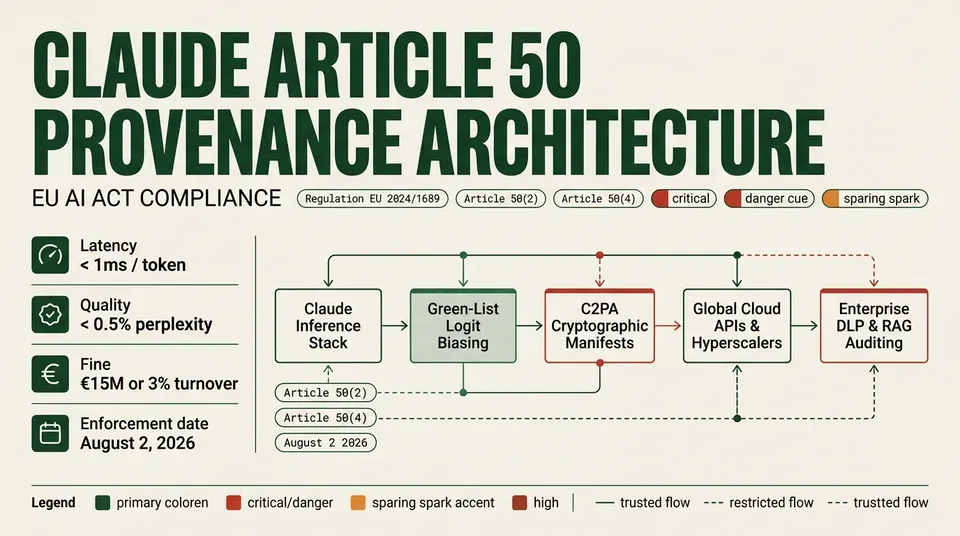
Anthropic rolls out global token watermarking and C2PA manifests across Claude models to comply with the EU AI Act Article 50 transparency requirements.
Frontier artificial intelligence lab Anthropic will implement universal, machine-readable output watermarking across all new Claude models launched on or after August 2, 2026, establishing a global compliance architecture to satisfy Article 50 transparency requirements under the European Union Artificial Intelligence Act (Regulation EU 2024/1689).
Rather than deploying a geo-fenced system restricted to European Union IP addresses or European cloud regions, Anthropic has committed to applying provenance controls by default across all distribution channels worldwide. The technical regime covers direct web interfaces, developer tooling, the primary Claude API, and third-party hyperscaler deployments across Amazon Web Services Bedrock, Google Cloud Vertex AI, and Microsoft Azure AI Foundry, alongside a phased rollout for existing model endpoints.
The unified rollout illustrates how European tech legislation continues to exert extraterritorial leverage over Silicon Valley infrastructure, establishing a single international standard for synthetic content provenance.
Deconstructing the Article 50 Compliance Mandate
The European Union Artificial Intelligence Act establishes strict transparency rules under Article 50 for organizations that develop and deploy generative artificial intelligence systems. The regulation draws a structural line between upstream system providers and downstream enterprise deployers.
Under Article 50(2), upstream providers of general-purpose AI systems generating synthetic audio, image, video, or text must ensure outputs are marked in a machine-readable format and detectable as artificially generated or manipulated. Solutions must meet state-of-the-art technical reliability standards while maintaining interoperability across enterprise environments.
Article 50(4) shifts the legal burden to downstream deployers. The Cyber Resilience Act adds its own downstream duty: Article 14's mandatory vulnerability reporting. Organizations utilizing AI systems to generate or manipulate text published to inform the public on matters of public interest must visibly disclose the artificial origin of the material. A statutory exemption applies only when the synthetic output has undergone human editorial review and an individual or entity holds formal editorial responsibility.
Non-compliance carries heavy financial exposure. Infringements of Article 50 transparency obligations carry administrative fines of up to €15 million or 3 percent of an enterprise’s total worldwide annual turnover for the preceding financial year, whichever is higher.
Dual-Track Architecture: Statistical Logits and C2PA Manifests
To meet regulatory thresholds without creating visible text artifacts or easily removable headers, Anthropic built a hybrid architecture combining statistical token-level watermarking with cryptographic file manifests.
For continuous text generation, the system alters next-token probability distributions inside the model’s autoregressive sampling loop. During inference, a pseudo-random hashing function keyed to a secret private seed evaluates the preceding sequence of context tokens. This hash partitions the model’s vocabulary into dynamic "green" and "red" sub-lists for the upcoming token step.
The model applies a mathematical bias ($\delta$) to the logits of green-list tokens before softmax normalization, slightly elevating their probability of selection:
import hashlib
import numpy as np

def apply_logit_watermark(logits: np.ndarray, context_tokens: list[int], private_key: bytes, bias_delta: float = 1.5) -> np.ndarray:
 # Hash previous context tokens with private key to generate pseudo-random partition
 context_hash = hashlib.sha256(bytes(context_tokens[-3:]) + private_key).digest()
 seed = int.from_bytes(context_hash[:4], byteorder="big")
 rng = np.random.default_rng(seed)

 # Split vocabulary into green and red lists
 vocab_size = logits.shape[-1]
 permutation = rng.permutation(vocab_size)
 green_list = permutation[: vocab_size // 2]

 # Shift green-list logits by positive bias delta
 watermarked_logits = logits.copy()
 watermarked_logits[green_list] += bias_delta
 return watermarked_logits
Automated detection endpoints evaluate output sequences by tallying green-list token frequencies against a baseline random distribution. When green-token concentration crosses a calculated $z$-score threshold ($p < 10^{-6}$), the verifier confirms algorithmic generation with statistical certainty.
Inference latency benchmarks show that logit shifting adds less than 1 millisecond per generated token because operations execute in-memory within active sampling kernels. Generation quality measurements indicate negligible perplexity degradation—under 0.5 percent—in high-entropy contexts such as long-form analysis, prose, and ideation. That compute isn't free: see Opus 5's enterprise pricing and the cybersecurity routing catch.
For multimodal assets, exported documents, and vector files, the platform injects Coalition for Content Provenance and Authenticity (C2PA) manifests. These manifests embed signed CBOR metadata containers verified by public key infrastructure (PKI) X.509 certificates, logging model provenance and asset lineage.
Threat Modeling and Evasion Vectors
Despite meeting legal compliance baselines, statistical and cryptographic watermarking models face operational and adversarial vulnerabilities when exposed to real-world threat actors.
| Attack Vector | Technical Mechanism | Threat Level | Primary Mitigation Strategy |
|---|---|---|---|
| Paraphrase Obfuscation | Routing marked text through an open-weights local LLM to alter token sequences. | High | Semantic invariant watermarking and multi-scale entropy correlation. |
| Short-Text Entropy Collapse | Generation sequences under 150 tokens (e.g., regex, SQL queries, short code). | Critical | Minimum length thresholds for automated verification triggers. |
| Watermark Forgery / Spoofing | Querying detection APIs repeatedly to reconstruct green-list hash boundaries. | Medium-High | Dynamic private key rotation and API query rate-limiting. |
| Metadata Stripping | Converting .png to .webp, screenshotting, or stripping EXIF/XMP blocks. | High | Cross-layer pixel-level robust image watermarking. |
| Token Perturbation | Inserting homoglyphs, zero-width spaces, or intentional spelling swaps. | Low | Pre-detection Unicode normalization and canonical tokenization. |
Paraphrasing poses the steepest technical challenge for enterprise text detection. When an adversary ingests Claude-generated text and rewrites it through an un-watermarked, locally hosted open-weights model, the altered n-gram structure disrupts hash continuity, dropping the detection $z$-score below significance thresholds.
Enterprise Infrastructure and the Over-Detection Dilemma
The presence of persistent, machine-readable provenance markers across commercial API streams requires chief information security officers and data architects to adjust security monitoring and ingestion pipelines.
Corporate data loss prevention (DLP) engines can now integrate with watermark verification endpoints to audit internal code repositories and document management platforms. This allows security teams to identify unapproved AI usage, shadow AI deployment, and potential intellectual property leaks within software development lifecycles.
# Example enterprise CI/CD pipeline check for unverified synthetic code
claude-provenance-verifier --input ./src/generated_auth.py --threshold 0.85 \
 || (echo "ERROR: Unverified synthetic code detected without human sign-off" && exit 1)
In retrieval-augmented generation (RAG) architectures, automated watermark detectors give data engineers a reliable mechanism to identify synthetic data prior to vector indexing. Filtering marked outputs prevents closed-loop model collapse, where enterprise models recursively train on synthetic text until output quality degrades.
However, widespread token marking introduces an operational "over-detection dilemma" for enterprise compliance teams. Statistical watermarks indicate whether text was processed by an AI model, not whether the AI authored the underlying ideas. If an employee uses Claude merely to copy-edit, reformat, or fix grammar on original research, the resulting text contains token-level watermarks.
This statistical footprint risks triggering false compliance alarms during automated Article 50(4) audits, potentially misclassifying human-authored, AI-assisted reporting as fully synthetic generation.
Market Landscape and the Open-Source Divide
Anthropic’s universal deployment sets an operational precedent that accelerates industry-wide adoption among proprietary frontier providers. Competitors such as Google with its SynthID framework and OpenAI with its C2PA and metadata integrations are standardizing provenance controls to maintain unified global service architectures.
Yet this regulatory alignment widens a major structural divide across the broader AI ecosystem. While compliant cloud API providers operate under mandatory provenance architectures and legal accountability, open-weights models running on self-hosted hardware operate entirely outside Article 50 enforcement.
As enterprise governance teams build automated policies around verifiable synthetic output signals, the technical asymmetry between regulated cloud APIs and unmonitored open-source generation will define the next phase of enterprise risk management and regulatory scrutiny. Board-level accountability for that governance gap is covered in DORA board liability audits across the EU.