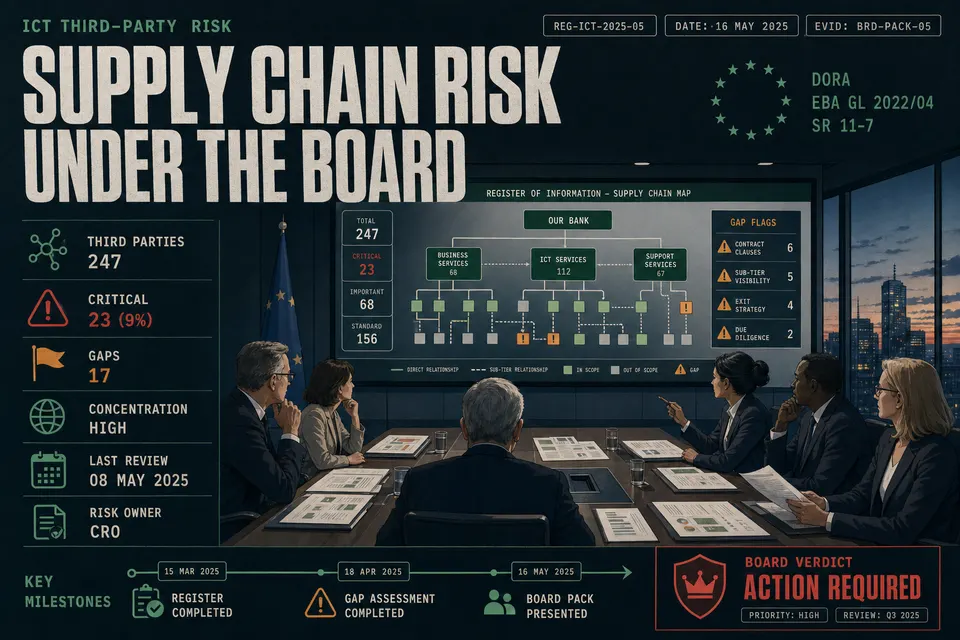
After the 2026 Register of Information cycles, operational resilience is no longer a checkbox a board can safely delegate to the CIO or a third party.
European financial supervisors have moved past education and good-faith reviews. After the Digital Operational Resilience Act (DORA) became fully applicable on 17 January 2025, most of that year was spent on guidance and industry engagement. From early 2026—after hard Register of Information (RoI) cycles such as De Nederlandsche Bank’s March 2026 submission—national competent authorities have moved into active, data-driven DORA board liability audits and first supervisory letters, with hard public individual-fine case law still thin as of mid-2026.
Boards of banks, insurers, investment firms and critical ICT third-party providers can no longer treat operational resilience as a compliance checkbox. Directors who lack minuted approvals, quarterly ICT risk packs and training records face real personal exposure under Article 5 and national rules implementing Article 50.
Why Boards Are Exposed
Three developments ended the informal grace period: hard RoI submissions giving supervisors a machine-readable map of ICT supply chains; expanded NCA operational-resilience teams; and early supervisory letters—most notably attributed to DNB—flagging material gaps in ICT risk management frameworks.
The personal-liability trigger is structural. Article 5 places non-delegable responsibility on the management body to define, approve, oversee and remain responsible for the ICT risk management framework. Appointing a CISO does not discharge the board. Article 5(4) adds a personal training duty: members must maintain sufficient ICT risk knowledge through regular training. Article 50 requires Member States to empower NCAs to fine natural persons—including management-body members—when infringements are attributable to them.
Supervisors now treat RoI data as intelligence. Automated checks score completeness against peers, map concentration risk, cross-reference providers against major incident reports, and flag shallow sub-outsourcing claims. An institution with a heavy ICT footprint and zero major ICT-related incidents since 2025 may be viewed as under-detecting or under-reporting rather than resilient. Process maturity—classification, escalation, and the reporting clock (initial notification, interim report typically within 72 hours, final report within roughly one month)—is now a key performance indicator. Product manufacturers face a parallel, faster clock under the Cyber Resilience Act's Article 14 reporting mandate, which requires 24-hour notification of actively exploited flaws.
Critical ICT third-party providers face a parallel track. Designated CTPPs are subject to Lead Overseer tools (EBA, ESMA or EIOPA), including inspections, recommendations, periodic penalty payments of up to 1% of average daily worldwide turnover for up to six months, and pressure on financial entities to terminate contracts. The stakes of unmanaged third-party ICT risk were on display in the 2026 Accenture Azure DevOps breach, which exposed source code and credentials tied to client work.
What Auditors Are Examining
Early examinations prioritise operational effectiveness over policy PDFs. Examiners test board-approved ICT risk management frameworks under Articles 5–16 and the RTS on the ICT RMF; incident classification and detection-to-report evidence under Article 19; resilience testing and, for significant entities, TLPT results plus remediation under Articles 24–27; and third-party risk under Articles 28–30, including RoI quality and mandatory Art. 30 contract clauses.
Priority findings patterns include incomplete or inconsistent RoI data; frameworks signed only by the CISO without board resolution; missing ICT risk appetite and disruption tolerance; weak asset and dependency mapping; gaps in access control, detection and ICT business continuity; unremediated Art. 30 clauses on contracts supporting critical or important functions; open TLPT findings without owners; and resilience budgets not approved by the board or not linked to risk profile. Weak third-party dependency mapping is exactly what let a nuclear plant's data leak trace back to a vulnerable supplier in a separate critical-infrastructure sector. Under-resourcing is treated as a governance failure. ISO 27001 and NIST CSF map well to technical controls but do not by themselves satisfy non-delegable board accountability, Art. 30 packs, RoI, TLPT or DORA incident timelines.
Personal Liability and Sanctions
Article 5(1)–(2) require the management body to own the ICT risk management framework and specifically approve the digital operational resilience strategy and ICT risk tolerance, ICT business continuity and recovery plans, ICT internal audit plans, adequate budget, the ICT third-party policy, and reporting channels for major incidents, third-party risk and testing results. Attribution paths for individual liability include failure of ICT risk oversight, no evidence the board received or acted on regular ICT risk reports, lack of demonstrable digital-resilience training, and approval of outsourcing without mandatory Art. 30 clauses.
Entity ceilings commonly combine absolute caps (often up to €5–10m, Italy up to €20m) with turnover-based maxima (typically 5–10% under national law); individual ceilings commonly reach €1m and up to €5m in Germany, Italy and Belgium. CTPPs face separate daily penalties up to 1% of average daily global turnover for up to six months. Aggravating factors include repeated breaches, non-cooperation and concealment; mitigating factors include prompt self-report, cooperation and demonstrable remediation. Public naming often weighs more heavily on boards than the cash fine.
Hard public individual-fine case law under DORA remains thin as of mid-2026. What exists is emerging supervisory practice: early letters and formal measures, Italian guidance on national thresholds, BaFin’s graduated and systemic-first approach, and industry expectations of broader French enforcement later in 2026. Dutch analysis notes that DORA raises the specificity of directors’ duties, easing mismanagement or tort arguments in cases of serious negligence, while civil claimants may cite non-compliance as a duty-of-care breach—still subject to a high negligence threshold. No named individual board fines should be invented; the accurate frame is activation of personal-liability provisions plus first formal measures.
| Jurisdiction | NCA(s) | Entity max (indicative) | Individual max (indicative) | 2026 posture |
|---|---|---|---|---|
| Italy | BdI / Consob / IVASS / COVIP | Up to €20m or 10% turnover | Up to €5m + management bans | Active; formal notices cited |
| Germany | BaFin / Bundesbank | Up to €5m (breach-type differentiation) | Up to €5m | Graduated; systemic first |
| Netherlands | DNB / AFM | Up to ~€5m by provision | Via de facto management | First-mover letters; public RoI process |
| Ireland | CBI | Up to €10m or 10% turnover | Up to €1m | Proportionate; significant entities prioritised |
| France | ACPR / AMF | EU-max trajectory | Evolving | Guidance first; enforcement expected later 2026 |
| Belgium | National framework | €5m or 10% turnover | €5m | High individual ceiling |
Multi-jurisdiction groups must run a baseline DORA programme plus local examination methodology and local penalty maths. Many of the same entities must simultaneously implement NIS2's technical control requirements under EU Regulation 2024/2690.
Action Checklist for Boards and CISOs
- Confirm minuted board resolutions for every Article 5(2) artefact—ICT RMF, digital resilience strategy, risk appetite/tolerance, ICT BCP/DR, third-party policy, ICT budget and ICT internal audit plan; re-approve anything only management-signed.
- Install a standing ICT/digital resilience agenda with a quarterly pack on risk posture, incidents, third-party concentration, test results and budget burn.
- Complete individual board ICT risk training with records; refresh annually or after material incidents.
- Explicitly approve ICT disruption tolerance and multi-vendor/concentration stance; appoint a named board lead without diluting collective responsibility.
- Run RoI reconciliation (inventory vs contracts vs incidents vs peer-expected providers) and remediate Art. 30 clauses on all CIF-supporting contracts, with residual gaps visible to the board. The playbook for securing those third-party data channels is covered in defending third-party data exchange portals after the Stadler Rail breach.
- Prove the incident classification and reporting clock end-to-end; maintain TLPT/testing calendars with remediation owners and board summaries of open critical findings.
- Commission independent internal audit of the ICT RMF and build a single evidence room: resolutions, board packs, training logs, RoI extracts, contract matrices and remediation trackers.
- Review personal D&O and indemnity against administrative fines (jurisdiction-specific; not always insurable) and pre-agree crisis remediation governance under compulsion pressure.
Forward Guidance
Emerging supervisory practice already shows that RoI quality beats glossy policies, paper is not operational, zero incidents can signal under-detection, personal liability is the board attention mechanism, national fine maths diverge, and cooperation still mitigates while concealment aggravates. Continuous RoI hygiene, candid regulator engagement, mature CTPP oversight and closed TLPT findings belong on the standing board agenda. Entities that treat DORA board liability audits as ongoing governance—not a closed 2025 project—will enter the next examination cycle with evidence rather than explanations.
Related reading
- EU Cyber Resilience Act 2026 Compliance for IoT: The September Reporting Deadline That Changes Market Access
- The Post-Quantum Enterprise Migration Deadline: Implementing FIPS 203 (ML-KEM) and FIPS 204 (ML-DSA) Ahead of CNSA 2.0
- Anthropic Implements Global Token Watermarking to Meet EU AI Act Article 50 Mandate