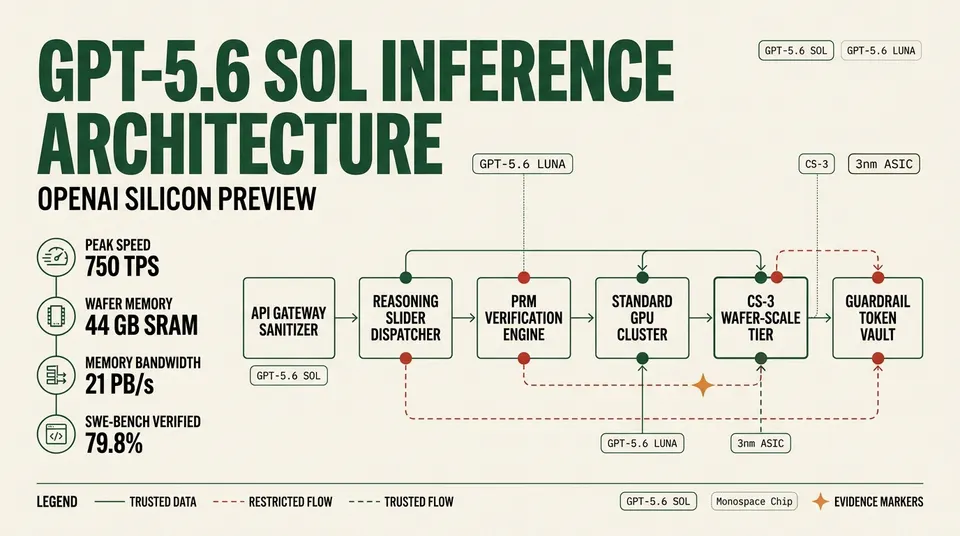
OpenAI previews GPT-5.6 Sol, combining dynamic test-time compute via a Reasoning Slider with ultrafast silicon delivering up to 750 TPS reasoning speeds.
OpenAI has previewed GPT-5.6 (codenamed "Sol"), introducing an adjustable runtime "Reasoning Slider" paired with a dedicated ultrafast silicon tier that together mark a definitive pivot toward dynamic inference scaling. The flagship model of the new GPT-5.6 family—which also includes the lightweight Luna and balanced enterprise Terra engines—enables developers to modulate test-time compute dynamically per query while delivering reasoning output speeds of up to 750 tokens per second (TPS) on specialized hardware.
The dual announcement tackles the core architectural bottlenecks of frontier artificial intelligence: the latency penalty of sequential chain-of-thought exploration and the diminishing returns of static pre-training. By uniting runtime algorithmic search with wafer-scale silicon co-design, the release fundamentally shifts software engineering, autonomous security research, and enterprise infrastructure economics.
Architectural Breakdown: Test-Time Compute and the Reasoning Slider
At the core of GPT-5.6 Sol is the operationalization of test-time compute (TTC) scaling laws. Previous frontier architectures fixed computational expenditure during pre-training and post-training, locking model parameters and compute per token. Sol decouples parameter execution from runtime depth, granting developers granular programmatic control via the reasoning_effort API parameter (low, medium, high, extreme) and explicit max_reasoning_tokens caps.
Under the hood, elevated reasoning tiers activate Monte Carlo Tree Search (MCTS) and Process-Supervised Reward Models (PRMs) that score intermediate logic steps and prune invalid trajectories before final output generation. If an intermediate path fails formal code or logic validation, automated backtracking routines re-sample alternate hypotheses.
| Reasoning Slider Setting | Algorithmic Mechanism | Target Enterprise Workload | Latency (Standard GPU) | Latency (Ultrafast Silicon) | Cost Multiplier | Failure Mode Risk |
|---|---|---|---|---|---|---|
| Low | Direct generation, minimal scratchpad | High-throughput classification, entity routing, text extraction | 200 ms – 800 ms | < 50 ms | 1.0× (Baseline) | Hallucination on complex logic |
| Medium | Linear step-by-step chain-of-thought | Standard software development, technical summarization | 2 s – 8 s | 300 ms – 1.2 s | 2.5× – 4× | Over-computation on simple tasks |
| High | Branching tree search, PRM step pruning | Binary vulnerability discovery, complex legal reconciliation | 15 s – 45 s | 1.5 s – 4 s | 6× – 12× | High token burn, context exhaustion |
| Extreme | Multi-turn self-correction, refutation trees | Autonomous zero-day patching, multi-repo refactoring | 60 s – 300 s+ | 6 s – 25 s | 20× – 50×+ | Unbounded cost overruns if unconstrained |
Hardware Deep Dive: Bypassing the Memory Bandwidth Bottleneck
Sequential chain-of-thought generation exposes the acute memory bandwidth limitations of traditional Von Neumann GPU clusters. That bandwidth ceiling and how to design around it is explained in Breaking the Memory Wall. Because autoregressive models generate hidden thinking tokens step-by-step ($O(N)$ sequential operations), standard clusters operating on High-Bandwidth Memory (HBM3e) spend substantial compute cycles transferring weights and key-value (KV) caches across PCIe buses and NVLink switches. When a model generates 4,000 hidden reasoning tokens before outputting an answer, standard 40–75 TPS throughput imposes an unacceptable interactive delay of over a minute.
+-------------------------------------------------------------------------+
| Inference Architecture Comparison |
+------------------------------------+------------------------------------+
| Traditional GPU Cluster (H100/H200)| Ultrafast Wafer-Scale Tier (CS-3) |
+------------------------------------+------------------------------------+
| • Distributed HBM3e Memory | • 44 GB On-Chip Integrated SRAM |
| • ~3.35 TB/s - 4.8 TB/s Bandwidth | • 21 PB/s Memory Bandwidth (5000x) |
| • Scale-out latency over NVLink | • Single-wafer unified compute |
| • Throughput: 40 - 75 TPS | • Throughput: 500 - 750 TPS |
| • Latency on 3k reasoning: ~50-70s | • Latency on 3k reasoning: ~4-6s |
+------------------------------------+------------------------------------+
To eliminate this "waiting time tax," OpenAI deployed its co-designed Ultrafast hardware tier across two key silicon tracks:
- Wafer-Scale CS-3 Integration: Cerebras CS-3 engines host 4 trillion transistors across an unbroken silicon wafer, providing 44 Gigabytes of on-chip SRAM with 21 Petabytes per second of memory bandwidth. By eliminating inter-chip communications, Sol processes search trees at up to 750 TPS—a 10× to 14× acceleration over enterprise GPU nodes.
- Custom Inference ASICs: Developed alongside Broadcom and TSMC, dedicated 3nm and 2nm Application-Specific Integrated Circuits optimize matrix-vector operations specifically for sparse Mixture-of-Experts (MoE) routing and continuous PRM verification. Open-weight labs are racing toward similar scale, with Alibaba confirming Qwen 4 training under its Apsara roadmap.
Benchmark Performance: Frontier Reasoning Capabilities
Across complex software engineering, competitive mathematics, and autonomous vulnerability synthesis, GPT-5.6 Sol establishes significant performance gains over existing frontier models.
| Benchmark Evaluation | Focus Domain | Claude 3.7 Sonnet (Extended) | o3-mini (High) | GPT-5.6 Sol (Ultrafast) | Strategic Takeaway |
|---|---|---|---|---|---|
| SWE-bench Verified (%) | Real-world GitHub issue resolution | 70.3% | 71.2% | 79.8% | +8.6% gain in multi-file repository manipulation |
| DeepSWE / Terminal-Bench 2.0 (%) | Autonomous bash and tool execution | 64.8% | 67.5% | 76.4% | Drastic reduction in agent execution loops |
| GPQA Diamond (%) | Graduate-level STEM reasoning | 78.4% | 79.7% | 88.2% | Latent verification closes hallucination gaps |
| AIME 2024 / 2025 (%) | Competition-grade discrete mathematics | 86.7% | 87.3% | 94.6% | Near-complete resolution of formal proofs |
| ExploitBench / Cyber Analysis (%) | Vulnerability synthesis and patch creation | 58.2% | 63.1% | 77.9% | Triggers enterprise isolation requirements |
GPT-5.6 Enterprise Security Implications: The Rise of Denial-of-Wallet
While dynamic test-time compute enhances reasoning accuracy, it introduces an expanded attack surface. High-reasoning models raise similar routing and cost questions for security teams, covered in Opus 5 Enterprise AI Pricing Reshapes Security Compute. Threat actors are pivoting from syntactic prompt injection to algorithmic complexity and resource-exhaustion attacks.
Critical Threat Vectors
- Denial-of-Wallet (DoW) Exploits: Attackers submit undecidable logic paradoxes or complex constraint puzzles disguised as routine input. When processed with open-ended reasoning parameters, Sol maximizes internal tree expansion, consuming tens of thousands of hidden scratchpad tokens and driving API billing up exponentially.
- Indirect Ingestion Injections: Malicious instructions embedded in parsed customer documents, PDF resumes, or scraped web pages can command background workers to "Simulate and verify 500 edge cases", forcing the inference engine into high-cost reasoning cycles without user awareness.
- Concurrency Starvation: Long-running, high-effort reasoning jobs monopolize dedicated connection pools and exhaust enterprise rate limits, causing cascading microservice timeouts for legitimate users.
- Scratchpad Inversion: Multi-tenant systems that fail to strip raw chain-of-thought traces risk leaking proprietary system prompts, retrieval context, and internal decision logic exposed during the latent thinking phase.
| Threat Vector | Mechanism | Operational Impact | Mitigation Strategy |
|---|---|---|---|
| Denial-of-Wallet (DoW) | Unchecked dynamic reasoning depth triggered by adversarial inputs | Financial exhaustion; thousands of dollars in unexpected API fees | Enforce hard max_reasoning_tokens caps at the gateway proxy |
| SLA Degradation | Forcing models into deep verification loops | Microservice timeouts; broken interactive user experiences | Implement tiered reasoning SLAs based on caller trust |
| Context Window Bleed | Scratchpad tokens consuming shared context limits | Truncation of critical system instructions or retrieval data | Strict isolation of scratchpad budgets from user payload |
| Model Inversion | Probing reasoning paths to extract internal context | Intellectual property theft and prompt extraction | Complete redaction of raw chain-of-thought tokens from clients |
Strategic Guidance: Implementing a Dynamic Inference Governance Framework
To securely deploy GPT-5.6 Sol without budget runaway or latency degradation, engineering teams must implement a Dual-Model Orchestration Architecture.
[Untrusted User Input]
 │
 ▼
[Tier 1 Gateway: GPT-5.6 Luna / Input Sanitizer]
 • Evaluates intent, safety, and complexity
 • Assigns bounded reasoning budget (low / medium / high)
 • Strips indirect prompt injection payloads
 │
 ▼
[Tier 2 Execution Engine: GPT-5.6 Sol (Constrained Budget)]
 • Executes verified reasoning on sanitized prompt
 • Enforces programmatic max_reasoning_tokens
 │
 ▼
[Tier 3 Output Guardrail & Token Accounting]
 • Flags token burn anomalies; vaults raw scratchpads
 • Emits clean, sanitized response to client
# Enterprise API Gateway: Safe Dynamic Inference Implementation
import openai

client = openai.OpenAI()

def execute_governed_inference(prompt: str, tier: str = "standard") -> str:
 limits = {
 "untrusted": {"effort": "low", "max_tokens": 512},
 "standard": {"effort": "medium", "max_tokens": 2048},
 "privileged": {"effort": "high", "max_tokens": 8192},
 }
 cfg = limits.get(tier, limits["untrusted"])

 response = client.chat.completions.create(
 model="gpt-5.6-sol",
 messages=[{"role": "user", "content": prompt}],
 extra_body={
 "reasoning_effort": cfg["effort"],
 "max_reasoning_tokens": cfg["max_tokens"]
 }
 )
 return response.choices[0].message.content
Actionable Governance Checklist for AI Architects and CISOs
- Enforce Programmatic Token Ceilings: Never deploy endpoints with unconstrained
reasoning_effort. Mandate explicitmax_reasoning_tokenscaps across all client routing tiers. - Deploy Cost Circuit Breakers: Configure gateway monitoring to throttle tenants exhibiting sudden 5× spikes in the ratio of reasoning tokens to output tokens.
- Isolate Endpoints by SLA: Reserve Ultrafast silicon tiers and high-effort settings for asynchronous worker queues (such as binary vulnerability scanning). Route interactive workflows through Luna or low-effort Sol configurations.
- Enforce CoT Redaction: Store raw chain-of-thought scratchpad tokens exclusively in encrypted, role-restricted audit vaults, preventing leakage to client-facing surfaces.
Dynamic test-time compute shifts the competitive frontier from training scale to real-time compute allocation. Rival labs are answering with their own moves, including xAI's Grok 4.6 and its 500k context window. As GPT-5.6 Sol enters production deployments, organizations that combine silicon-accelerated inference with rigorous runtime governance will secure substantial capability advantages while maintaining tight cost and security controls. Google has pursued a similar hybrid-reasoning path with Gemini 3.7 Flash, launched as its flagship Pro model faced delays.
Related reading
- Cursor Ultra vs. Claude Max 20x vs. ChatGPT Pro: The $200/Month Developer Tier Showdown
- GLM 5.3 Cybersecurity Benchmarks and Enterprise Security: Frontier Capabilities Meet Operational Realities
- The 2.4-Trillion Parameter Shock: Inside Alibaba’s Qwen 2.4T Open-Weights Architecture and Enterprise Security