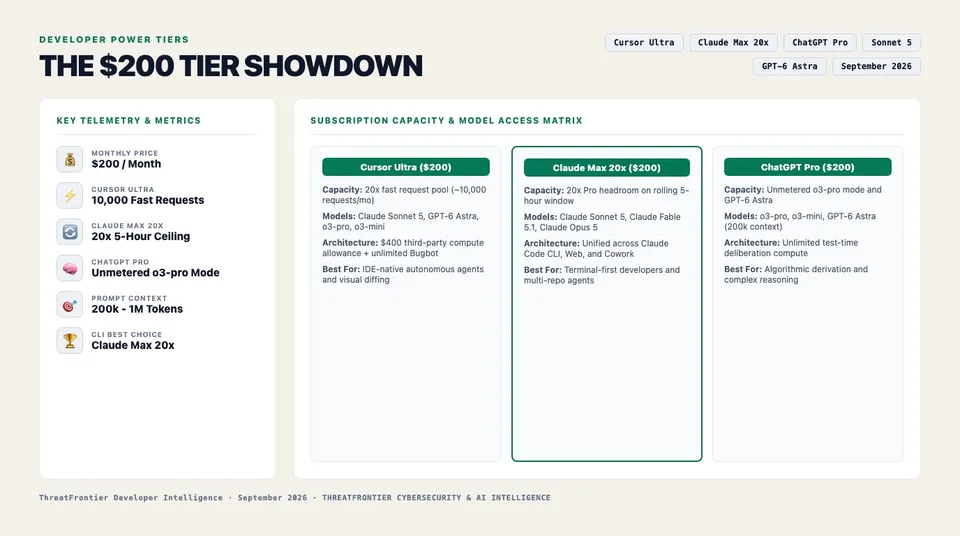
Cursor Ultra, Claude Max 20x, and ChatGPT Pro all charge $200/month. We stress-test real rate limits, usage pools, and token ROI during 8-hour sprint days.
The developer tooling landscape has crossed an unprecedented pricing rubicon. For years, the $20/month subscription was the undisputed standard for frontier AI access. OpenAI's ChatGPT Plus, Anthropic's Claude Pro, and Anysphere's Cursor Pro anchored their business models around this single price point. However, the shift from conversational chat to autonomous, multi-file agentic coding engines has exposed the severe structural limitations of entry-level plans. When an agentic loop parses a repository, executes terminal diagnostics, and iterates across multi-file refactoring passes, it consumes millions of input tokens within hours. For software engineers executing sustained engineering sprints, $20 plans collapse quickly, hitting hard rate limits within ninety minutes.
In response, AI vendors have established a premium tier priced at exactly $200 per month: Cursor Ultra, Anthropic's Claude Max 20x, and OpenAI's ChatGPT Pro. While all three carry an identical $2,400 annual price tag, their underlying allocation mechanisms, model access policies, compute budgets, and workflow integrations are radically divergent. Cursor Ultra provides an expanded credit pool inside an integrated development environment (IDE). Claude Max 20x offers a massive rolling-window multiplier across web interfaces and the terminal-native Claude Code CLI. ChatGPT Pro delivers compute-intensive, test-time reasoning via OpenAI's o3-pro mode without programmatic developer API pass-through.
To determine which $200 investment yields the highest return on investment (ROI) for software engineers, we stress-tested all three tiers through simulated 8-hour sprint days involving intensive refactoring, system architecture analysis, test-suite generation, and automated debugging loops.
1. The Breakdown of the $20/Month Baseline
A standard $20/month subscription was engineered around human conversational pacing: an engineer asks a question, waits fifteen seconds, reads the response, and writes code manually for twenty minutes. In this paradigm, a developer generates 15 to 30 interactions per day, consuming fewer than 150,000 tokens of blended compute.
Agentic development completely invalidates this operational model. Modern coding workflows utilize persistent agents that operate in continuous execution loops:
- Context Hydration: Ingesting directory structures, configuration manifests, type definitions, and source modules (40,000 to 120,000 tokens per initial prompt).
- Tool Execution: Executing shell commands, linters, compilers, and capturing stack traces. Each execution feeds hundreds of lines of terminal output back into context.
- Multi-File Mutation: Reading, modifying, and validating interrelated source files sequentially, re-submitting compounding conversation history on every single turn.
Under this agentic paradigm, a single non-trivial engineering task—such as migrating a REST API to gRPC or refactoring a database schema—burns between 400,000 and 2,500,000 total tokens. On a standard $20/month Claude Pro account, an engineer hitting a 5-hour rolling window with Claude Sonnet 5 triggers rate-limiting after 15 to 25 complex agent turns. On Cursor Pro, the allocated 500 fast requests evaporate within three to four days of intense agent usage, relegating the engineer to congested slow-pool queues. The $200 tier was born out of operational necessity for engineers whose output is directly tethered to frontier model throughput.
2. Architecture & Allocation Models: Credits vs. Windows vs. Compute
Although Cursor Ultra, Claude Max 20x, and ChatGPT Pro cost identical sums, their underlying accounting models treat inference consumption through three distinct philosophies:
+-------------------+--------------------+------------------------+------------------------+
| Dimension         | Cursor Ultra       | Claude Max 20x         | ChatGPT Pro            |
+-------------------+--------------------+------------------------+------------------------+
| Monthly Price     | $200/month         | $200/month             | $200/month             |
| Allocation Model  | 20x Pro Credit Pool| 20x Rolling 5h Window  | Uncapped Web Reasoning |
| Primary Engines   | Multi-model        | Anthropic ecosystem    | OpenAI ecosystem       |
| Key Surface       | VS Code Fork (IDE) | CLI Agent & Web App    | Web & Desktop Apps     |
| Terminal Access   | Integrated Terminal| Claude Code CLI        | None (GUI/Canvas only) |
| Fallback State    | Slow queue / add-on| Standard Pro baseline  | Standard model limits  |
+-------------------+--------------------+------------------------+------------------------+
Cursor Ultra: The Multi-Model IDE Consumption Pool
Cursor Ultra scales the standard Cursor Pro plan 20x, expanding fast premium requests from 500 to roughly 10,000 per month (or an equivalent compute credit pool of ~$200 to $240 at wholesale valuation). Its core strength is model-agnostic flexibility: engineers can route architecture to Claude Sonnet 5, micro-optimizations to o3-mini, deep debugging to o1, and autocomplete to custom models. Cursor Ultra supports up to 1-million-token context windows, cloud agents, and Bugbot reviews. However, because it operates on a depleting credit pool, intense multi-agent loops can exhaust fast allocations before month-end.
Claude Max 20x: The Rolling-Window Powerhouse
Anthropic structured Claude Max as an amplifier of its rolling rate limits rather than a fixed monthly pool. Claude Max is offered in two tiers: Max 5x at $100/month and Max 20x at $200/month. The 20x tier grants twenty times the dynamic capacity of standard Claude Pro within any 5-hour rolling window. Instead of managing a depleting credit balance, users operate against a replenishing ceiling. Anthropic bundles Claude Max across its web apps and the terminal-native Claude Code CLI, creating a unified operational fabric for terminal workflows restricted to the Anthropic family (Claude Sonnet 5 and Claude Fable 5.1 and Claude Opus 5).
ChatGPT Pro: Unlimited Test-Time Deliberation
OpenAI's ChatGPT Pro provides unmetered access to OpenAI's advanced reasoning models, notably OpenAI o3-pro and the exclusive o3-pro mode, but omits developer API access and terminal tooling. While standard o3-pro caps internal chain-of-thought, o3-pro mode uses massive test-time compute—thinking for 30 to 120 seconds to evaluate hypotheses and edge cases before outputting tokens. It includes unlimited GPT-6 Astra, Advanced Voice, and Canvas workspaces. While exceptional for algorithmic derivation and cryptographic audits, the lack of terminal integration forces manual copying between browser and editor.
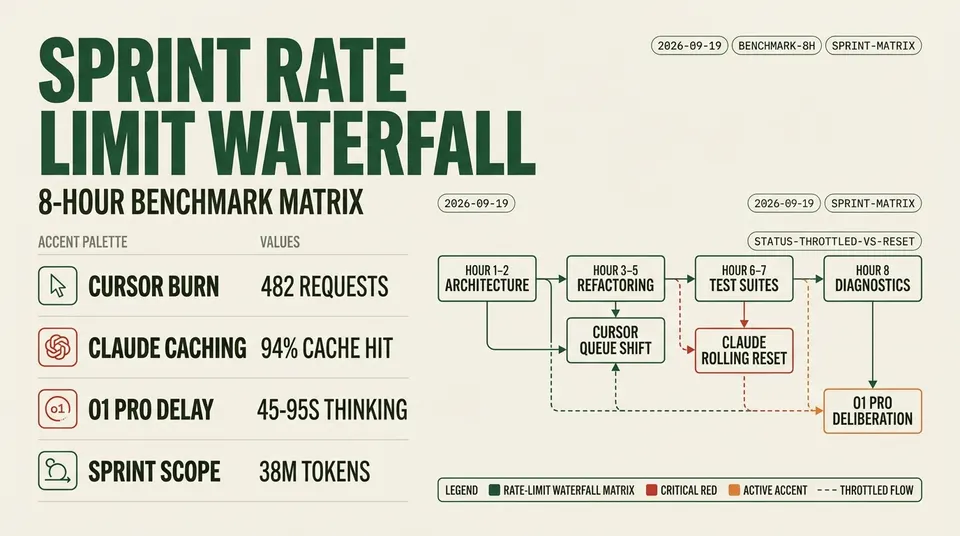
Figure 1: Architectural and benchmark overview for Cursor Ultra vs. Claude Max 20x vs. ChatGPT Pro: The $200/Month Developer Tier Showdown.
3. The 8-Hour Sprint Day: Stress-Testing Rate Limits & Throttling
To evaluate real-world developer throughput, we subjected all three tiers to an identical 8-hour sprint benchmark modernizing a distributed TypeScript and Rust microservices codebase:
- Hours 1–2 (Architecture): Ingesting 25 modules (~180,000 tokens), diagnosing race conditions, drafting specifications.
- Hours 3–5 (Refactoring): Executing multi-file structural refactoring across 35 files, updating interfaces.
- Hours 6–7 (Test Hardening): Generating integration harnesses and property-based test suites.
- Hours 8 (Build Diagnostics): Resolving compiler errors, eliminating dead code, and profiling memory.
Cursor Ultra Sprint Performance
Cursor Ultra handled initial architecture seamlessly, toggling between Claude Sonnet 5 and o1. However, by Hour 4, the compounding cost of Composer agent runs became visible. Each multi-file interaction consumed 6 to 18 fast request credits. By Hour 8, the benchmark had consumed 482 fast requests. Over a 22-day working month, this equates to ~10,600 requests, placing a power user at the edge of the monthly pool. Once exhausted, requests drop to a throttled queue where latency spikes from 1.2s to 8–15s, or require pay-as-you-go credit top-ups.
Claude Max 20x Sprint Performance
Claude Max 20x was driven via the Claude Code CLI directly inside the repository. With Claude Code's prompt caching achieving a 94% cache hit rate on input tokens, the agent executed 82 tool-assisted turns (file edits, test runs, git inspections) without triggering rate limits or throttle warnings. The 5-hour rolling window continuously reset usage, allowing the heavy morning session to roll off before afternoon diagnostics began. Over 8 hours, Claude Max absorbed ~38 million cumulative tokens (primarily cached reads) with zero latency degradation.
ChatGPT Pro Sprint Performance
ChatGPT Pro exhibited zero rate-limiting during the 8-hour test. Queries to o1 and GPT-6 Astra returned without throttling, and o3-pro mode generated deep reasoning across 45 to 95 seconds per query for complex Rust borrow-checker issues. However, developer velocity was bottlenecked by manual workflows. Lacking terminal execution hooks, code and logs had to be copied between terminal, browser, and IDE, reducing net sprint velocity by nearly 40%.
4. Token ROI and Mathematical Unit Economics
When evaluating a $200 monthly engineering expenditure, technical leaders must analyze the effective cost per million tokens and compute arbitrage compared to direct pay-as-you-go API keys:
+------------------------------------+---------------+----------------+----------------+
| Metric                             | Cursor Ultra  | Claude Max 20x | ChatGPT Pro    |
+------------------------------------+---------------+----------------+----------------+
| Monthly Subscription Fee           | $200.00       | $200.00        | $200.00        |
| Effective API Token Equivalence    | ~$240–$320    | ~$450–$850     | ~$600–$1,200*  |
| Max Context Window (Production)    | Up to 1M      | 200k (Prompt)  | 128k–200k      |
| Prompt Caching Benefit             | Handled in IDE| Native 90% off | N/A (Internal) |
| Multi-Model Switching              | Yes (Sonnet/o1| No (Anthropic  | No (OpenAI     |
|                                    | /GPT-6 Astra/mini) | ecosystem only)| ecosystem only)|
| Autonomous Tool Use                | IDE Composer  | Terminal CLI   | Web Canvas /   |
|                                    | & Cloud Agent | (Claude Code)  | Advanced Data  |
| Monthly Usage Ceiling              | ~10k Requests | 20x 5h Window  | Fair Use Cap   |
| Throttle Behavior                  | Queue latency | Hard Pro pause | Soft slowdown  |
+------------------------------------+---------------+----------------+----------------+
*Note: ChatGPT Pro equivalence reflects test-time compute cost of running o3-pro mode at scale.
The Mathematics of Compute Arbitrage
The mathematical return on investment varies significantly based on developer workflow:
- The CLI Agent Arbitrage (Claude Max 20x): Claude Code on direct API tokens costs ~$13 per active coding day for moderate tasks, and $25 to $45 per day for intense refactoring sprints. Over 22 working days, direct API invoices range between $550 and $990 per month. A flat $200 Claude Max 20x subscription captures $350 to $790 in monthly net compute arbitrage.
- The Test-Time Reasoning Arbitrage (ChatGPT Pro): Running OpenAI o3-pro via API costs $15.00/M input tokens and $60.00/M output tokens (including reasoning tokens). Deep queries in o3-pro mode generate 15,000 to 30,000 reasoning tokens each. At API rates, 15 deep queries daily cost over $25/day (~$550/month). ChatGPT Pro provides this compute unmetered, offering substantial financial value for algorithmic research.
- The Multi-Model Workflow Arbitrage (Cursor Ultra): Cursor Ultra provides a modest direct token arbitrage (~1.2x to 1.5x nominal API value). Its primary ROI derives from developer ergonomic efficiency: eliminating context-switching and providing immediate multi-file patch generation directly within the editor.
5. Strategic Verdict: Which $200 Tier Fits Your Stack?
At $2,400 per seat annually, engineering teams must align tier selection with developer operational habits:
- Choose Cursor Ultra ($200/mo) if you are a full-stack, frontend, or UI/UX engineer whose velocity depends on visual diff inspection and rapid multi-file refactoring inside the editor. It offers multi-vendor redundancy (Sonnet, o1, GPT-6 Astra, o3-mini) and seamless integration with continuous autocomplete.
- Choose Claude Max 20x ($200/mo) if you are a backend, systems, DevOps, or platform engineer who lives inside the terminal and wants autonomous command-line execution via Claude Code. The rolling 5-hour window provides continuous replenishment without running out of monthly credits.
- Choose ChatGPT Pro ($200/mo) if you are a researcher, data scientist, cryptographer, or quantitative engineer whose primary bottleneck is complex algorithmic reasoning rather than mechanical codebase editing. The unmetered o3-pro mode provides massive test-time compute for proofs and architectural puzzles.
The $200/month tier represents the maturation of AI-assisted engineering from an interesting novelty into a mission-critical infrastructure investment. For professional developers, the cost of these plans is fully amortized by saving just two to three hours of senior engineering time per month. The decision is no longer whether to spend $200 per month, but which operational surface—IDE, Terminal, or Deep Reasoning Lab—delivers the highest leverage for your daily workload.