ChatGPT Pro $100 vs $200 vs $500 explained: usage vs Plus, the new Ultrafast tier, and the Pro 200 cut from 30 Oct. See which plan fits your work.
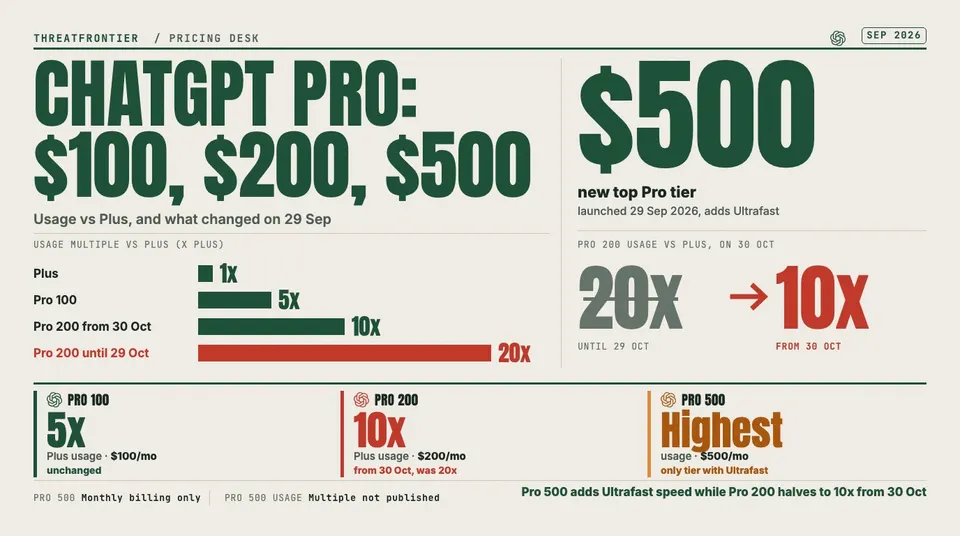
OpenAI now sells three Pro plans, and they are the same product with different fuel tanks. Pro $100 is Pro 5×, five times Plus usage. Pro $200 is the older high-capacity tier, and from 30 October 2026 it drops to 10× Plus. Pro $500, new on 29 September 2026, has the highest included usage of the three and is the only plan with Ultrafast, a faster service tier for GPT-6 Astra. For users already hitting Plus walls, the choice is still mostly headroom, not a different model suite. Anthropic frames its own plans the same way: Claude Max splits into 5x and 20x usage tiers, and it has no consumer tier above $200.
Quick answer
| Plus | Pro $100 | Pro $200 | Pro $500 | |
|---|---|---|---|---|
| Price | $20 | $100 | $200 | $500 |
| Usage vs Plus | 1× | 5× | 20× until 29 Oct (grandfathered), 10× after and for new sign-ups | Highest of the three (25× reported, not official) |
| Ultrafast | No | No | No | Yes |
| Five-hour cap | Yes | No | No | No |
Start at $100 and move up only when the weekly limit binds. The per-model Codex numbers live in the GPT-6 usage limits by plan reference.
What changed since July: GPT-6 Astra reached ChatGPT on 3 September, with Sol and Luna following on 22 September; the five-hour window was removed and then reinstated for Plus only; Pro $500 and Ultrafast launched on 29 September, with Ultrafast now covering GPT-6 Astra and GPT-6.1 Sol; and the Pro $200 allowance halves on 30 October. GPT-5.5 retires from ChatGPT, Work and Codex on all plans on 14 October 2026. OpenAI's Codex pricing page has also moved to learn.chatgpt.com/docs/pricing.
Update — 29 September 2026: Pro $500 launched, Pro $200 reopened, and the $200 allowance is being halved. At DevDay, OpenAI announced Pro 500 at $500 a month and lifted the pause on Pro $200 that had blocked new sign-ups and upgrades since 10 September. The catch is the allowance. From 30 October, included usage in ChatGPT Work and Codex falls from 20× to 10× Plus, and GPT-6 Pro chat messages fall from 200 to 100 a week. The price stays at $200. OpenAI's stated reason is its increasingly efficient models.
Who keeps the old allowance for now is set by a fixed window. OpenAI's Help Center says grandfathering applies if you had an active Pro $200 subscription at any point from 22 September 2026 through 10 a.m. Pacific Time on 29 September 2026. Those subscribers keep the previous allowance through 29 October while the subscription stays active, then move to the lower one. Anyone who signs up for Pro $200 now gets the lower allowance from day one. Coverage of the announcement also reports a one-time grant of 62,500 usage credits, valued by OpenAI at $2,500, for existing subscribers, expiring on 31 December 2026. Keeping the old allowance does not turn a Pro $200 plan into Pro $500 or add Ultrafast. Pro $100 was not part of the changes. The full breakdown of the new tier is in ChatGPT Pro 500: What $500 a Month Buys.
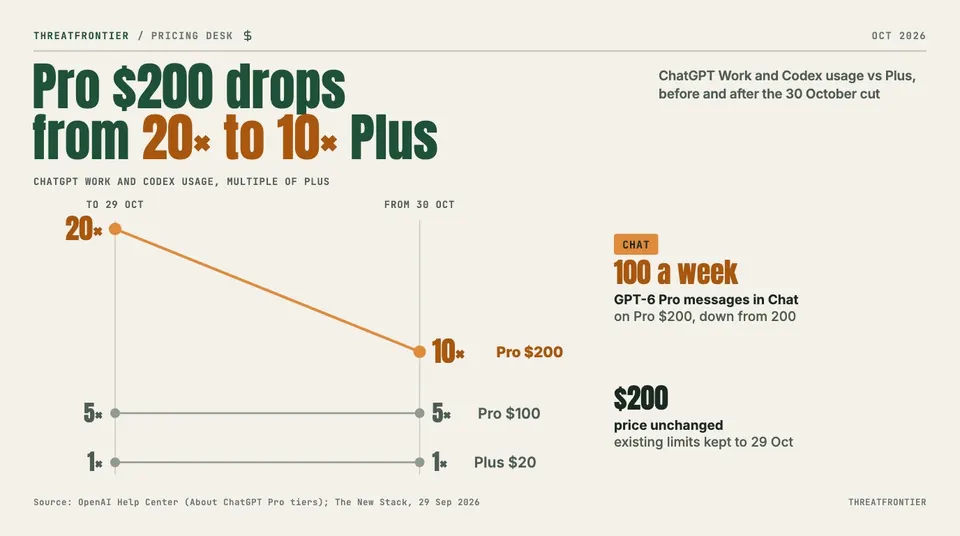
Pro $200 halves from 20× to 10× Plus on 30 October 2026; Pro $100 and Plus are unchanged. Sources: OpenAI Help Center, The New Stack.
Pricing snapshot: Plus, Pro 5×, Pro 10× and Pro 500
| Plan | Monthly price | Official usage framing vs Plus |
|---|---|---|
| Plus | $20 | Baseline (1×) |
| Pro $100 | $100 | 5× higher usage than Plus |
| Pro $200 | $200 | 20× until 29 October 2026 (grandfathered subscribers only), 10× from 30 October |
| Pro $500 | $500 | Highest included usage of the three plans; reported as 25×, not printed on OpenAI's own pages; Ultrafast included |
OpenAI's Help Center says the Pro tiers share the same core capabilities and differ mainly in usage allowance. For Pro $500 it publishes no multiple at all. Its wording is only that Pro 200 includes more usage than Pro 100, and Pro 500 offers the highest included usage of the three. Launch coverage, including The New Stack, reports Pro $500 at 25× Plus. OpenAI's Help Center and pricing page do not print that figure, so treat it as reported rather than confirmed. If it holds, Pro $500 works out to the same $20 per multiple of Plus as the two cheaper tiers.
The price-to-capacity math changes on 30 October. $20 → $100 is a 5× price step for a 5× capacity step, and after the cut $20 → $200 is a 10× price step for a 10× capacity step. That makes Pro $100 and Pro $200 the same $20 per multiple of Plus, which is also what Plus costs. The $200 plan now buys a higher ceiling and more per-model headroom, not a better rate. Pro $500 can only be scored this way on the reported 25× figure, because OpenAI's own pages do not give a multiple. Annual or multi-month prepay is not available for Go, Plus or Pro, and Pro 500 is billed monthly only.
Pro launched as a single $200 plan; the $100 tier arrived on 9 April 2026 as a mid-tier option, especially for Codex-heavy demand, without changing Pro's role as a capacity product on shared Pro-grade access. Ignore any lingering "10× Codex" framing for the $100 tier from its launch window; 10× is now the Pro $200 figure. That was a promotion, it ran through 31 May 2026, and it is over. Steady-state for Pro $100 is 5×.
How rate limits work
OpenAI does not publish a fixed "messages per day" guarantee for every model. Official framing is multipliers vs Plus, plus windows and per-model allowances.
Multipliers. Think in 5× for Pro $100, 20× then 10× for Pro $200, and "highest" (reported 25×) for Pro $500, all relative to Plus. Some models carry separate allowances. When one is exhausted, that model can become temporarily unavailable until reset; ChatGPT may show a reset time. Hitting an allowance is not an account ban or subscription end. You can switch models or wait. The $100 tier has lower per-model allowances than $200.
Codex and agentic work. ChatGPT Work and Codex share one agent usage allowance, so local messages, cloud tasks and Work sessions all draw from the same pool. OpenAI's Codex pricing docs give per-model estimates of local messages, with five-hour estimates shown for Plus and Standard Business only, and weekly limits may also apply. A separate Codex-specific breakdown covers GPT-6 Astra, Sol and Luna message allowances by plan.
The five-hour window is not the Pro constraint. OpenAI removed the rolling five-hour cap in July 2026, then reinstated it on 25–26 August 2026 for Plus only. It stays off on the Pro tiers, and OpenAI has said it will not bring it back for Pro. On Pro, the weekly limit is the live ceiling. OpenAI's pricing page now says Pro plans currently have no five-hour limit, so any older five-hour figure you see for Pro is out of date.
Usage depends on task size, complexity, model, local vs cloud, reasoning, tools and context, not prompt count alone. Image generation burns included limits about 3–5× faster on average. Speed-oriented modes also consume faster: Fast mode is charged at 2.5× the Standard rate against your plan allowance (2× when paying with purchased credits), and Ultrafast at 8× (6× with purchased credits). Live tables show range bands that scale with the official multipliers; those bands drift and are orientation, not a permanent quota.
After included limits. Plus and Pro can buy credits to continue without upgrading, or run extra local tasks against an API key at API rates. Purchased credits last 12 months and are separate from API billing. The break-even math between the ChatGPT API and a Plus subscription helps decide when that overflow path is worth it.
Pro 500 and Ultrafast: what the extra $300 adds
Pro $500 is Pro $200 plus two things: the highest usage allowance in the lineup, and Ultrafast. Ultrafast is a faster service tier for GPT-6 Astra and GPT-6.1 Sol in ChatGPT Work and Codex, selected from the model picker. OpenAI says it is up to eight times faster than Astra Standard at generating tokens in Codex, at up to about 300 tokens per second. Among personal plans, only Pro $500 can use it; OpenAI's speed page also lists eligible Enterprise and Edu plans. Buying extra credits on Pro $100 or Pro $200 does not unlock it. For data residency, GPT-6.1 Sol Ultrafast supports inference residency in the United States and Europe (EEA + Switzerland), while GPT-6 Astra Ultrafast supports the United States only.
Two caveats matter before you pay for it:
- "Up to 8×" is a token-generation speed, not a task-completion speed. If a 10-minute Codex task spends two minutes generating and eight minutes running tools, tests and waiting on external services, Ultrafast saves roughly a minute and three-quarters, not eight and a half.
- Ultrafast spends your allowance faster. It consumes plan usage at 8× the Standard rate, and purchased credits at 6×. The more you run it, the sooner the weekly limit arrives.
For a full walk-through, see ChatGPT Pro 500: What $500 a Month Buys.
Feature parity: same Pro core, different headroom
Between $100 and $200, the upgrade is almost pure capacity, with one published exception.
Both tiers include the Pro model set and Pro package: Codex, deep research, image creation, memory, file uploads and related tools. The exception is voice: unlimited ChatGPT Voice on desktop is a $200 line item. OpenAI's plan-dependent desktop Voice allowances run roughly 30 minutes–1 hour on Plus, about 3–6 hours on Pro 5× ($100), and unlimited on Pro $200. Unlimited voice does not make Codex tasks unlimited; tasks started through Voice still draw on your Codex usage budget.
Pro $500 shares the published Pro feature list with Pro $200, including memory and a 100 GB file library, and adds Ultrafast. It does not add a separate model suite. Dot, the always-on agent OpenAI announced at DevDay, is listed on the pricing page for Pro as a whole, not for Pro $500 alone.
GPT-5.3-Codex-Spark (research preview) was the other Pro-versus-Plus differentiator, and it is on its way out. OpenAI announced on 11 September 2026 that Spark would be retired the following week, citing declining usage and better models in the lineup, so do not buy a Pro tier for it. Third-party "Pro exclusives" are otherwise generally Pro vs Plus distinctions, not a hidden gap between the Pro prices. If a model feels missing on $100, the official explanation is usually a lower allowance, not a locked SKU.
How to switch and bill
- Entry: Pricing page or Settings → My Plan
- Upgrade (Plus → Pro $100): new limits apply immediately; billing cycle starts over
- Pro $200: open to new subscribers again since 29 September 2026. New sign-ups get the reduced 10× allowance straight away; grandfathered subscribers move to it on 30 October. Cancelling and re-subscribing on the same account keeps grandfathering only if you were in the 22–29 September window. Check Settings → My Plan for your own upgrade path
- Pro $500: sold through ChatGPT on the web at launch, monthly billing only
- Downgrade (including Pro → Plus, or $200 → $100): effective at next renewal; keep current plan until then
- Cancel: access through period end, no renewal
- No annual plan for Go, Plus or Pro
Guardrails still ban automated extraction, account sharing and reselling; temporary restrictions can appear with in-product notice.
Who should buy which tier
Stay on Plus ($20) if limits hit infrequently, waiting for a five-hour or weekly reset is fine, credits cover rare overflow, and you do not need sustained Pro-model or max Codex density. Plus is the tier that carries both a rolling five-hour cap and a weekly cap as of 26 August 2026.
Choose Pro 5× ($100) if Plus regularly dies mid-session, you need Pro capabilities without all-day multi-agent volume, and a few weeks of use show 5× matches your bursts. This is the default for power knowledge workers and freelancers who lose billable time to walls but are not running continuous parallel agents. Since $100 and $200 now cost the same per multiple, you lose nothing on price by starting at $100 and moving up only when weekly limits actually bind.
Pro $200 (10× from 30 October) fits continuous Codex, long-context sessions and parallel agents where 5× is genuinely too small, and where you do not need Ultrafast. If you held it at any point between 22 September and 29 September 2026, you keep 20× until 29 October; a new subscription starts at 10×. A deeper look at which tier actually fits continuous agentic Codex work breaks down the older 5× versus 20× trade-off, which the cut has changed.
Pro $500 is for people whose bottleneck is waiting for the model to write, not running out of allowance: interactive Codex sessions where you watch every token, and teams billing that time to a client. If your tasks are mostly tool execution, tests and long-running jobs, the speedup shrinks and the 8× allowance burn works against you. Try Ultrafast on real work before committing, because the plan is monthly and can be dropped at renewal.
Before you pay: Log limit hits for 1–2 weeks (time of day, model, local vs cloud, context size). A practical playbook for tracking rate limits across ChatGPT, Claude and Cursor covers how to log that data cleanly. Prefer official multiplier language over third-party absolute message counts or expired promo multipliers. Re-check the Help Center Pro tiers page and live pricing tables before you buy: bands, model names and plan availability changed several times in September 2026. Limits are dynamic and load-sensitive; fair-use and Terms always apply; API and ChatGPT are separate bills.
Bottom line
ChatGPT Pro now comes in three sizes: Pro $100 unlocks 5× usage versus Plus; Pro $200 unlocks 20× until 29 October and 10× after; Pro $500 unlocks the highest usage and Ultrafast. The $100 and $200 tiers share the same core Pro capabilities, with unlimited desktop Voice as the one $200 extra. After 30 October both cost the same per multiple of Plus, so the real decision is where your weekly ceiling sits. Weekly caps are the live Pro limit, the five-hour window applies to Plus only, and per-model allowances sit underneath. Measure your limit hits for a couple of weeks, try credits for overflow, then buy the lowest tier that keeps work moving. Pay for $500 only when generation speed, not allowance, is what slows you down.
Sources
- About ChatGPT Pro tiers, OpenAI Help Center
- ChatGPT pricing, OpenAI
- Codex pricing, OpenAI
- Speed modes: Fast and Ultrafast, OpenAI
- OpenAI halves $200 plan allowance, launches $500 plan, The New Stack, 29 September 2026
- OpenAI adds $500(!) Pro subscription, nerfs its existing $200 tier, Engadget
Related reading
- ChatGPT Pro 500: What $500 a Month Buys
- ChatGPT Pro $100 vs $200: Which OpenAI Codex Plan Gives Developers More Real-World Usage?
- Google AI Ultra vs Claude Max vs ChatGPT Pro: Which $100 or $200 Plan for Developers?
- Claude Code vs OpenAI Codex Limits: Which $100 or $200 Plan Is Better for Developers?