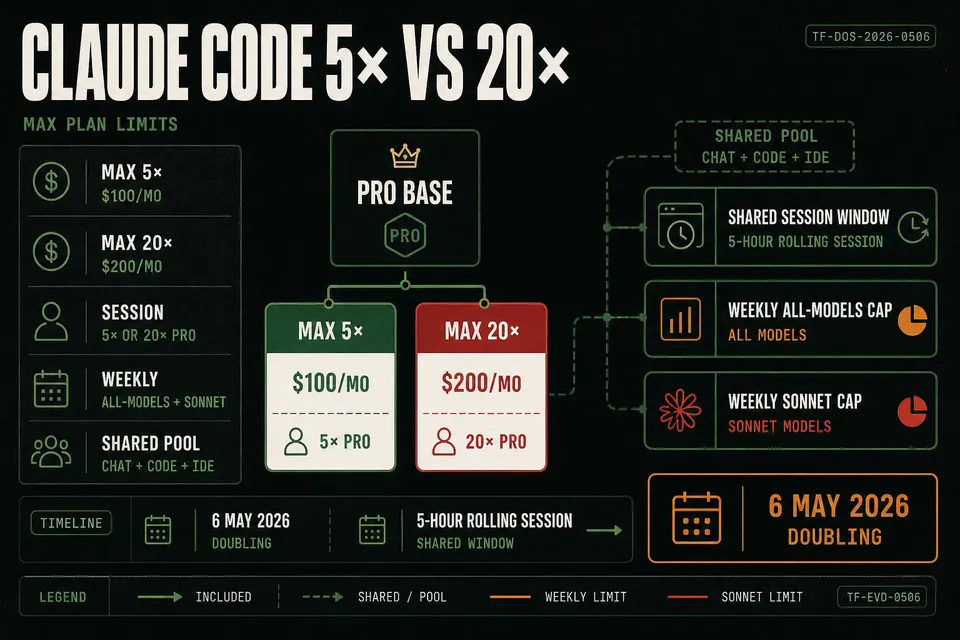
Claude Code Max 5× ($100) vs 20× ($200) explained: shared session & weekly caps with chat, agent burn rates, hygiene tips, and when each plan fits developers.
Claude Code is not a separate product. It rides the same Anthropic Pro or Max subscription that powers Claude on web, desktop, and mobile, and every file read, tool call, and agent loop draws from one shared usage pool with ordinary chat. Max is sold as Max 5× at $100 per month and Max 20× at $200 per month—each framed only as a multiplier of Pro usage per session. Multi-file refactors and long autonomous agents burn that pool far faster than research chat, so choosing 5× versus 20× is a budgeting decision for developers and engineering leads.
How Claude Code attaches to Max and shares limits with chat
Claude Code is included with Pro and Max. Free Claude.ai does not unlock it. For how Claude Code stacks up against other terminal agents on price and sandboxing, see Claude Code vs Codex CLI vs Antigravity CLI vs OpenCode. Install the terminal tool or a supported IDE extension for VS Code, Cursor-style forks, or JetBrains, authenticate with the same credentials used for claude.ai, and the subscription covers both surfaces. One trap matters: if ANTHROPIC_API_KEY is set, Claude Code bills the Console API instead of the subscription. Removing the key and logging in with plan credentials keeps usage inside the prepaid allotment.
Anthropic’s official language is unambiguous. Max 5× delivers five times more usage per session than Pro; Max 20× delivers twenty times more. Both Max tiers also carry two weekly usage limits—one across all models and a separate Sonnet-only cap. Those weekly limits reset at a fixed time assigned to each account, visible under Settings → Usage; the reset day does not slide with first use. All activity—claude.ai chat, Claude Code in the terminal, supported IDE sessions, and Cowork multi-step work on desktop—counts against the same pool. A heavy coding afternoon leaves less headroom for evening research chat, and vice versa.
Short-term control sits on a five-hour rolling session that opens with the first prompt. On 6 May 2026 Anthropic doubled Claude Code’s five-hour rate limits for Pro, Max, Team, and seat-based Enterprise and removed the peak-hours reduction for Pro and Max Code, citing new SpaceX Colossus capacity. Older posts that still describe weekday morning throttling are outdated for Pro and Max Code.
When the shared budget is exhausted the product presents clear options: wait for the session or weekly reset, upgrade (Pro to 5×, 5× to 20×), enable usage credits that continue at API-like rates after the included allotment, or explicitly switch to Console pay-as-you-go for an intensive sprint. Credits and API billing always require user consent; auto-reload lives in the Console, not inside Claude Code.
What 5× and 20× mean in practice
Anthropic no longer publishes fixed “messages per hour” or “hours of Sonnet per week” as official consumer numbers. The hard published facts remain the multipliers, the dual weekly structure on Max, the shared pool, and the May 2026 doubling. Everything beyond that is independent testing and community observation and must be treated as highly task-dependent.
Independent analyses after the doubling commonly place Pro in a rough band of tens of active Sonnet hours per week, Max 5× several times higher, and Max 20× higher still, with a far smaller Opus allowance even on the top tier. Prompt-per-window ranges reported in the same tests run from roughly tens on Pro through low hundreds on 5× into the mid-to-high hundreds on 20× inside a single five-hour window. Those figures are not Anthropic SLAs; they vary with context size, tool rounds, model choice, and whether extended thinking is enabled. The only reliable official framing is still 5× or 20× the Pro session budget, plus Max’s dual weekly all-models and Sonnet caps that reset on a fixed account schedule.
Inside Claude Code the commands /usage and /status surface remaining capacity. On the web, Settings → Usage shows the weekly reset clocks for each bucket. A cross-tool approach is covered in monitoring AI rate limits across ChatGPT, Claude and Cursor. Clearing a conversation with /clear does not restore quota; only the session window, the weekly reset, or paid overflow does.
Burn rate and hygiene: why agents exhaust budgets faster
Claude Code is an agent, not a single-turn chat box. One user instruction routinely expands into dozens of file reads, greps, edits, tool results, and history re-injections. Every one of those tokens counts against the shared pool. Fixed overhead compounds the problem: CLAUDE.md and its import tree are loaded every session, auto-memory files contribute by default, and every connected MCP server injects its full tool schemas on every turn even if the tools are never called. Long unbroken sessions reprocess growing history; extended thinking tokens count as output; Opus is more expensive per token than Sonnet.
A light research day of short Q&A may leave most of a five-hour window intact. A carefully scoped edit session that touches a handful of files on Sonnet can fit inside Max 5× for part-time use. The same clock period spent on an agent that walks a monorepo, maintains long context, and loops on tool results can empty a session window in a couple of wall-clock hours—even on Max. Sustained multi-day agent work plus normal chat then collides with the weekly all-models or Sonnet-only cap even when individual five-hour windows still look healthy.
The practical hygiene is the same list that reduces burn: keep CLAUDE.md short (commonly guided under roughly 200 lines), path-scope rules, disconnect idle MCP servers, disable unused auto-memory, prefer Sonnet for mechanical work and reserve Opus for architecture, start a fresh session per task, and run /compact when history bloats. Check Settings → Usage before long runs so weekly reset times are known; poll /status and /usage in the terminal rather than discovering the wall mid-refactor. Decline API credits if the goal is to stay strictly on the subscription; remove any ANTHROPIC_API_KEY that would silently switch billing. None of those steps increase the official multiplier; they reduce the fixed tax that multiplies every agent turn.
Decision thresholds: when Max 5× is enough and when 20× becomes necessary
Anthropic positions Max 5× for frequent users who work with Claude on a variety of tasks and Max 20× for daily users who collaborate with Claude for most tasks. Mapping those phrases onto real Code intensity produces a practical matrix.
Part-time Code—a few focused hours per week, mostly Sonnet, scoped files, light accompanying chat—rarely exhausts the five-hour window and almost never hits weekly caps. Max 5× is the natural fit; light enough users may even stay on Pro. Daily but bounded bursts that stay under roughly half a day of careful, context-hygienic work can also live on 5× provided weekly headroom is watched. Full-time pairing, multi-file agents most days of the week, multi-repo work, or Opus-heavy architecture sessions reliably press both the session multiplier and the weekly buckets; those patterns match Max 20×. Teams running 24-hour shared agents or heavy CI should look past consumer Max toward Team/Enterprise or an API gateway, because the individual Max plans are not designed as shared farms.
Upgrade triggers follow the same logic. Pro users who consistently hit limits on larger repositories should consider Max 5×. Max 5× users who still hit limits week after week should move to 20× rather than treating every spike as a reason to pay for overflow. One-off sprints can be handled with usage credits or a temporary Console switch without permanently raising the subscription.
Claude Max + Code versus ChatGPT Pro + Codex
Both ecosystems offer a similar consumer price ladder—about $20 entry paid, then roughly $100 and $200 heavy tiers—but the metering units are not 1:1 comparable. One alternative some teams weigh is splitting $200 between both ecosystems instead of maxing out one. Claude Code meters through opaque capacity expressed as session multipliers plus weekly all-model and Sonnet caps, all shared across chat, terminal, IDE, and Cowork. Codex meters primarily in messages and model credits inside a five-hour window, often with separate or differently budgeted allowances for certain cloud tasks and code-review flows, and without the same style of dual weekly hour structure.
Quality and efficiency narratives diverge as well. Many developers still prefer Claude Code for long interactive agent sessions and large-context multi-file work. Independent cost anecdotes and comparisons frequently report that Codex completes similar agent tasks with lower effective token spend or lower percentage of the weekly budget. For the OpenAI side, see which ChatGPT Pro tier suits Codex developers. The correct decision is therefore not “which $200 plan gives more messages” but “which metering shape matches the work.” Long uninterrupted terminal pairing and context-heavy refactors lean Claude Max; high-volume parallel cloud tasks, automated PR review, and token-efficiency focus lean Codex. Teams that need both usually end up with one primary interactive stack and API overflow for the other. Developers exploring cheaper alternatives can also compare MiniMax's Plus, Max and Ultra token plans.
Claude Code’s power comes from the same agent loop that makes its limits feel tight. Part-time or carefully scoped terminal work that still needs headroom beyond Pro fits Max 5× at $100. Daily multi-file agents, multi-repo sessions, or Opus-heavy architecture fit Max 20× at $200. Both tiers share every token with chat and IDE surfaces under a dual session-plus-weekly regime Anthropic still describes only in multiplier language.