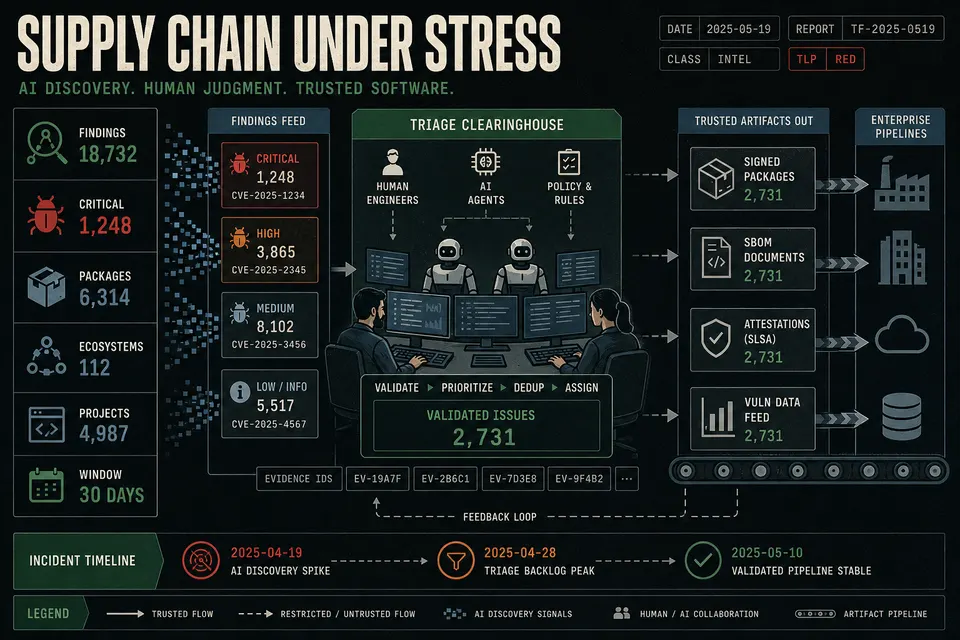
With NVD enrichment stalled and bounty programs closing, coordination is shifting to systems that turn findings into rebuildable artifacts before exploits land.
In the first half of 2026, AI agents scanned more than a thousand open-source projects and surfaced tens of thousands of issues. Coordinated disclosure timelines stretched. Bug bounties closed. The U.S. National Vulnerability Database stopped routine enrichment of most new CVEs. The discovery flood had arrived; the human coordinate-and-patch model could not keep up. What is taking shape instead is AI automated vulnerability orchestration open source—triage agents, signed remediation catalogs, and clearinghouses that convert findings into rebuildable artifacts before exploit windows close.
The discovery flood
Anthropic’s Project Glasswing, powered by the restricted Claude Mythos Preview model, became the clearest public signal. After scanning more than 1,000 open-source projects, the effort logged 23,019 issues, of which 6,202 were rated high or critical. Independent security firms assessed 1,752 of those high- and critical-severity findings; more than 90 percent validated as true positives. Partners including Cloudflare and Mozilla each reported hundreds of findings. One illustrative case involved a certificate-forgery class issue in wolfSSL—already patched, with technical details still under embargo.
Parallel pressure hit the rest of the ecosystem. Trend Micro’s Zero Day Initiative reported roughly a 450–490 percent surge in AI-driven submissions across mid-2026 windows, including year-over-year spikes cited in public ZDI and Pwn2Own Berlin reporting; programs said they were struggling to keep up, and the Internet Bug Bounty paused submissions. Daniel Stenberg ended the curl bug-bounty program on 31 January 2026 after confirmed rates collapsed from historical levels above 15 percent to below 5 percent in 2025 under a wave of low-quality “AI slop.” Historically the program had confirmed 87 vulnerabilities and paid more than $100,000. NIST’s National Vulnerability Database announced in April 2026 that it would enrich only CISA Known Exploited Vulnerabilities, federal-used software, and Executive Order 14028 “critical software.” Everything else moved to “not scheduled.” CVE submissions had risen 263 percent between 2020 and 2025; the NVD enriched nearly 42,000 records in 2025 and still fell behind. Mandatory reporting rules are arriving alongside that backlog; see how the EU Cyber Resilience Act's Article 14 changes vulnerability reporting.
The bottleneck is no longer finding bugs. It is verifying them, writing correct patches, coordinating multi-project disclosure, and shipping signed updates enterprises can consume.
How AI scanners outpace SAST, DAST, and fuzzing
Classic static testing relies on hand-written rules and produces high false-positive rates. Dynamic testing needs running systems. Coverage-guided fuzzing remains strong on memory-corruption surfaces yet historically misses many semantic, authorization, and cryptographic-misuse bugs, and some variants of already-patched issues.
Agentic systems change the loop. Models trained on large code and vulnerability corpora locate entire classes of flaws from natural-language prompts. Agents then read source, hypothesize, write proof-of-concept exploits, iterate, and chain issues. Variant analysis from prior commit diffs lets them hunt remaining similar defects. Non-experts can produce both real findings and convincing false reports with commercial models. Used carefully, the same agents also draft suggested fixes.
Google’s Project Zero / DeepMind Big Sleep effort illustrated the shift as early as 2024 by finding an exploitable memory-safety zero-day in SQLite that existing harnesses had not surfaced; the fix landed the same day, before release. Open-weight models are catching up fast on raw vulnerability-reproduction scores too: see Xiaomi's MiMo-V2.6 breaking the CyberGym ceiling with MIT-licensed weights. Commodity models already generate usable reports with simple prompts. Frontier Mythos-class systems raise both true-positive rates on high-severity issues and the dual-use risk of automated exploit generation. GLM-5.3's own cybersecurity benchmark results show a similar frontier-capability-versus-operational-reality gap on the defensive side.
Discovery is parallelizable compute. Validation, correct patching, regression testing, coordinated disclosure, and safe rollout remain serial human and organizational processes.
Where the manual model breaks
CNCF and practitioner analyses describe a four-stage pipeline: scanning, triage and analysis, fix development and release, and production consumption. Stages two through four clog first.
Volunteer maintainers spend hours or days on reports that turn out to be threat-model mismatches, unit-test-only “PoCs,” non-compiling samples, or duplicates. Bug bounties that once attracted skilled researchers now attract volume; quality collapses and programs pause or shut. High-value chains sit mixed with low-severity noise, so prioritization fails. Downstream, enterprises face certification, regression risk, and long-lived version pins; even after an upstream fix lands, exposure continues. Maintainers describe the mental load as “death by a thousand slops.”
Open-source code constitutes the bulk of modern codebases, with download volumes in the trillions annually and average applications carrying hundreds of known vulnerabilities. A finding that is real but unpatched is an open window for anyone who obtains the same agent capability.
Clearinghouses and automated triage
Industry response has moved from pure discovery tooling to orchestration.
IBM and Red Hat’s Lightwell effort, backed by a $5 billion open-source security commitment and more than 20,000 engineers, and positioned by the companies as a response to Mythos-class discovery velocity, moved into commercial offerings in July 2026. Lightwell Network launched with a catalog of more than 6,500 remediated, signed application-layer dependencies (Java and Python first), complete with SBOMs for pipeline consumption. Lightwell Clearinghouse Premier provides limited-availability embargo windows, member-specific versions, and vertical coordination, starting with financial services. The model emphasizes AI-assisted remediation plus human engineering oversight, backports to long-lived versions, and an upstream-always posture. Major banks signed on early; partners span hyperscalers and security vendors. Catalog size and design are launch claims; independent long-term MTTR outcomes remain to be measured.
Anthropic continues Glasswing with partners including AWS, Apple, Google, Microsoft, the Linux Foundation, and CrowdStrike, plus an Alpha-Omega partnership to help maintainers triage. Claude Security is in enterprise beta; Mythos-class models remain gated, with Anthropic stating that no company yet has safeguards strong enough for general release.
Hadrian open-sourced OpenHack as a multi-agent workspace: discovery, an independent triage agent for exploitability and severity, and attack planning on white-box code. Red Hat and others productized event-driven patterns—scanner alerts trigger containment, AI-assisted remediation generation from CVE/SIEM/CMDB data, human approval gates, then patch and reverse containment—with signed content libraries and ITSM audit trails.
Some vendors frame mean time to exploit as already negative under AI pressure—disclosure as a starting gun rather than a finish line. Throughput and upstream acceptance, not pool size alone, become the operative metrics.
Dual-use, leaders, and what success looks like
The same agent loop that finds and chains bugs can write exploits and explore evasion. Anthropic has acknowledged both the productivity help existing tools already give threat actors and the short-term attacker advantage possible before defensive scale catches up. Observed stress so far centers less on named nation-state Mythos campaigns—public attribution remains thin—and more on volume as a denial-of-service against maintainer attention, non-compiling PoCs, severity inflation for bounties, and filter-training efforts by programs such as ZDI.
Leaders span model labs (Anthropic Glasswing, Google Big Sleep lineage), foundations (OpenSSF Alpha-Omega, CNCF threat-model and report-quality guidance), enterprise remediation platforms (IBM/Red Hat Lightwell, Sonatype-style VulnOps), open tooling (OpenHack), and canary maintainers (curl, Kubernetes security teams, Mozilla, Cloudflare, wolfSSL). NIST’s risk-based NVD policy and CISA KEV act as prioritization anchors under strain.
Early success signals include true-positive rates above 90 percent on assessed high/critical Mythos subsets, same-day pre-release fixes such as Big Sleep’s SQLite case, Lightwell’s multi-thousand package catalog at launch, and programs adopting AI-assisted first-pass triage. Failure signals remain stark: early claims that fewer than 1 percent of discovered potential issues were fully patched at disclosure time, bounty deaths, NVD structural backlog reclassification, and persistent enterprise upgrade friction. Optimists expect pre-release AI finding plus automated remediation to favor defenders. Pragmatists warn of short-term attacker edges, two-tier security if only paying customers receive backports, and automation that recreates noise at higher speed when human threat-model judgment is skipped.
Practical steps this quarter
Maintainers
- Publish an in-repo threat model with explicit out-of-scope classes
- Require working PoCs on real project interfaces; reject unit-test-only, non-compiling, or automated mass filings
- Route volume through private GitHub vulnerability reporting or security@ addresses; pause bounties if they reward noise
- Use AI only for prioritization and draft fixes—human review before acceptance
- Engage Alpha-Omega or foundation triage help; track reports/week, true-positive rate, and time-to-fix for high severity
Enterprise consumers
- Maintain continuous SBOMs; identify crown-jewel apps and long-lived pins
- Route open-source ingress through approved sources and SCA on every commit and treat CI/CD plugins as part of that same perimeter — see hardening the Jenkins plugin supply chain before attackers do.
- Run event-driven containment playbooks with human approval before patches exist
- Evaluate signed remediated catalogs for packages that cannot upgrade quickly; prefer operators that contribute upstream
- Prioritize by exploitability, production exposure, and KEV—not raw CVSS or raw AI report volume
- Measure MTTR and signed-fix-path coverage; keep human oversight on AI patches and quarantine actions non-negotiable
Anti-patterns are clear: auto-filing every model finding, treating all AI reports as equal priority, relying solely on major-version upgrades, and ignoring published threat models.
Forward look
If fix capacity scales—through signed catalogs, human-in-the-loop rulebooks, upstream-always clearinghouses, and secure-by-design rebuilds of foundational libraries—AI can compress the defender’s timeline as well as the attacker’s. If only commercial customers receive timely backports while unfunded maintainers drown, the result is two-tier risk across the same shared dependencies. The summer of clearinghouses is temporary infrastructure. The durable goal is an open-source base layer hard enough that agents come up empty. Until then, orchestration velocity—not discovery volume—is the metric that decides how wide the exploit window stays open.
Related reading
- CVE-2026-55944: Critical Unauthenticated RCE Hits Microsoft Dynamics NAV and Business Central On Premises
- Trivy Vulnerability Turns Trusted CI/CD Scanner Into Supply Chain Secret-Stealing Threat
- LLM Reasoning Block Replay Vulnerability: Architectural Flaw in Frontier APIs Leaks Secrets and Distillation Data