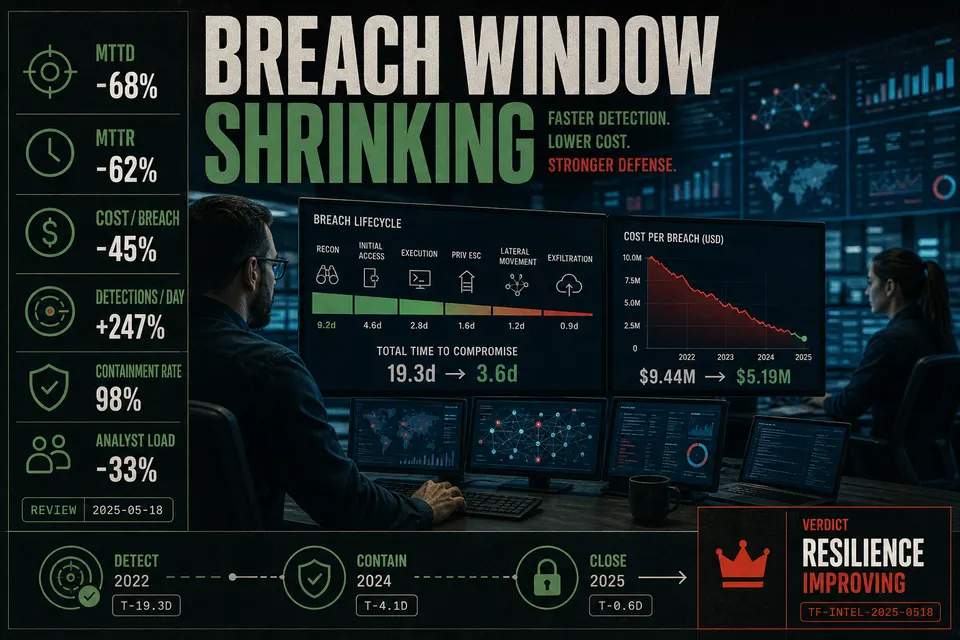
Drawn from 600 breached organizations, the figures are converting abstract AI hype into concrete budget justification for CISOs facing machine-speed attackers.
Organizations that extensively deploy artificial intelligence and automation across security operations reduce average data breach costs by $1.9 million and shorten the full breach lifecycle by roughly 80 days, according to the 2025 Cost of a Data Breach research that has become the board-level benchmark for AI security ROI. As offensive AI compresses attacker timelines from weeks into minutes, those figures—drawn from 600 breached organizations and amplified by a multi-stakeholder white paper on defender advantage—are converting abstract AI hype into concrete budget justification for CISOs facing ransomware, cloud sprawl, and tighter disclosure clocks.
The cost and speed numbers come from research conducted by the Ponemon Institute and sponsored by IBM. Analysts examined breaches between March 2024 and February 2025 across 600 organizations worldwide, using activity-based costing from identification through containment and service restoration. Organizations in the highest band of security AI and automation usage posted an average $1.9 million lower total breach cost than peers with limited or no such tooling. Their mean lifecycle was about 80 days shorter. Context matters: the global average breach cost fell to $4.44 million—the first decline in five years—while the average lifecycle dropped to a record-low 241 days, a 17-day year-over-year improvement. U.S. breaches remained far more expensive, averaging $10.22 million. Internally detected incidents cost roughly $900,000 less than those first disclosed by attackers.
A May 2026 World Economic Forum white paper developed with KPMG, Empowering Defenders: AI for Cybersecurity, cites those IBM outcomes as evidence of defender advantage and layers on operational texture from 20 partner case studies plus insights from 105 representatives across 84 organizations and 15 industries. The Forum’s broader outlook work shows 94 percent of cyber leaders now view AI as a defining force and 77 percent of organizations already use AI in cyber operations. The white paper does not itself run a 600-organization cost study; its contribution is deployment practice, case-study metrics, and an explicit call to treat AI as a strategic capability under human oversight rather than a standalone gadget.
Those operational examples illustrate how the cost and time deltas materialize. IBM’s Autonomous Threat Operations Machine (ATOM) reportedly handles about 95 percent of daily managed-security investigations, automates more than 850 analyst hours per month, and cuts end-to-end investigation time by 37 percent. Accenture’s “Agent Oliver” analyzed more than 100,000 internet-facing sites, collapsing per-site review from roughly 15 minutes to under one minute—about a 93 percent reduction in manual effort. KPMG’s threat-intelligence team reported a 25 percent efficiency gain. Check Point’s Universe platform compressed investigation cycles from multi-week manual work to roughly one hour. ING’s machine-learning data-leakage prevention pipeline processed five million alerts and lifted analyst precision by 20 percent across a workforce of roughly 60,000. Dream Group cut malware remediation guidance time by up to 95 percent. These figures are self-reported by participating organizations and carry selection bias; they function as directional proof points, not audited industry averages. A similar gap shows up in frontier models: GLM 5.3's cybersecurity benchmark scores outpace daily security operations.
Technically, AI-augmented detection and response outperforms traditional security operations centers by fusing telemetry and collapsing manual pivots. Classic SOCs still rely on siloed logs, signature rules, and ticket queues that leave analysts drowning in noise. Modern stacks combine SIEM with extended detection and response (XDR) for cross-domain graphs spanning endpoint, identity, network, cloud, and email; user and entity behavior analytics (UEBA) and machine-learning models that score multi-stage attack sequences; and security orchestration, automation, and response (SOAR) playbooks that can isolate a host, revoke a token, block an indicator, or quarantine a mailbox in seconds. Natural-language agents summarize root cause and generate audit-ready evidence trails useful for GDPR, DORA, and SEC four-business-day disclosure windows. Those DORA audit trails matter beyond compliance box-checking: DORA now carries personal board liability exposure across the EU. On large hybrid estates the defender advantage is proprietary internal context—asset inventories, normal business baselines, identity graphs—that attackers cannot easily replicate.
Offense AI already weaponizes the same model families for personalized phishing at industrial scale, deepfake vishing, adaptive malware, and rapid vulnerability discovery. Defensive counterparts counter with behavioral email analysis, continuous attack-surface management, runtime anomaly detection that isolates polymorphic code before signatures catch up, and identity risk scoring paired with phishing-resistant authentication. That focus tracks the data: compromised credentials have overtaken software flaws as ransomware's top entry point. The arms race is real; the durable edge is environment-specific data wired into detection and response pipelines, not claims that defenders always outpace attackers.
Gains do not appear automatically. Integration with live SIEM, XDR, SOAR, identity, and cloud connectors is non-negotiable—alert-only chatbots produce little ROI. Clean telemetry, accurate asset inventories, and labeled incident history determine model quality; blind spots and shadow IT destroy it. False-positive rates must be measured and fed back into models, or automation is simply ignored. Skills and operating-model redesign matter: analysts become supervisors of AI rather than pure ticket processors. Roughly half of organizations still cite talent shortages as a primary barrier. Governance must match autonomy to blast radius—full automation for reversible low-risk actions such as endpoint isolation, human approval for domain-wide blocks or legal holds. That kind of control mapping is exactly what NIS2's technical-controls requirements demand of EU-regulated operators. Structured pilots with go/no-go metrics beat big-bang rollouts. Shadow AI itself is a reverse-ROI tax: high levels of ungoverned AI raised average breach costs by about $670,000, and 97 percent of organizations that experienced AI-model or application breaches reported lacking proper access controls. Much of that gap traces to static credentials; see why ephemeral credentials are replacing static API keys.
Security leaders calculate and present ROI in board language rather than model accuracy:
ROI ≈ (Breach cost avoided + OpEx efficiency + Risk-reduction value − Total cost of ownership) / TCO
Core metrics include mean time to detect and contain, average cost per incident, alert precision, analyst hours automated, share of internal versus attacker-disclosed discovery, and compliance timeline readiness. External anchors such as the $1.9 million and 80-day figures provide validation; internal before-and-after baselines provide credibility. Separate efficiency gains from probabilistic loss avoidance and always track full TCO—licenses, data engineering, integration, model operations, human review, and failure drills. Quarterly board packs that show days of exposure reduced, dollars avoided, and hours automated outperform accuracy dashboards.
Limitations remain material. Over-reliance can erode resilience if detection pipelines fail; tabletop exercises that simulate “AI dark” are essential. Adversarial machine learning—poisoning, evasion, prompt injection—targets the security models themselves. Dual-use generative tools that help defenders also write malware and phishing lures. Automation bias can turn false negatives into silent disasters; irreversible actions need human-in-the-loop controls. Agentic multi-agent systems introduce cascading-action risk and unapproved-agent sprawl. Ethical and privacy questions around behavioral monitoring and training-data provenance require transparent purpose limitation. Adoption remains uneven: large mature enterprises pull ahead while many mid-market firms, governments, and SMBs lag on data maturity, skills, and budget.
The practical path is clear. Baseline lifecycle days, cost per incident, alert precision, and internal-detection share now. Pilot one or two high-volume, reversible use cases—phishing triage, alert clustering, endpoint isolation—with explicit go/no-go criteria. Wire AI into the existing SIEM/XDR/SOAR fabric before chasing novelty. Inventory and control shadow AI. Govern autonomy by reversibility. Drill AI outages. Report quarterly with external benchmarks plus internal deltas. Treat defensive AI as a measurable force multiplier under deliberate strategy and human oversight, not an autonomous silver bullet. Organizations that do so are already isolating incidents faster and spending millions less when breaches inevitably occur; those that wait are funding the other side of the AI-versus-AI ledger.