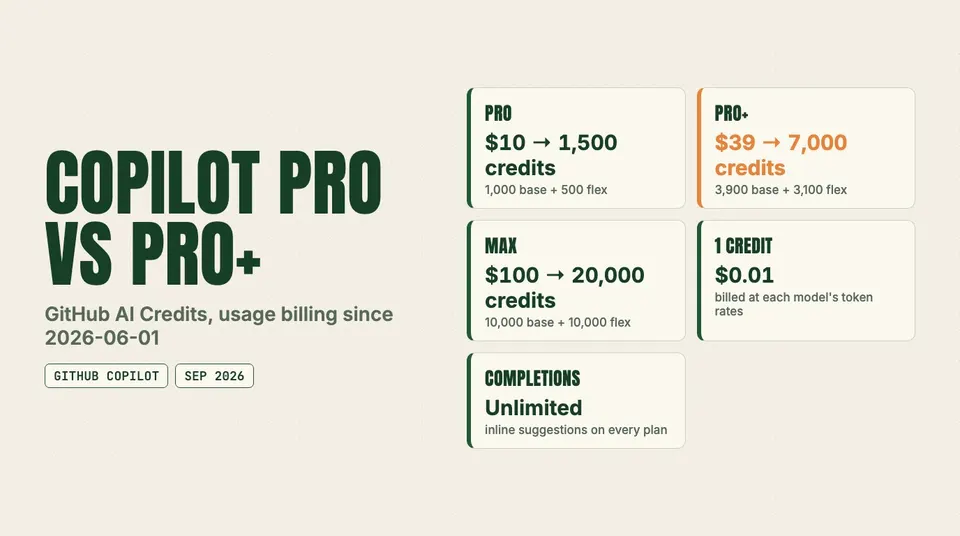
Copilot now bills in AI credits at $0.01 each. Here is what Pro's 1,500 and Pro+'s 7,000 credits buy per model, and when Pro+ beats Claude or Cursor.
The short answer: Copilot Pro ($10/month) now includes 1,500 AI credits, worth $15 at API rates, and Copilot Pro+ ($39/month) includes 7,000 credits, worth $70. The bigger difference is model access, not the credit count. Pro cannot use Claude Opus 5.5, Claude Fable 5.1, GPT-6 Astra or GPT-6 Sol at all, so if you want frontier models inside Copilot, Pro+ is the entry ticket.
Since June 1, 2026, every monthly Copilot plan bills by tokens instead of "premium requests." Each chat turn or agent step burns credits at the chosen model's published per-token rates, which makes Copilot easy to compare with Claude, Cursor and raw API spend, and easy to overspend on.
This guide was last checked against GitHub's Copilot plans page, the GitHub Docs pages on usage-based billing for individuals, models and pricing, and legacy request-based billing, and the GitHub Blog announcement of the change, on September 24, 2026.
Quick summary
- 1 AI credit = $0.01. Credits are drawn down at each model's per-token API rate. There is no flat "one request" price any more.
- Pro: $10/month, 1,000 base credits plus a 500-credit flex allotment, for 1,500 total.
- Pro+: $39/month, 3,900 base plus 3,100 flex, for 7,000 total. It also unlocks Opus, Fable, GPT-6 Astra, GPT-6 Sol, GPT-5.6 Sol and GPT-5.5.
- Max: $100/month, 10,000 base plus 10,000 flex, for 20,000 total. This tier is officially listed now; it is not a rumor.
- Inline code completions and next edit suggestions are unlimited on every paid plan and do not touch your credits.
- Flex credits can change month to month. Base credits match your subscription price and GitHub says they do not change.
- Annual Pro and Pro+ subscribers who did not switch are still on premium requests (300 or 1,500 per month) with steep model multipliers and no access to new models. When the annual term ends they drop to Copilot Free.
Copilot plans after AI credits: the comparison table
| Plan | Price | Base credits | Flex allotment | Total credits | Dollar value at API rates | Frontier models (Opus, Fable, GPT-6 Astra) |
|---|---|---|---|---|---|---|
| Copilot Free | $0 | not published | none | "an allowance" | n/a | No (auto model selection only) |
| Copilot Pro | $10/mo | 1,000 | 500 | 1,500 | $15 | No |
| Copilot Pro+ | $39/mo | 3,900 | 3,100 | 7,000 | $70 | Yes |
| Copilot Max | $100/mo | 10,000 | 10,000 | 20,000 | $200 | Yes |
| Copilot Business | $19/user/mo | 1,900 per user, pooled | none listed | 1,900 per user | $19 per user | Yes |
| Copilot Enterprise | $39/user/mo | 3,900 per user, pooled | none listed | 3,900 per user | $39 per user | Yes |
Pro+ gives almost 4.7 times Pro's credits for 3.9 times the price. The organization plans list no flex allotment: a Business seat gets 100 credits per dollar (1,900 for $19), while personal Pro gets 150 per dollar and Pro+ about 180, as long as the flex part holds.
Why blogs disagree about the allotments
If you searched this topic, you have probably seen three different numbers for Pro+: 3,900, 7,000 and "$39 of credits." They all trace back to real sources. The GitHub Blog announcement from April 27, 2026 said Pro+ would include "$39 in monthly AI Credits," which is 3,900 credits. GitHub's current docs and plans page split that into 3,900 base credits plus a 3,100-credit flex allotment, for 7,000 in total. Articles written in April and May quote the first figure. The official figure today is 7,000, with the caveat that 3,100 of it is the flexible part.
What an AI credit actually is
Every time Copilot calls a model, three kinds of tokens are counted:
- Input tokens: your prompt, the files and context Copilot attaches, tool definitions.
- Cached input tokens: context the model already saw in an earlier turn and can reuse at a heavy discount.
- Output tokens: what the model writes back, including code and reasoning.
GitHub multiplies each count by the model's published price per million tokens, adds them up in dollars, and converts at 100 credits per dollar. The formula is:
credits = (input_tokens × input_rate
         + cached_tokens × cached_rate
         + output_tokens × output_rate) / 1,000,000 × 100
Rates are per million tokens. Anthropic models and the newer OpenAI models (GPT-5.6 and GPT-6 families) also have a separate cache-write price, which adds a little on the turns where new context is first cached.
Per-model rates that matter for coding
These are GitHub's published Copilot rates, per million tokens, as of September 24, 2026.
| Model | Input | Cached input | Output | Available on Pro? |
|---|---|---|---|---|
| GPT-6 Luna | $0.10 | $0.01 | $0.50 | Yes |
| Gemini 3.8 Flash (promo to Dec 31, 2026) | $0.75 | $0.075 | $3.75 | Yes |
| Claude Haiku 4.5 | $1.00 | $0.10 | $5.00 | Yes |
| Claude Sonnet 5 | $2.00 | $0.20 | $10.00 | Yes |
| GPT-6 Sol | $2.00 | $0.20 | $10.00 | No (Pro+ and up) |
| Claude Opus 5.5 | $4.00 | $0.20 | $20.00 | No (Pro+ and up) |
| Claude Fable 5.1 | $10.00 | $0.25 | $50.00 | No (Pro+ and up) |
| GPT-6 Astra | $10.00 | $1.00 | $50.00 | No (Pro+ and up) |
GPT-6 Astra, GPT-6 Sol and GPT-5.6 Sol also have a higher "long context" tier once a request passes 272K input tokens. Astra's long-context rate is $20 input and $75 output, so a huge repository dump can double the cost of a turn.
One discount is worth knowing: paid plans get 10% off model costs when you use auto model selection in Copilot Chat, Copilot CLI, the Copilot app or the cloud agent.
Worked examples: converting credits into real work
GitHub does not publish "tasks per month" figures, so the numbers below use two clearly labelled assumptions. Your real sessions will differ, but the ratios between models hold.
Assumption A, a quick chat question: 6,000 input tokens, 800 output tokens, no cache.
Assumption B, a medium agent task: 25 model turns, each re-reading about 50,000 cached tokens of context, adding 8,000 fresh input tokens and writing 1,500 output tokens. That totals 1.25M cached, 200K fresh input and 37.5K output. Cache-write premiums are ignored, so treat these as slightly optimistic.
Here is the math for one medium agent task on Claude Sonnet 5: 200K × $2 = $0.40, plus 1.25M × $0.20 = $0.25, plus 37.5K × $10 = $0.375. That is $1.025, or about 102 credits.
| Model | Quick chat question | Medium agent task | Agent tasks on Pro (1,500) | Agent tasks on Pro+ (7,000) | Agent tasks on Max (20,000) |
|---|---|---|---|---|---|
| GPT-6 Luna | 0.1 credits | ~5 credits | ~290 | ~1,365 | ~3,900 |
| Gemini 3.8 Flash | 0.75 credits | ~38 credits | ~39 | ~182 | ~520 |
| Claude Haiku 4.5 | 1 credit | ~51 credits | ~29 | ~136 | ~390 |
| Claude Sonnet 5 | 2 credits | ~102 credits | ~14 | ~68 | ~195 |
| GPT-6 Sol | 2 credits | ~102 credits | not available | ~68 | ~195 |
| Claude Opus 5.5 | 4 credits | ~180 credits | not available | ~38 | ~111 |
| Claude Fable 5.1 | 10 credits | ~419 credits | not available | ~16 | ~47 |
| GPT-6 Astra | 10 credits | ~512 credits | not available | ~13 | ~39 |
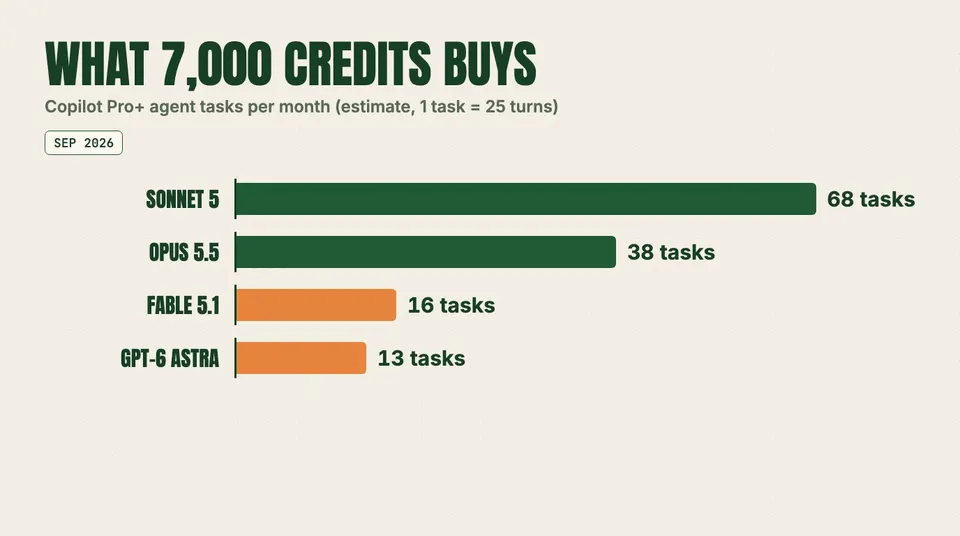
Copilot Pro+ agent tasks per month (estimate, 1 task = 25 turns)
Chat is cheap on any model: even GPT-6 Astra costs about a dime per question. Agent work is where the budget goes. Fourteen Sonnet 5 agent tasks a month on Pro is about three a week; Pro+ gives about 68 on Sonnet 5 or 38 on Opus 5.5.
Output is the expensive part for frontier models: Fable 5.1's cached input costs $0.25 per million, its output $50. An agent that writes a lot drains credits much faster than one that mostly reads.
Pro vs Pro+: what the $29 difference buys
For most developers the decision comes down to three things.
1. Model access. This is the real line. On Pro you get Sonnet 5, Sonnet 4.6, Haiku 4.5, GPT-5.4, GPT-5.3-Codex, GPT-5.6 Terra, the Luna models, Gemini Flash, Grok 4.x, Kimi and MAI-Code. You do not get any Opus model, either Fable model, GPT-6 Astra, GPT-6 Sol, GPT-5.6 Sol or GPT-5.5. If you want the models that sit at the top of current coding comparisons (see our GPT-6 Astra vs Claude Fable 5.1 vs Opus 5.5 coding comparison), Pro is not an option.
2. Headroom. 7,000 credits vs 1,500. If you use agent mode or the cloud agent daily, Pro will run out in the first week or two on Sonnet-class models.
3. Extras. Pro+ adds audit logs, GitHub Spark (public preview) and GPT-5.4 nano in the Codex VS Code extension. Both plans include the cloud agent, agent mode, code review, MCP, Copilot CLI and third-party agents (public preview).
Upgrading mid-month is cheap
If you hit the Pro ceiling on the 18th, you do not lose money by upgrading. GitHub charges only the price difference between plans, counts your earlier usage against the larger allowance, and makes the extra credits available immediately. You are never billed for both plans over the same period.
Copilot Pro+ vs Claude Code, Cursor and the rest at similar spend
| Plan | Monthly price | How usage is measured | Frontier model access |
|---|---|---|---|
| Copilot Pro | $10 | 1,500 credits at API rates | No Opus, Fable or GPT-6 Astra |
| Copilot Pro+ | $39 | 7,000 credits at API rates | Opus 5.5, Fable 5.1, GPT-6 Astra, GPT-6 Sol |
| Copilot Max | $100 | 20,000 credits at API rates | Same as Pro+ |
| Claude Pro | $20 ($17/mo billed annually) | Session and weekly limits, not published as tokens | Opus and Sonnet; Fable via usage credits |
| Claude Max | from $100 | 5x or 20x Pro's limits | Opus, Sonnet; Fable at 50% of weekly limits |
| Cursor Pro | $20 | Included usage pool plus unlimited Tab | Frontier models from the included pool |
| Cursor Pro+ | $60 | Larger usage pool | Same |
The honest comparison is transparency against generosity. Copilot tells you exactly what a turn costs. Claude's subscriptions do not publish token budgets, so there is no exact exchange rate, but a flat subscription does not bill each extra Opus turn the way Copilot's metered credits do. We break those limits down in Claude Pro vs Max for Claude Code after Opus 5.5 and the older Claude Max $100 vs $200 breakdown.
Pro+ beats Claude Pro when:
- You want several model families in one place. Pro+ lets you plan with Opus 5.5, switch to GPT-6 Astra for a second opinion, and run subagents on GPT-6 Luna, all inside VS Code, JetBrains, Xcode or the Copilot CLI.
- You need unlimited inline completions. Claude Pro has no equivalent of Copilot's tab completion.
- You work mostly inside GitHub: PR summaries, PR code review and the cloud agent are native.
- You prefer a metered bill with a hard cap.
Claude Pro or Max beats Pro+ when:
- Most of your day is long Claude Code agent sessions on Opus. At $70 of API-rate value, Pro+ covers roughly 38 medium Opus 5.5 tasks, which a heavy agent user can spend in two or three weeks.
- You live in the terminal and do not need IDE completions.
Cursor Pro at $20 sits between the two: unlimited Tab plus a usage pool, in a forked VS Code editor. Our Cursor Ultra vs Pro guide covers how that pool drains. For the terminal agents themselves, see Claude Code vs Codex CLI vs Antigravity CLI vs OpenCode.
A common, cheap stack in 2026 is Copilot Pro for completions and quick chat plus a separate Claude or ChatGPT plan for heavy agent work. Our best AI coding stack guide walks through three budget builds like that.
Overage controls and spend caps
When your included credits run out, you have three choices: upgrade, pay for additional usage, or wait for the reset. Some details to set up on day one:
- Credits reset at 00:00 UTC on the first of each calendar month, not on your billing date. Unused credits do not roll over.
- Base credits are used first, then the flex allotment, automatically.
- Additional usage is set as a dollar budget at $0.01 per credit, so a $10 budget buys 1,000 extra credits. Create it under Settings, Billing and licensing, Budgets and alerts, and choose the "Bundled AI credits budget" type to cover Copilot, the cloud agent and Spark together.
- Budgets on personal accounts can block usage when exhausted. GitHub's docs note that if you do not tick "Stop usage when budget limit is reached" on a budget that offers it, you get an email but usage is not stopped.
- Alerts fire at 75%, 90% and 100% of a budget, and separate included-usage emails fire at 90% and 100% of your plan allotment.
- Session limits in Copilot CLI and the Copilot SDK cap how many credits a single agent task can spend. The agent stops cleanly and asks whether to continue. This is the best guard against a runaway loop on GPT-6 Astra.
- If you subscribed through GitHub Mobile on iOS or Android, you cannot buy additional credits at all.
For a broader system that tracks limits across tools, see how to monitor AI rate limits across ChatGPT, Claude and Cursor.
Five habits that stretch credits
- Use auto model selection by default for the 10% discount and model routing.
- Plan with a strong model, implement with a cheaper one. GitHub's own guidance recommends exactly this split.
- Do not switch models mid-session. A new model cannot reuse the old model's cache, so the full context is billed again as fresh input.
- Start a new session when you change problems, or run
/compactin Copilot CLI. Caches expire after about an hour of inactivity for most models (24 hours for OpenAI models). - Trim tools. Every enabled MCP tool adds to the input on each turn.
The annual-plan legacy trap
If you bought Copilot Pro or Pro+ on an annual plan before June 1, 2026, you were not moved to AI credits. You stay on premium requests until the term ends: 300 per month on Pro, 1,500 on Pro+, with extra requests at $0.04 each.
That sounds generous until you see the multipliers. Under the legacy model, one Claude Opus 4.8 request costs 27 premium requests, GPT-5.5 costs 57, and Claude Sonnet 4.6 costs 9. So 1,500 Pro+ requests buy about 55 Opus 4.8 prompts or 26 GPT-5.5 prompts a month. Copilot code review costs 13 requests per review.
There are two more catches:
- Legacy annual users do not get new models or features. No Opus 5.5, no Fable 5.1, no GPT-6 family.
- When the annual term ends, you are downgraded to Copilot Free, not moved to a monthly paid plan. If you rely on Copilot, put a calendar reminder a week before renewal.
Your options, per GitHub's docs: stay put, cancel for a prorated refund and resubscribe monthly, or upgrade to a monthly plan with prorated credit for the rest of the term. If you want current frontier models, switching is the only way to get them.
Which plan should you pick?
- Completions and occasional chat only: Copilot Pro at $10. Unlimited completions, 1,500 credits, and Sonnet 5 when you need it.
- Daily agent mode on Sonnet-class models: Pro+ at $39, or Pro plus a small additional-usage budget if you only spill over some months.
- You want Opus 5.5, Fable 5.1 or GPT-6 Astra in your IDE: Pro+ is the minimum. Budget roughly 40 medium Opus tasks or 13 Astra tasks per month before overage.
- All-day agent work on frontier models: compare Copilot Max at $100 (20,000 credits, $200 at API rates) with Claude Max. Our individual AI subscription decision matrix lays out the options side by side.
- Teams: Business at $19 per user pools 1,900 credits per seat across the organization and adds admin budgets, content exclusion and policy controls.
Caveats
- The flex allotment is explicitly variable. GitHub says it "may vary from month to month" as model pricing and efficiency change. Plan around base credits if you need certainty.
- Copilot code review uses an undisclosed model, so its per-review cost varies, and it also consumes GitHub Actions minutes.
- Our task estimates assume one specific session shape. Large repositories, long-context tiers and high reasoning settings can multiply the cost.
FAQ
Copilot Pro vs Pro+: which is worth it?
Pro+ is worth it if you want Opus 5.5, Fable 5.1 or GPT-6 Astra (Pro cannot use them) or run agent mode daily. For completions plus light chat, Pro at $10 is enough.
How do GitHub Copilot AI credits convert to dollars?
One AI credit equals $0.01, so 100 credits are $1. Pro's 1,500 credits equal $15 of model usage at GitHub's published per-token rates, Pro+'s 7,000 equal $70, and Max's 20,000 equal $200.
How many AI credits does each model use?
It depends on tokens, not requests. Using our example medium agent task (25 turns), GPT-6 Luna uses about 5 credits, Claude Sonnet 5 about 102, Claude Opus 5.5 about 180, Claude Fable 5.1 about 419 and GPT-6 Astra about 512. A short chat question costs between 0.1 and 10 credits.
Do code completions use AI credits?
No. Inline code completions and next edit suggestions are not billed in AI credits and are unlimited on all paid plans. Copilot Free is capped at 2,000 completions a month.
Is Copilot Pro+ better than Claude Code?
They solve different problems. Pro+ gives metered access to several model families, unlimited completions and GitHub-native agents for $39. Claude Pro and Max give you Claude Code under flat subscription limits, which suits long Opus sessions. Many developers pair Copilot Pro with a Claude plan.
What happens to my annual Copilot plan?
It stays on legacy premium requests (300 per month on Pro, 1,500 on Pro+) with model multipliers until it expires, and you get no new models. At expiry you drop to Copilot Free. You can switch early to a monthly plan and get prorated credit.