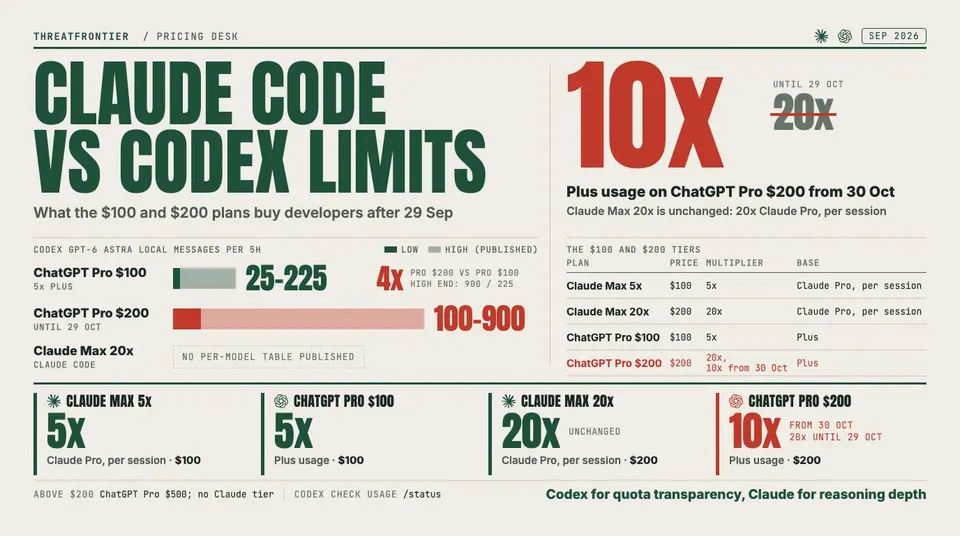
Codex still publishes clearer per-model limits and Claude still reasons deeper, but OpenAI's $200 Pro tier drops from 20x to 10x Plus usage on 30 Oct.
As of September 14, 2026, OpenAI Codex still offers the clearer published five-hour Codex limits, while Claude Code remains the stronger reasoning-first coding partner for many developers. The best choice depends less on the monthly price and more on whether you need predictable quotas, deep code reasoning, cloud tasks, code review throughput or long terminal-based coding sessions.
Update, September 30, 2026: OpenAI's $200 ChatGPT Pro plan is open to new buyers again after a three-week pause, but from October 30 it carries 10x Plus Codex usage instead of 20x. OpenAI also launched a $500 Pro tier with Ultrafast Codex, which has no Anthropic equivalent. Read the section on the $200 changes before you plan around that tier.
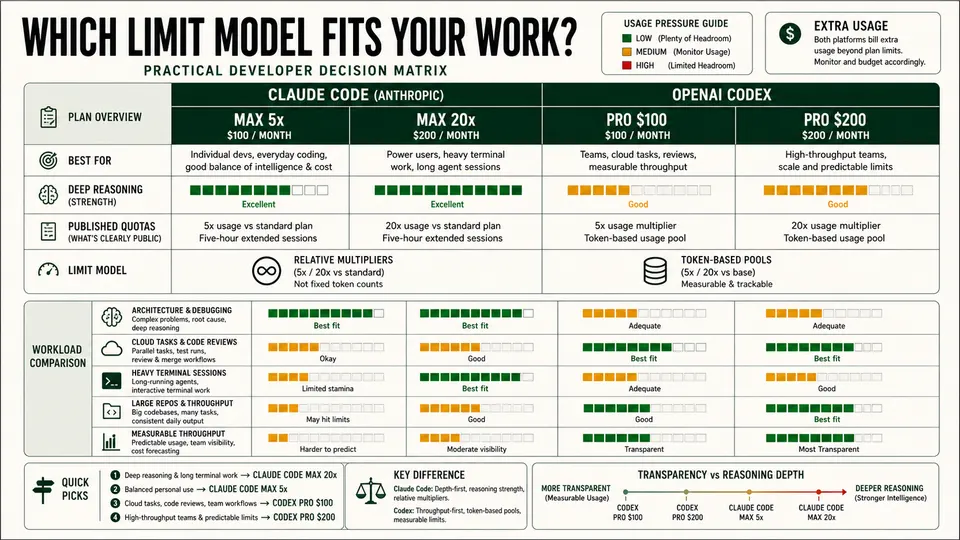
Quick Summary
Claude Code and OpenAI Codex are both agentic coding tools built for developers who want an AI assistant to inspect repositories, edit files, debug errors, write tests, explain code and handle multi-step coding work.
Both companies now sell premium individual tiers at $100/month and $200/month:
- Claude Code is bundled into Anthropic’s Claude Max 5x and Claude Max 20x plans.
- OpenAI Codex is included in ChatGPT plans, with ChatGPT Pro $100 carrying Codex Pro 5x limits and ChatGPT Pro $200 carrying Codex Pro 20x limits until October 29 and 10x from October 30. A new ChatGPT Pro $500 tier sits above both.
- Claude publishes Max usage multipliers and baseline usage guidance, but not an exact public per-model Claude Code message table like OpenAI’s Codex table.
- OpenAI publishes approximate limits for messages per model, broken down by plan and five-hour window.
- In both products, real-world usage depends on model choice, context size, repository size, task complexity, output length, tool calls, MCP servers, cloud execution and image generation.
The short version: Claude sells confidence in the model; OpenAI sells visibility into the meter.
Plan Mapping: Claude Code vs OpenAI Codex
| Product | $100 plan | $200 plan | Usage multiplier | Coding tool included | Exact limits published? | Best for |
|---|---|---|---|---|---|---|
| Claude Code | Claude Max 5x | Claude Max 20x | 5x / 20x more usage per session than Claude Pro | Yes — Claude Code is included with Pro and Max | No exact public per-model Claude Code message table | Deep reasoning, terminal workflows, large refactors, debugging, architecture |
| OpenAI Codex | ChatGPT Pro $100 / Codex Pro 5x | ChatGPT Pro $200 (20x until October 29, 10x from October 30) | 5x / 20x higher Codex usage than Plus; 5x / 10x from October 30 | Yes — Codex is included in ChatGPT plans | Yes — per-model message allowances are published as ranges | Predictable quotas, cloud chats, code review, high-throughput coding |
Claude’s Max plans are straightforward on price: Max 5x costs $100/month and Max 20x costs $200/month. Anthropic says Max 5x provides five times more usage per session than Pro, while Max 20x provides 20 times more usage per session than Pro.
Claude Code access is included, but Claude chat, Cowork and Claude Code all draw from the same usage pool, as do the Claude Code integrations for VS Code, Cursor and JetBrains IDEs. Max plans carry a five-hour session limit and a weekly limit that applies across all models. If users hit included limits, they can enable usage credits, which are billed separately at standard API rates.
OpenAI’s structure is more numerical. Codex is included in ChatGPT plans, and the individual ladder now runs Free, Go at $8/month, Plus at $20/month and Pro from $100/month. A full plan-by-plan breakdown of Codex and GPT-6 usage limits by ChatGPT tier covers Go and Business too. The $100 Pro tier has 5x Codex usage versus Plus, while the $200 Pro tier has 20x until October 29 and 10x from October 30. Above both, Pro $500 has the highest allowance and is the only plan with Ultrafast, up to 8x faster GPT-6 Astra token generation in Codex; see ChatGPT Pro 500: What $500 a Month Buys. The temporary Codex promotions that ran in the first half of 2026 have expired; OpenAI’s Codex pricing page currently advertises no usage boost on either Pro tier.
The $200 ChatGPT Pro changes
On September 10, 2026, OpenAI temporarily paused new sign-ups and upgrades to the $200 ChatGPT Pro plan. Reporting attributed the pause to demand for GPT-6 Astra, released September 3, 2026, outrunning serving capacity — the 20x tier being the heaviest load per subscriber.
On September 29 OpenAI reopened the plan and cut it. From October 30, Pro $200's included usage in Codex and ChatGPT Work falls from 20x to 10x Plus, and GPT-6 Pro chat messages fall from 200 to 100 a week. Existing subscribers keep 20x until October 29.
For this comparison, that changes the $200 matchup. Claude Max 20x still offers 20 times Claude Pro's per-session usage, while ChatGPT Pro $200 will offer 10 times Plus. The two multipliers use different bases and cannot be compared directly, but the OpenAI side's headroom per dollar at $200 is now the same as at $100.
OpenAI Codex Published Usage Limits
OpenAI’s biggest advantage is transparency. It publishes approximate per-model message ranges for each plan and five-hour window. The Pro $200 table below is the published 20x table, valid until October 29; OpenAI had not published revised 10x ranges when this was updated. It has not published ranges for Pro $500 either.
ChatGPT Pro $100 / Codex Pro 5x
| Model | Published limit |
|---|---|
| GPT-6 Astra | 25–225 local messages / 5h |
| GPT-5.6 Sol | 50–500 local messages / 5h |
| GPT-5.6 Terra | 125–1,000 local messages / 5h |
| GPT-5.6 Luna | 1,250–10,000 local messages / 5h |
| GPT-5.5 (legacy) | 75–400 local messages / 5h |
| GPT-5.4 (legacy) | 100–500 local messages / 5h |
| GPT-5.4 mini (legacy) | 300–1,750 local messages / 5h |
ChatGPT Pro $200 / Codex Pro 20x (until October 29)
| Model | Published limit |
|---|---|
| GPT-6 Astra | 100–900 local messages / 5h |
| GPT-5.6 Sol | 200–2,000 local messages / 5h |
| GPT-5.6 Terra | 500–4,000 local messages / 5h |
| GPT-5.6 Luna | 5,000–40,000 local messages / 5h |
| GPT-5.5 (legacy) | 300–1,600 local messages / 5h |
| GPT-5.4 (legacy) | 400–2,000 local messages / 5h |
| GPT-5.4 mini (legacy) | 1,200–7,000 local messages / 5h |
Two notes on reading those tables. The GPT-5.4 and GPT-5.5 rows are legacy entries that OpenAI still lists but which no longer represent the models most developers should be planning around. And GPT-5.3-Codex-Spark sits outside the table entirely: it is a research preview available only to ChatGPT Pro users, governed by a separate usage limit that OpenAI says may adjust based on demand.
There are three important caveats. First, local messages and cloud chats share your plan’s usage allowance — there is no separate cloud budget. Second, OpenAI says weekly limits may also apply, with no published numbers for them. Third, OpenAI says Codex usage limits are shared with other agentic features once pricing for those features is effective, currently including ChatGPT for Excel on Plus and Pro.
That means the five-hour table is not a guarantee of unlimited sustained usage around the clock. It is also a planning scale rather than an enforced window on Pro: OpenAI removed the five-hour limit in July 2026, restored it on August 25 for Plus only, and said on September 29 that it will not bring it back for Pro. On ChatGPT Pro, the weekly limit is the one that stops you.
OpenAI also warns that larger codebases, longer-running tasks, bigger outputs, fast mode, MCP servers, image generation and long context can burn through limits faster than expected. Cheaper models such as GPT-5.6 Luna stretch usage much further for routine edits, small bug fixes and repetitive tasks — its published allowance is roughly fifty times Astra’s on the same plan.
Code review through the GitHub integration draws on the same plan allowance rather than on a separately published review quota.
How Claude Code Usage Works
Claude’s usage model is less transparent but more flexible in feel. Anthropic does not publish a table saying, for example, how many Sonnet, Opus or Haiku Claude Code prompts a Max 5x subscriber gets in a five-hour window.
Instead:
- Claude Max 5x means 5x Pro capacity per session.
- Claude Max 20x means 20x Pro capacity per session.
- Claude Code, Claude chat and Cowork share limits.
- Every paid plan carries a five-hour session limit plus a weekly limit that applies across all models.
- Usage depends heavily on model, context and tools.
- Usage credits can continue after included limits, but they are billed separately at API rates.
One mechanic is worth stating plainly, because it is the one developers most often misread. The mechanics behind that shared pool, and what a single agentic turn actually costs in tokens, are broken down in Claude Code's token economics. The weekly limit is a single pool across all models, so switching models with /model will not restore access once you hit it. Narrower model-family caps do exist and behave differently — after an Opus-specific or Sonnet-specific message, switching to a model outside that family does keep you working. Reading which limit you actually hit is what makes the difference.
Anthropic also changed the weekly allowance during the period covered here. A promotion raised weekly Claude Code limits by 50% from May 13, 2026 through September 13, 2026, after which the help center says weekly limits return to their standard levels. Anthropic separately announced on X that from September 14, 2026 it is permanently raising standard weekly Claude Code limits by 25%, and clarified that against the promotional level this amounts to roughly a 17% reduction. Those percentages come from Anthropic’s announcement rather than from its documentation, so treat them as company-stated.
As of September 2026, the current Claude lineup is Claude Fable 5.1, Claude Opus 5, Claude Sonnet 5 and Claude Haiku 4.5, with Fable available to Pro and Max subscribers on a limited basis. Fable 5 became a permanent part of Max plans in July 2026, covering up to half of weekly usage. For coding, Anthropic’s own guidance is practical:
- Sonnet is the default choice for most coding because it is fast, capable and more quota-efficient.
- Opus is better for hard debugging, architecture and large cross-cutting refactors, but it consumes meaningfully more quota.
- Fable is the top reasoning tier and the most expensive to run, because extended thinking cannot be switched off on it.
- Haiku is best for quick lookups, simple edits and high-volume scripted work.
Claude Code gives developers context- and model-management commands. Developers can use Claude Code commands such as /model, /context, /compact and /clear to manage model choice and context; /usage shows plan usage bars and a breakdown of what is consuming them, with /cost now serving as an alias for it. OpenAI Codex users can check remaining limits with /status during active CLI sessions, which reports rate-limit state with progress bars and reset times.
The most important lesson is that long sessions get expensive because every turn carries previous conversation history, project context, files read and the new prompt.
For large repositories, that matters. A debugging session where Claude reads 20 files, writes several diffs and discusses multiple approaches will consume far more capacity than a short prompt asking for a regex or test case. For a deeper look at what happens under the hood on each of those turns, see how Claude Code executes tools internally.
Real-World Developer Experience
Claude Code’s main strength is reasoning depth. It is particularly strong for:
- Large refactors
- Architecture planning
- Debugging tangled systems
- Explaining unfamiliar code
- Thinking through trade-offs
- Terminal-first workflows
- Repository understanding
Many developers will prefer Claude Code when they want an AI coding partner that behaves less like a task counter and more like a senior pair programmer. Whether that reasoning depth is worth the jump from Pro is covered in Claude Pro vs Max for Claude Code after Opus 5.5. The Opus/Sonnet workflow also makes sense: use Opus to reason through a difficult plan, then switch to Sonnet to implement.
Its weakness is predictability. A Max 5x user may have a great day of uninterrupted coding — or hit limits faster than expected if the session is long, the repository is large, Opus is left on, or too much context accumulates. Heavy users can enable usage credits, but that turns a fixed subscription into a subscription-plus-metered-billing setup.
OpenAI Codex’s main strength is measurable throughput. It is better for developers who want to know roughly how many messages they can run in a five-hour period against a named model. That tradeoff between the two Codex tiers is examined directly in ChatGPT Pro 5x vs 20x for Codex coding. It also has a strong workflow story across ChatGPT, CLI, IDE extension, cloud work, Slack and GitHub review integrations where available.
Codex is especially attractive for teams or solo developers doing:
- Multiple pull-request reviews
- Cloud coding tasks
- Repetitive small edits
- High-volume test generation
- Repo automation
- Throughput-heavy coding work
Its weakness is that published ranges are still ranges, and the spread is wide — Astra’s Pro 5x range runs from 25 to 225 messages, a factor of nine. A “message” is not a fixed unit of work. A tiny local edit and a multi-file refactor are not equivalent. Large repos, long instructions, image generation, fast mode and tool-heavy agentic work can all drain usage faster than the headline numbers suggest. Cloud work shares the same pool as local messages, so cloud runs come out of the same budget.
Claude Max 5x vs ChatGPT Pro $100 With Codex Pro 5x Limits
At $100/month, the decision is sharp.
Choose Claude Max 5x if you care most about:
- Deep reasoning
- Claude Code’s terminal workflow
- Debugging quality
- Architecture discussions
- Large refactors
- Strong code understanding
Claude’s $100 plan is better for “thinking-heavy” coding. If you often ask the model to reason through system design, diagnose weird bugs, understand legacy code or plan a risky refactor, Claude Max 5x may feel better than a more quota-transparent tool.
Choose ChatGPT Pro $100 with Codex Pro 5x limits if you care most about:
- Transparent usage numbers
- Cloud work
- OpenAI ecosystem integration
- Higher-volume small and medium coding tasks
- Predictable quota planning
From October 30, ChatGPT Pro $100 and Pro $200 cost the same per multiple of Plus, so on the OpenAI side the $100 plan loses nothing on rate by comparison.
Verdict for most solo developers: pick Claude Max 5x if quality and deep reasoning matter more. Pick ChatGPT Pro $100 with Codex Pro 5x limits if quota transparency and throughput matter more.
Claude Max 20x vs ChatGPT Pro $200
At $200/month, the choice becomes more about working style — and, from October 30, about how much less Codex headroom the OpenAI plan carries.
Choose Claude Max 20x if you want Claude Code to act like an all-day coding partner. It is the better fit for:
- Architecture
- Long debugging chains
- Complex refactors
- Planning-heavy work
- Terminal-first development
- Deep repository reasoning
Claude Max 20x is not the most transparent plan, but it is the stronger choice when model judgment matters more than raw task count. Its multiplier is also unchanged, while the ChatGPT tier at the same price is being halved.
ChatGPT Pro $200 (20x until October 29, 10x from October 30) remains the better fit for:
- High-volume coding tasks
- Multiple PR reviews
- Cloud coding flows
- Repo automation
- Predictable published per-model limits, with no five-hour window on Pro
- Teams or individuals who need measurable throughput
The $200 ChatGPT Pro plan gives the clearest operational picture for Codex because OpenAI publishes large five-hour ranges per model. For developers who want to plan work around quotas, that matters, though from October 30 the ranges will be half what the 20x table shows.
Verdict for serious agentic coding: Claude Max 20x is the better deep coding assistant and reasoning partner. ChatGPT Pro $200 is the better measurable usage, automation and cloud plan, with half its former Codex allowance from October 30. Developers who want more than either should look at ChatGPT Pro $500; Anthropic has no consumer tier above $200.
The Controversy Around Usage Limits
Common user complaints around Claude Code are consistent: “5x” and “20x” do not translate cleanly into exact message counts. Some developers say Claude Code can hit limits quickly on large repositories or long sessions. Others object to paying $100 or $200 and still needing usage credits. Opus also draws criticism because it can burn quota quickly, especially when users leave it enabled for routine work.
The September 14, 2026 weekly-limit change added a fresh complaint. Anthropic framed it as a permanent 25% increase to standard weekly Claude Code limits, but because it landed the day after a 50% promotion expired, developers who had been coding through the promotion experienced it as a cut — roughly 17% less weekly headroom than the week before, by Anthropic’s own subsequent clarification.
Those are anecdotal complaints in part, but they line up with Anthropic’s official caveats: usage depends on conversation length, files read, model choice, context size and tool use, and Opus consumes more quota than Sonnet.
Common user complaints around Codex are different but related. OpenAI’s numbers are clearer, but a range that spans a factor of nine is still a range, and actual message consumption varies widely. Long-running tasks, large codebases and tool-heavy jobs can consume far more than developers expect. Some users also dislike shared agentic limits and the need to buy credits after hitting included usage. September 2026 added two new grievances: a three-week sign-up pause on the $200 tier showed capacity constraints can remove a plan from the menu, and the plan returned on September 29 with half its Codex allowance from October 30.
OpenAI’s official caveats are explicit: the published numbers are approximate ranges; local messages and cloud chats share your plan’s allowance; weekly limits may also apply; usage can be shared with other agentic features; and big contexts, MCP servers, image generation and fast mode can drain limits faster.
Both companies face the same economic reality. Agentic coding is expensive because it involves long context windows, file reads, tool calls, code edits, test runs, retries and large outputs. Unlimited high-quality coding agents at $100 or $200 per month are not realistic if users expect giant repos, continuous cloud execution and all-day multi-agent workflows. Token- and context-based metering is more honest, but harder to understand than a simple message counter. For a broader look at how these two compare against other agentic CLIs like Antigravity and OpenCode, see Claude Code vs Codex CLI vs Antigravity CLI vs OpenCode.
Final Recommendation Matrix
| Use case | Best choice |
|---|---|
| Casual coding | Lower plan; neither $100 nor $200 is necessary |
| Daily coding, moderate repo | Claude Max 5x or ChatGPT Pro $100 with Codex Pro 5x limits |
| Heavy terminal coding | Claude Max 20x |
| Heavy cloud work / code review | ChatGPT Pro $200 (10x from October 30) |
| Large refactors / architecture | Claude Max 20x |
| High-volume small coding tasks | ChatGPT Pro $100 with Codex, on GPT-5.6 Luna |
| Need predictable published numbers | Codex |
| Need strongest reasoning feel | Claude |
| Frequently hit limits | $200 plan on either side; ChatGPT Pro $500 if you need more than Pro $200 |
| Occasional intense sprint | $100 plan plus usage credits |
Final Verdict
The best $100 value is ChatGPT Pro $100 with Codex Pro 5x limits if you want published numbers to plan against, because OpenAI still prints per-model five-hour ranges and Anthropic still does not. The temporary Codex boosts that ran earlier in 2026 have expired, so this is now a judgment about transparency rather than about a discount.
The best $100 quality coding partner is Claude Max 5x, especially for developers doing reasoning-heavy coding, debugging and architecture work.
The best $200 deep-reasoning plan is Claude Max 20x.
The best $200 measurable-throughput plan is ChatGPT Pro $200, especially for cloud work, code reviews and high-volume automation, bearing in mind it carries 10x Plus rather than 20x from October 30.
If you code all day and hate interruptions, $200 is safer on either platform. If you are a solo developer trying to maximize value, start with $100 and upgrade only if limits become a real constraint.
The simplest rule is this: choose Codex if exact quota transparency matters; choose Claude if reasoning quality and code understanding matter more.