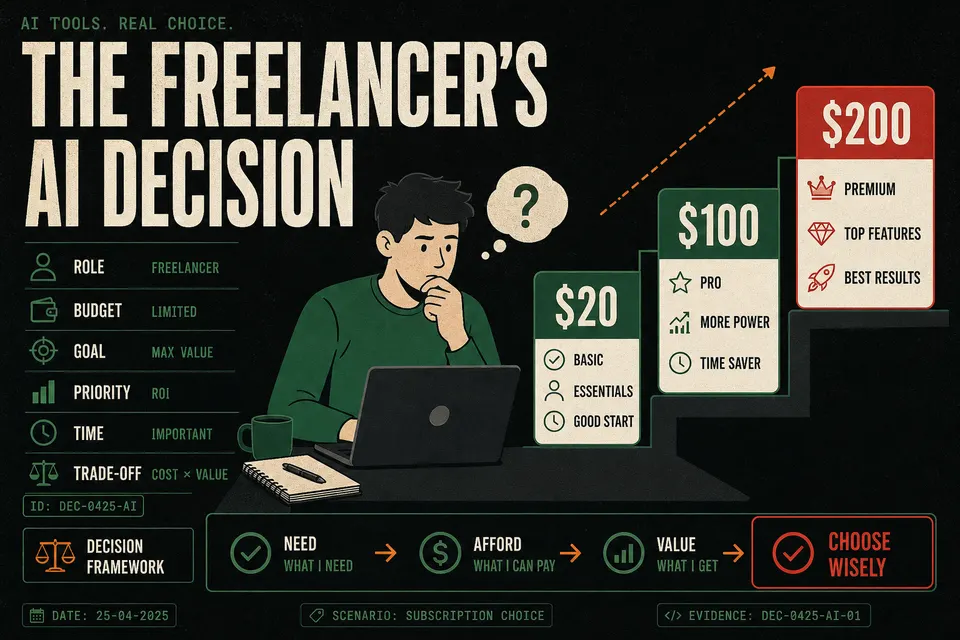
Are $100–$200/mo AI plans from OpenAI, Anthropic and Google worth it for freelancers? Break-even math, workflows that pay off, and a clear decision checklist.
For years, the price of a professional AI assistant was a settled question: $20 a month, the same as a streaming subscription, small enough to expense without a second thought. That era is over. OpenAI, Anthropic and Google now sell tiers that run from $100 to $250 a month — five to ten times the old baseline — and the jump has forced freelancers and solo developers to treat these tools not as a casual utility but as a genuine business line item that has to earn its keep.
The decision is no longer trivial. As tiers multiply and "AI fatigue" sets in, search interest in cost-justification queries — is Claude Max worth it, ChatGPT Pro ROI — keeps climbing. The honest answer is not a slogan. It's a calculation, and it depends almost entirely on how you work.
What the premium tiers actually buy
Start with the published pricing, because the structure matters as much as the number.
| Provider | Entry tier | Premium tiers | What the money buys |
|---|---|---|---|
| OpenAI ChatGPT | Plus — $20/mo | Pro — $100/mo (5× usage), $200/mo (20× usage) | Both Pro tiers are feature-identical; the only difference is usage headroom |
| Anthropic Claude | Pro — $20/mo (~$17/mo annual) | Max 5× — $100/mo; Max 20× — $200/mo | More usage plus priority access to newest models, Claude Code and agentic desktop tooling |
| Google Gemini | AI Pro | AI Ultra — launched ~$250/mo, since cut to ~$200/mo | Higher limits, developer credits, large cloud storage, entertainment perks |
Two structural facts cut through the marketing. First, OpenAI's $100 and $200 Pro tiers are feature-identical — the extra $100 buys only volume, not new capability. Second, Anthropic's Max tier buys capability, not just headroom: priority access to the newest models, Claude Code, and agentic tooling that the $20 Pro plan doesn't unlock.
That distinction points to the single most important upgrade trigger. On Claude's $20 plan, you are effectively limited to the mid-tier model; the top-end reasoning model sits behind Max. Anthropic made that top-end model, Fable 5, a permanent part of Max in July 2026 — see whether Claude Max is worth it now. For deep architecture work or complex refactors, that is a capability wall, not a volume wall — and no amount of patience on the cheaper tier gets you over it.
One nuance freelancers routinely miss: on Claude, chat, Claude Code and the agentic desktop tools all draw from one shared quota. Hammer one and you starve the others.
The break-even math
Ignore the vendor testimonials and run two independent calculations.
Track one — versus the pay-as-you-go API. Roughly $100 of top-model API usage buys on the order of 1.3 million output tokens, equivalent to a few hundred hours of moderate use. The rule of thumb from practitioner testing: below about two hours a day, metered API access is usually cheaper; above it, the flat subscription wins. The same break-even logic, worked out in detail for ChatGPT specifically, is in ChatGPT API vs Plus break-even math. A single day of heavy agentic coding can burn $20–$50 in equivalent API spend, which means a $200 plan — about $6.67 a day — pays for itself in roughly four to ten heavy working days a month.
Track two — versus your own billable time. This is the framing that actually matters for a freelancer, and it's refreshingly simple:
Break-even hours saved per month = Plan cost ÷ your billable hourly rate
| Plan | @ $50/hr | @ $100/hr | @ $150/hr |
|---|---|---|---|
| $20 Plus/Pro | 0.4 hr/mo | 0.2 hr | 0.13 hr |
| $100 Pro/Max 5× | 2.0 hr/mo | 1.0 hr | 0.67 hr |
| $200 Pro/Max 20× | 4.0 hr/mo | 2.0 hr | 1.33 hr |
The numbers are almost embarrassingly forgiving. At any professional freelance rate, a $200 plan needs to reclaim just one to four hours a month to break even. At $150 an hour, the top tier pays for itself if it saves you barely 80 minutes across an entire month.
But there is a catch that vendor math conveniently omits: freed time is only worth something if you can bill it or reinvest it. An hour saved that turns into an hour of idle scrolling is not ROI — it's a rounding error. The real question is never whether the plan is cheaper than your rate. It's whether you reliably save the hours and actually put them to work.
Where premium measurably pays off
The upgrade justifies itself in specific, token-hungry workflows:
- Long agentic coding — multi-hour sessions with tools like Claude Code or Codex. This is the strongest case: it's the most token-intensive workflow, it hits the $20 limits fastest, and it demands the top reasoning model. Heavy users report running the $200 tier 60–80 hours a week without exhausting quota. Claude Code's own token economics, why an agentic session can burn millions of tokens, are broken down in Claude Code pricing and token economics.
- Long-context refactoring — large codebases mean high token burn and a need for top-model reasoning, a combination the Sonnet-only $20 tier can't sustain.
- Deep research and long synthesis — extended conversations quietly consume tokens; a predictable flat fee removes the anxiety of a metered bill.
- Multi-tab parallel work — practitioners report running four or five concurrent sessions on the $100 tier with quota intact.
Where it doesn't pay: occasional drafting, one-off questions, or a single well-defined task. And if you're building a product that serves other users, the subscription is the wrong tool entirely — consumer plans prohibit reselling and programmatic use, so you need the API regardless.
The counter-case
The loudest argument for premium plans — that they deliver "thousands of dollars of value" — is economically misleading, and it's worth understanding why. Those figures come from scripts running maximum utilization at off-peak hours, when the provider's marginal cost is close to zero. Token prices are set to maximize profit, not to reflect cost. As one skeptic put it, you're the buffet customer being told you got $8,000 of value because the all-you-can-eat sign says so — even though you mostly don't eat that much.
Reliability friction erodes the premium proposition too. Providers have tightened weekday-morning limits and acknowledged that users hit caps faster than expected; there are recurring complaints of premium sessions silently falling back to smaller models. And a forward-looking risk hangs over the whole category: much of today's pricing is widely believed to be subsidized, and heavy users worry it won't hold.
The metered API wins outright when your use is sporadic, when you can route simple work to cheap models and reserve the expensive one for hard problems, or when you're billing a team. And for a large share of users, the $20 tier remains, in the blunt verdict of one forum, "more than enough."
The verdict — a decision checklist
The market itself is recalibrating. Users now juggle an average of roughly four premium AI tools — about $66 a month — and Google's Ultra price cut from $250 to $200 hints at pressure building against runaway tiers. For a full map of every tier from $6 to $300, see the complete AI subscription decision matrix for solo developers. A third path is quietly emerging: some developers stack ChatGPT and Claude simultaneously, past $300 a month combined, using each for its distinct strength — one for implementation, the other for review. Cheaper alternatives are emerging too, as covered in how Chinese labs are reinventing coding-agent token pricing.
Upgrade to $100–$200 only when all of these are true: you use AI two-plus hours a day on billable work; you regularly hit the $20 limits mid-task; you genuinely need the top reasoning model; your work is agentic or long-context; and you can bill or reinvest the hours you free.
Hold at $20 when your sessions are short and focused, you rarely hit limits, or you lean on one well-defined task type.
Use the API instead when your usage is variable, you can route across cheap and expensive models, or you're building a product.
The premium tier is not a status symbol, and it is not a scam. It is a lever — powerful for the heavy, token-hungry, high-billing operator, and dead weight for the occasional user. Run the two numbers, be honest about whether you'll actually bill the hours you save, and let the arithmetic, not the marketing, decide.