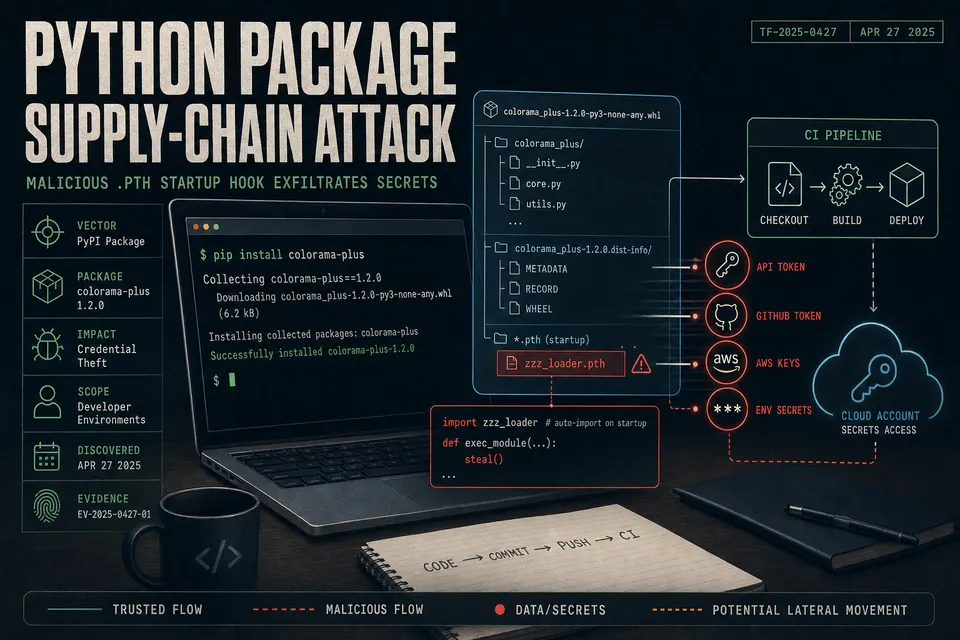
From index hosting through source and wheel formats to virtual-environment install, the report reframes how teams should treat everyday Python dependency risk.
Cisco Talos researchers Onur Mustafa Erdogan and Darin Smith published a detailed analysis on July 14, 2026, that reframes how security teams should treat Python package risk. In “The serpent’s tongue: Luring the Python out of its den,” Talos maps the full journey of a package—from hosting on PyPI or a custom index, through source and wheel formats, to installation into a system or virtual environment—and shows that native packaging features can execute attacker code at install time with no further user action.
The report lands as software supply-chain attacks accelerate and Python remains central to enterprise tooling, data science, AI pipelines, and cloud automation. Similar risk runs through the model layer itself, where OpenAI and Hugging Face AI supply-chain risks have produced RCE and credential theft. GitHub’s 2025 security data, cited by Talos, recorded a 69 percent year-over-year rise in published malware advisories, with roughly 17 percent of reviewed advisories in the GitHub Advisory Database tied to the pip ecosystem. Developer workstations and CI systems are prime targets: people who install packages often hold administrative rights to endpoints, source repositories, continuous-integration pipelines, and cloud accounts. The rise of AI tooling has only expanded that surface. That expansion also runs through AI gateways directly: a chained flaw in Starlette and LiteLLM was used to steal foundation model provider keys from AI infrastructure rather than a developer laptop.
How attackers reach PyPI and weaponize distributions
Talos organizes the package journey into three layers: hosting, distribution, and installation. Hosting is not limited to the official Python Package Index. Packages can arrive from PyPI (the default for pip, with metadata via the JSON API and artifacts on files.pythonhosted.org), direct VCS installs from GitHub or GitLab, or custom and extra indexes configured through --index-url, --extra-index-url, PIP_* environment variables, or multi-level pip configuration. Those extra-index paths are natural homes for dependency confusion and malicious mirrors. Typosquatting, namespace confusion, compromised maintainer accounts, and automated mass publication complete the injection picture.
Two distribution formats dominate. Source distributions (sdist, typically .tar.gz) build on the victim machine and rely on setup.py and/or pyproject.toml. Classic setup.py can run arbitrary code during install, download, or build. Wheel distributions (.whl, ZIP-compatible) are prebuilt and marketed as “install only.” They avoid a full local build, yet they still carry package content, entry points, .dist-info metadata, scripts, and the ability to drop path-configuration files and hooks into site-packages. Treating wheels as safe is a misconception Talos explicitly rejects.
Adversarial techniques fall into two families. Build-hook abuses fire during install or build—setuptools command classes, setup execution, and build backends. Package-content abuses fire later: on import via __init__.py, on module run via __main__.py, through entry-point console scripts, or at interpreter startup. Both families abuse legitimate packaging mechanics rather than exotic exploits.
Virtual environments are not sandboxes
Virtual environments isolate packages and binaries; they do not isolate the host. They share the filesystem and network. Compromising a developer venv therefore compromises a high-privilege workstation surface, not a sealed container.
| Mechanism | When it runs | Strength |
|---|---|---|
.pth files in site-packages / dist-packages | Every Python start (imports and one-liners allowed) | Strong across subsequent tooling on that interpreter |
sitecustomize.py / usercustomize.py | Every Python start | Strong site-wide hook |
| Entry points / console scripts | When a named command is invoked | Conditional; can shadow system tools via PATH in venv Scripts/bin |
“Privilege” here is not classic kernel elevation. Developer identities commonly hold cloud keys, LLM API keys, GitHub personal access tokens, PyPI tokens, SSH keys, Docker configs, CI secrets, and source repositories. An install-time or startup payload can spawn shells, run recon, and exfiltrate over HTTP. Stolen registry or GitHub tokens enable further package poisoning—worm-like propagation seen in campaigns such as Hades. The path to production is short: laptop to committed lockfile, to CI runner, to artifact, to customer environments. That path can end in a headline breach: Accenture's Azure DevOps breach exposed 35GB of source code and leaked credentials after similar exposure.
Talos cites impact timing that compresses response windows: payload execution within minutes of install, exfiltration often within about an hour, operationalization of stolen assets within days, and a dwell-time trend on the order of roughly nine days once a system is compromised.
The Hades campaign, analyzed by Orca Security, illustrates the model in practice. It compromised 26 packages (37 malicious wheels) across bioinformatics, graph ML, deep learning, and developer tooling. Malicious wheels dropped *-setup.pth files that ran at interpreter startup, pulled a Bun runtime, harvested cloud and registry credentials, and used stolen tokens to propagate. TeamPCP-linked activity, including backdoored LiteLLM releases on PyPI and multi-wave campaigns Talos notes via Wired reporting, shows the same pattern: install-time footholds and startup hooks that turn a routine pip install into credential theft.
How far a single poisoned dependency can travel
Direct impact is credential theft from the workstation or CI job. The software path is transitive: a poisoned dependency enters a product binary or container and reaches customer estates. Amplification comes from token reuse that trojanizes additional packages and from multi-wave campaigns. Sonatype’s 2026 State of the Software Supply Chain reported more than 454,600 new malicious packages identified in 2025 across major ecosystems, bringing cumulative known and blocked malware above 1.23 million. More than 99 percent of that 2025 volume was on npm; the figure is useful as an industrialization signal, not as a PyPI-only count. The Python-specific signal remains the sustained share of advisories and the demonstrated use of install-time and startup-hook techniques.
Indicators and defenses that matter now
Detection is hard because the techniques abuse legitimate packaging features. High-signal host telemetry includes:
pythonorpipspawning unexpected children such as shells,curl/wget,systeminfo, ornetstatduring or right after install- File creates under site-packages for
*.pthcontent that is not limited to directory paths, plus new or modifiedsitecustomize.py/usercustomize.py - Entry-point binaries in venv
Scripts/binnamed like OS utilities, or profile edits that setPYTHONPATH - Outbound HTTP(S) during
pip install, unexpected typosquat or internal-looking package names, and SBOM/SCA hits on known-bad hashes
Benign packages can legitimately use path-configuration files; executable content in .pth files is the high-signal anomaly. Relevant MITRE ATT&CK mappings include T1059.006 (Python), T1546.018 (Python startup hooks), T1547/T1574 (persistence/hijack), and T1552 (credentials).
Controls must assume install-time execution:
- Audit and pin — use
pip-auditor SCA, lockfiles, and cryptographic hash-checking; forbid floating “latest” - Cooldown — delay adoption of newly published versions so registry cleanup can catch malware first
- Isolate builds — ephemeral runners only; keep long-lived cloud keys off developer laptops; the same discipline applies to hardening Jenkins plugins as CI/CD's high-privilege control plane
- Monitor hooks — alert on install-time process trees and
.pth/site-hook file creates under site-packages - Secret hygiene — short-lived tokens, least privilege, aggressive rotation and environment rebuild if a bad install is suspected
- Publish with provenance — Trusted Publisher plus attestations for first-party releases; ship SBOMs outbound
PyPI has raised the bar on the registry side. Trusted Publishing now covers more than 50,000 projects and more than 20 percent of file uploads in the cited period; roughly 17 percent of uploads carried attestations. Trusted publishing is not foolproof, though: the Mini Shai-Hulud worm compromised more than 170 npm and PyPI packages by abusing compromised CI/CD environments rather than the provenance system itself. Malware response improved: about 66 percent of reports handled within four hours and 92 percent within 24 hours in the 2025 year-in-review. Stronger 2FA, typosquatting flags, domain-resurrection checks, and a hardened ZIP upload pipeline help further. None is a silver bullet. Registry provenance improves publish integrity; consumer pin-and-hash policy, install isolation, and runtime monitoring remain essential. Waiting for takedown alone leaves an hours-long window enough for credential theft.
Over the past eighteen months the threat industrialized: higher volume, multi-stage chains, self-spreading via stolen publish tokens, and a shift toward startup hooks alongside classic setup.py one-shots. AI-oriented packages expanded the lure surface. Defenders should expect more hook-based persistence, cross-ecosystem token reuse, and continued extra-index confusion against monorepos—pressure that falls on consumer-side policy because registry removal alone cannot close the window.
For CISOs briefing non-technical stakeholders, the mental model is simple. Python package install is remote code execution under a trusted brand. A poisoned dependency does not require a user to “run malware.” pip install and Python startup hooks can steal cloud and CI credentials from developer machines and seed the build pipeline. Controls must assume install-time execution: pin and hash dependencies, delay new versions, isolate builds, and alert when Python drops startup hooks or spawns shells during install.