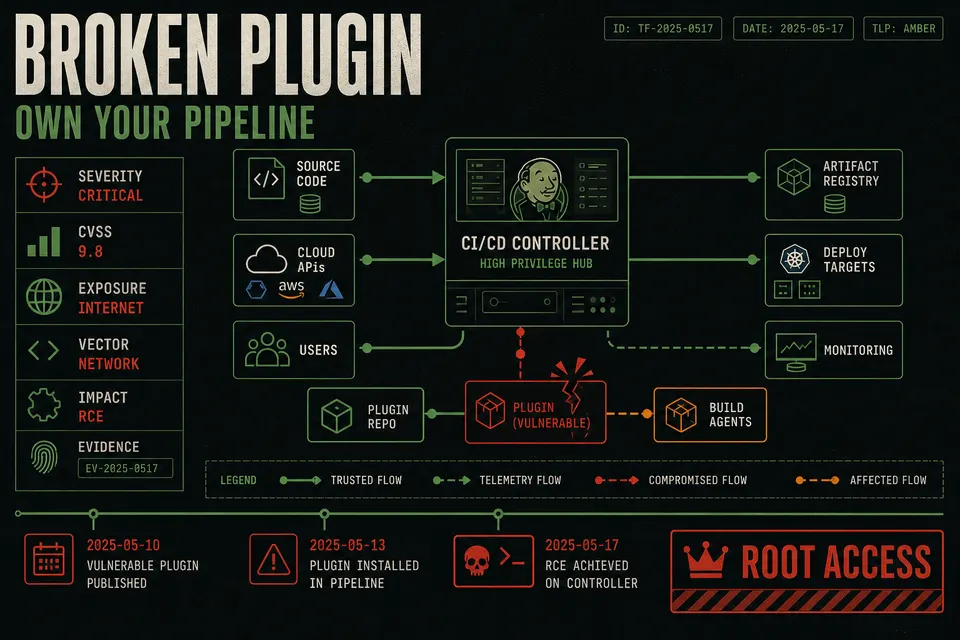
*A conceptual view of Jenkins as the high-privilege control plane of the software factory—and of plugins as the supply-chain links that can break it.*
A conceptual view of Jenkins as the high-privilege control plane of the software factory—and of plugins as the supply-chain links that can break it.
Jenkins remains the automation backbone for countless enterprise software factories. Controllers orchestrate builds, hold credentials, talk to source control and cloud APIs, and push artifacts into production paths. That power rests on a thin core and an ecosystem of more than 2,000 plugins. Those plugins are both the product’s greatest strength and one of its most durable attack surfaces.
A 2026 marketplace compromise of a vendor security plugin, dense multi-plugin advisories, and cloud telemetry showing end-of-life cores and unmaintained extensions still widely installed have made the risk concrete. For platform engineers, AppSec teams, and CISOs, Jenkins plugin security is no longer niche hygiene. It is a core software supply-chain control.
Why Jenkins Plugins Attract Attackers
Plugins often run with controller-class impact. They manage credentials, expose HTTP endpoints, execute Groovy or shell, integrate with SCM and cloud providers using broad tokens, and sit on highly privileged identities. A single popular plugin can pivot into code, registries, and cloud control planes.
Maintainers enjoy substantial autonomy. The Jenkins Security Team strives to fix issues but cannot guarantee timely patches across the full ecosystem. When maintainers cannot or will not fix a flaw, the project publishes unresolved advisories, may stop distributing the plugin, and surfaces warnings in the UI and on the plugins site. That process is mature for open source—yet absence of a fix remains first-class risk.
Wiz cloud telemetry shows Jenkins present in more than a third of environments. Among those environments, 59 percent run instances with critical core vulnerabilities, more than 87 percent still host end-of-life Jenkins, 37 percent use plugins marked “up for adoption,” 31 percent run deprecated plugins, and 21 percent run plugins with critical or high issues and no available patch. Nearly half place Jenkins on highly privileged service accounts; about one in five use administrative cloud identities. Two percent expose vulnerable instances directly to the internet. That exposure has a cost, as Jenkins CVE-2024-23897 ransomware exploitation showed.
The attack surface is layered:
- Controller vs. agents — builds on the built-in node, Docker socket mounts, and shared namespaces turn a plugin or pipeline flaw into host or cloud escape
- Dependencies and classloaders — incomplete isolation and restart-driven “don’t touch” cultures leave stale code running for years
- Secrets — tokens still leak into logs and environments when masking and short-lived credentials are uneven
- Network — internet-facing controllers and open agent inbound paths invite scanners
- Update-center trust — official marketplace installs are necessary, not sufficient, if a publisher is compromised; trusted publishing also failed to stop the Mini Shai-Hulud npm and PyPI worm
- Pipeline trust — untrusted pull requests or unsanitized parameters executed with secrets become remote execution
Attackers chain exposure, weak authentication, pipeline abuse, over-privileged agents, and stale plugins more often than they hunt exotic zero-days alone.
Case Studies That Illustrate Current Risk
In 2026, Checkmarx confirmed that a modified, malicious version of its Jenkins AST plugin—used to integrate Checkmarx One scanning into pipelines—was published to the Jenkins Marketplace. Customers were directed to known-good builds, including version 2.0.13-829.vc72453fa_1c16 from December 2025, and subsequently cleaned releases such as 2.0.13-848.v76e89de8a_053. The incident sat inside a broader TeamPCP campaign that earlier leveraged a Trivy-related compromise of Checkmarx repositories. Presence on the update center does not equal continuous integrity of the publisher. Security-scanner plugins themselves become high-trust, high-value targets. The Trivy CVE-2026-33634 scanner compromise showed the same pattern in GitHub Actions.
Earlier plugin flaws remain instructive. Stored XSS in the GitLab plugin (CVE-2022-34777) showed how webhook-driven content could reach authenticated sessions. Multi-plugin advisories across 2024–2026 have repeatedly hit Git client, Credentials Binding, Script Security, SAML/OIDC, HTML Publisher, HashiCorp Vault, and pipeline components. The project has also suspended distribution of plugins with severe unresolved issues—Pipeline Classpath Step, certain Kubernetes pipeline steps, scripttrigger, and others—because harm outweighed benefit. Historical availability is not a safety certificate.
Layered Defense Playbook
Effective Jenkins plugin security follows one sequence: minimize, govern, pin, isolate, inventory, respond.
Before install. Default-deny new plugins. Prefer Pipeline shared libraries, native steps, or external APIs. Disqualify plugins with no release in six to twelve months, up-for-adoption or deprecated status, unresolved advisories, non–update-center sources, or core requirements outside your LTS path. Review install stats, maintainer activity, required permissions, and transitive dependencies. Record requester, business reason, alternatives, owner, and rollback plan. Stage on a mirrored non-production controller first.
At install. Use the official update center only. Pin exact versions in Configuration as Code, container images, or plugins.txt-style manifests. Snapshot JENKINS_HOME before changes. Treat signature or metadata bypass as an incident.
After install. Inventory every controller, including shadow instances. Map Jenkins security advisories to installed versions within hours. Treat unresolved warnings as remove-or-isolate decisions. Remove unused plugins, watch for version drift, and monitor credential use and egress tied to plugin endpoints.
Shrink blast radius. Set built-in-node executors to zero. Prefer ephemeral agents and separate trust zones for production versus pull-request builds; never mount the Docker socket. Use external identity providers, matrix or role-based authorization, and least-privilege job identities. Keep CSRF protection and the Script Security sandbox enabled. Store secrets in the credentials system, mask logs, and rotate after any plugin incident. Keep controllers private with HTTPS and tight cloud IAM—no administrative service accounts on Jenkins nodes.
SBOMs, Scanning, and Compliance
Treat the CI platform itself as an asset. A complete plugin list with versions is a lightweight “CI SBOM.” Correlate it continuously against advisories and CVE data, generate CycloneDX SBOMs for build outputs, and feed them into Dependency-Track or equivalent. Scanner plugins improve application security—but the Checkmarx incident shows they must be governed like any other high-privilege extension. Map controls to NIST SSDF expectations for the build environment and third-party components, and to SLSA-style isolation and provenance. Auditors increasingly ask who can install plugins and whether continuous inventory evidence exists for SOC 2 or ISO programs. With NVD enrichment stalled, open source vulnerability clearinghouses are taking on more of that coordination.
Operational Checklist Teams Can Execute This Week
P0 — next 48 hours
- Inventory every Jenkins controller, including shadow and development instances
- Export plugin lists and versions; flag deprecated, up-for-adoption, and security-warning plugins
- Confirm built-in-node executors equal zero
- Verify external identity provider and least-privilege roles; eliminate anonymous admin
- Restrict network exposure of controllers and agents
- Identify plugins with unresolved advisories and plan removal or compensating controls
- If Checkmarx AST or any security-vendor plugin is installed, verify the exact version against post-incident guidance and pin it
P1 — this week
- Freeze unapproved plugin installs under a default-deny process
- Pin versions in IaC, CasC, or images
- Establish a staging path for the next security advisory
- Verify automated
JENKINS_HOMEbackup or volume snapshots - Audit Script Security approvals and revoke overly broad ones
- Harden agents: no Docker socket, ephemeral where possible, review secret access
- Subscribe the security team to Jenkins advisories with on-call routing
- Review cloud IAM on Jenkins nodes and remove administrative service accounts
P2 — 30 days
- Run a plugin-usage cleanup sprint
- Implement continuous CI platform inventory and CVE correlation
- Formalize pipeline trust models for forks and pull requests
- Tabletop a malicious plugin version appearing on the update center
- Align documentation with SSDF/SLSA talking points for auditors
- Assign named owners for every critical plugin
Jenkins plugin security will never be solved by a single patch. High privilege, massive scale, maintainer autonomy, and long-lived operational debt guarantee residual risk. Update-center governance is stronger than many ecosystems, yet the 2026 marketplace incident proved publisher compromise still works. Teams that default-deny, pin, isolate the controller, treat unresolved warnings as removal candidates, and continuously inventory their plugin surface convert that residual risk into something manageable. The controls above are implementable this week. The cost of delay is measured in credentials, cloud accounts, and production pipelines already sitting behind the next compromised or unpatched plugin.