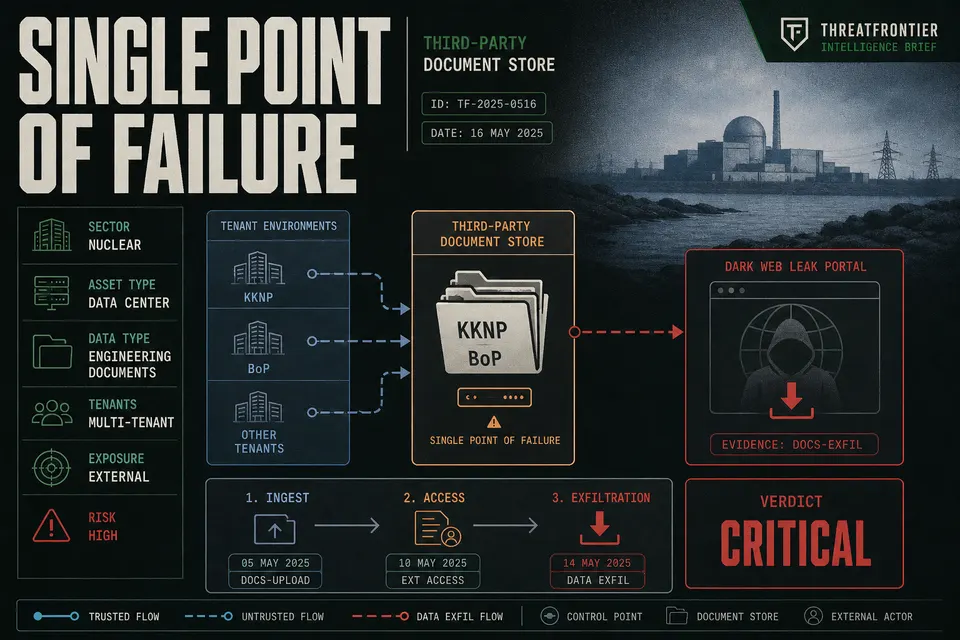
Reactor core systems were untouched, but a multi-tenant engineering document store became a single point of failure for the Kudankulam project's supplier graph.
Nearly 19,000 files totaling 14.3 gigabytes tagged to India’s largest nuclear power plant appeared on the dark web on June 11, 2026, after a ransomware-linked breach of a contractor’s server hosted by a third-party data center. The dump, claimed by the extortion group World Leaks and labeled as originating from Anil Ambani’s Reliance Group, did not compromise reactor core systems. It did, however, turn a multi-tenant engineering document store into a single point of failure for Balance-of-Plant design data and the supplier graph of the Kudankulam Nuclear Power Project (KKNPP).
The incident crystallizes a pattern energy CISOs already track: most high-consequence breaches now travel through vendors rather than direct assaults on operational technology.
Dump Timeline and Confirmed Facts
Yotta Data Services, which hosts infrastructure for Reliance Infrastructure, reported suspicious activity on a client server on May 29, 2026. Yotta said the process was terminated, suspected ransomware execution was prevented, and no lateral movement or data loss occurred inside its environment. At the end of June, Reliance informed Yotta of external claims of a breach. By mid-July, Reuters and Indian outlets confirmed that a KKNP-tagged subset of roughly 19,000 files sat inside a larger corpus of approximately 858,000 Reliance-labeled files on the World Leaks leak site.
Independent researcher Rakesh Krishnan first flagged the material. Reuters reviewed documents dated from 2016 to mid-2025 but could not independently verify authenticity of every file. Reliance publicly described a “partial breach,” reported the matter to CERT-In, and made a Regulation 30 disclosure to stock exchanges under SEBI LODR rules. Nuclear Power Corporation of India Limited (NPCIL) stated the material concerns “conventional balance of plant common service facilities” and does not relate to nuclear safety or nuclear security systems.
Reliance Infrastructure won the 2018 public tender for engineering, procurement and construction of common services for KKNPP Units 3 and 4. Those units, still under construction with Rosatom VVER technology, are expected online around 2027 and will add roughly 2,000 MW. Units 1 and 2 already operate; Units 5 and 6 remain in build-out. Kudankulam is central to India’s nuclear capacity expansion.
Technical Reconstruction of the Third-Party Vector
Public forensic detail remains thin. No CVE, edge-device family, phishing lure, or malware name has been disclosed. The high-confidence reconstruction is straightforward: project document stores belonging to the EPC contractor, hosted in a multi-tenant data center, became reachable from the internet or from insufficiently segmented administrative planes. Bulk collection of engineering repositories followed. Exfiltration fed the World Leaks dump.
There is no public evidence of a hop into NPCIL operational technology or air-gapped safety instrumentation and control. Nuclear relevance derives from the content of contractor files, not from compromise of plant control systems. Yotta’s claim of containment and “no data loss” sits in tension with the later appearance of 14.3 GB of KKNP-tagged material; the data may have left before detection, originated from a broader Reliance estate, or both. CERT-In is investigating. Operators should treat the initial-access method as unknown and prioritize blast-radius controls rather than wait for a full public IR report.
Risk Assessment of the Leaked Materials
Reported categories include:
| Category | Reported content | Operational or safety risk if authentic |
|---|---|---|
| Engineering drawings | Ventilation and cooling systems for Units 3–4; complete floor layout of a “common control room” | Physical and OT mapping of support systems; planning aid for sabotage, insider paths, or hybrid attack |
| Supplier data | Vendor proposals, approved supplier lists | Supply-chain targeting, spoofing, sub-tier compromise |
| Inspection records | 2024 joint NPCIL–Reliance inspection records with equipment photographs | Access patterns, cadence, and equipment state |
| Equipment reviews | Plant-related equipment assessments | Weakness identification |
| Commercial | Purported $112 million terrorism insurance cover for Unit 3 or 4 | Insight into risk pricing and contingency framing |
NPCIL’s framing is precise: these are conventional Balance-of-Plant common services of the kind found in thermal plants; indicative drawings came from the tender; detailed designs prepared by Reliance with OEMs were reviewed and accepted by NPCIL. Core reactor systems supplied by Rosatom are not claimed to appear in the dump.
Independent experts push a sharper edge. Nickolas Roth of the Nuclear Threat Initiative called the risk “serious,” noting that the files can show “not just who has access to the project but which systems that access reaches.” Plant sources described “absolute commotion” among top brass. Both statements can hold: BoP is not the core, yet BoP plus supplier graphs plus control-room layouts remain high-value for hybrid physical-cyber campaigns and follow-on supplier attacks.
Regulatory Response and Governance Gaps
Reliance and Yotta emphasize containment, enhanced monitoring, and ongoing technical investigation. CERT-In is engaged. The Department of Atomic Energy declined comment in early coverage; no public AERB enforcement action was announced in the first wave of reporting.
What remains largely opaque is the day-to-day governance of contractor common data environments: classification rules for nuclear-adjacent drawings, encryption and retention requirements, right-to-audit of cloud hosts, continuous monitoring of vendor SOCs, and contractual breach SLAs. Public tendering supplied indicative drawings and accepted detailed design; the cyber annex governing least privilege, data residency, and document-repository segmentation has not been equally visible. That gap is the governance story. Accenture's 2026 Azure DevOps incident shows the same governance gap at a software vendor: see Accenture's Azure DevOps supply-chain breach.
Comparative Cases and Global Signal
This is the second cyber-linked episode at Kudankulam. In 2019, Dtrack malware associated with North Korea’s Lazarus Group was found on the plant’s administrative network; NPCIL stated plant systems were unaffected. The 2026 case differs in vector—financially motivated document theft from an EPC contractor rather than state malware on admin infrastructure—but shares the same lesson: IT and contractor estates remain the softer edge of nuclear programs.
Globally, SecurityScorecard research has linked 67 percent of energy-sector third-party breaches to software and IT vendors. The same third-party exposure pattern is dissected in our blueprint for securing data-exchange portals after the Stadler Rail breach. Parallel World Leaks activity against Tata Electronics produced large design dumps affecting Apple and Tesla supply chains. Colonial Pipeline (2021) showed how IT ransomware can force operational shutdown without deep ICS implants; SolarWinds demonstrated the force-multiplier effect of a trusted third party. Extortion groups do not need novel ICS zero-days to harm nuclear construction programs—EPC document stores and approved-supplier lists are enough for mapping, coercion, and secondary campaigns.
Practical Mitigation Checklist for the Next 30–90 Days
- Segment project CDEs for nuclear BoP work from the general corporate estate and multi-tenant data-center admin planes.
- Enforce MFA and least privilege on every VPN, RDP, document platform, and console—World Leaks repeatedly exploits valid accounts without MFA.
- Baseline egress and deploy DLP capable of detecting multi-gigabyte transfers to cloud storage, TOR, or unusual destinations.
- Harden and inventory edge appliances; rotate long-lived service accounts after any vendor incident.
- Maintain immutable, offline-capable backups of engineering repositories with integrity monitoring.
- Insert enforceable right-to-audit of hosts and sub-processors, with 24–72-hour breach notice and forensic package delivery.
- Classify nuclear-adjacent drawings as restricted; time-box access; watermark; keep approved-supplier lists compartmented from full plant layouts.
- Make continuous third-party risk scoring a bid criterion with a contractual kill-switch for non-compliance, and run joint IR tabletops among owner, EPC, and host at least annually—insurance, including purported terrorism cover, does not substitute for these controls.
Outlook: Ransomware Against OT/ICS Supply Chains
World Leaks emerged as a rebrand of Hunters International, itself linked in industry reporting to the Hive ecosystem. The group shifted heavily toward pure extortion as encryption payments declined, running an Extortion-as-a-Service model with leak sites, negotiation portals, affiliate panels, and early-access channels for journalists. Pressure on individual victims was the model in the Vastaamo case against Aleksanteri Kivimäki, convicted of mass patient extortion. Ransom negotiation itself has become an attack surface, as detailed in how insider negotiators inflated ransoms and betrayed victims. Prior victims include Nike and Tata Electronics. Common access patterns involve compromised VPNs and valid accounts lacking MFA, phishing, and edge appliances; exfiltration often uses custom tooling, MEGA, Rclone, and living-off-the-land techniques.
For nuclear and energy operators, the Kudankulam case is not an exotic outlier. It is the predictable result of placing high-value engineering data on third-party infrastructure without equivalent security annexes. As India and other nations expand nuclear fleets, the attack surface expands with every EPC contract and every multi-tenant document repository. Boards and regulators that treat third-party cyber risk as a compliance checkbox rather than a single point of failure will keep rediscovering the same lesson—after the files are already online.