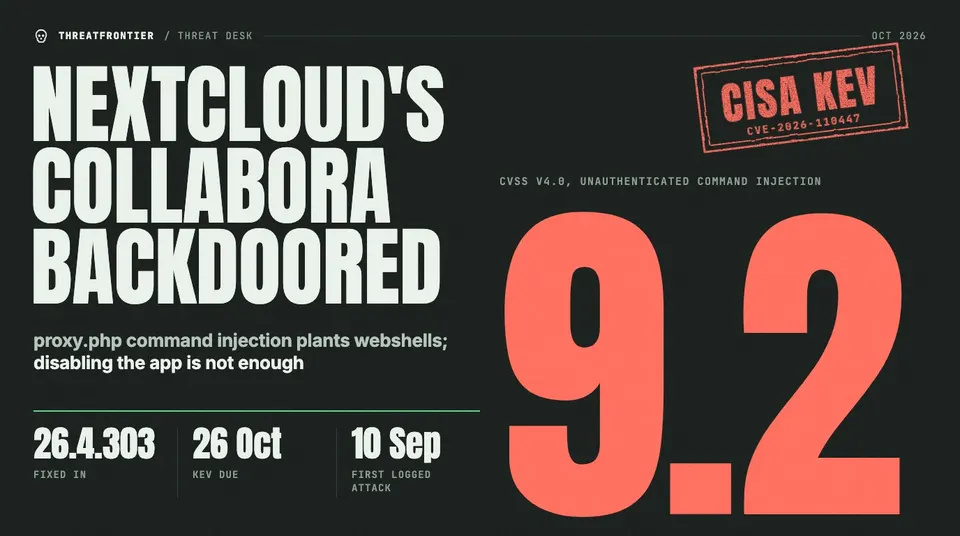
Attackers have used a proxy.php command injection in Nextcloud's built-in Collabora CODE server to plant webshells since 10 Sep. Patch to 26.4.303, then hunt.
Attackers have been exploiting an unauthenticated OS command injection in the Collabora Online Built-in CODE Server app for Nextcloud (richdocumentscode) since at least 10 September 2026. CISA added the flaw, CVE-2026-110447, to its Known Exploited Vulnerabilities catalog on 23 October with a due date of 26 October. Every richdocumentscode release before 26.4.303 is affected. The only fixes are to upgrade or to remove the app. Disabling it does not close the hole, and a patched server can still carry a webshell planted earlier.
Who is affected
The vulnerable component is richdocumentscode, the Nextcloud app that downloads and runs a local Collabora Online (CODE) server so that Nextcloud can edit documents without a separate office server. The CVE record and the Collabora advisory both state that the flaw is not present in standalone Collabora Online servers. A Collabora maintainer described it as affecting "only the Development Edition, and only in this (rather rarer) Built-in CODE Server deployment mode that downloads a local appimage."
The Nextcloud community thread that CISA cites also lists setups that are not exposed. These are installs that use the richdocuments app without richdocumentscode, Collabora run through Docker or Linux distribution packages, and hosted Collabora services. That list comes from the forum thread rather than the advisory text, so confirm your own setup by checking whether the richdocumentscode app is installed and which version it is.
You are in scope if richdocumentscode is installed at version 26.4.302 or older, whether or not the app is currently enabled. The advisory also flags Nextcloud 29 and earlier, which are end of life. On those releases, upgrade Nextcloud or remove the app.
What the flaw is
The bug is a CWE-78 OS command injection in proxy.php, scored 9.2 (Critical) under CVSS v4.0 with no authentication or user interaction needed. A crafted request makes the server run a command as the web server user. The CVE record says it can be triggered "when the CODE server isn't running (e.g., the product was recently restarted)." In practice that means the window opens after a restart, an upgrade or a crash. The advisory says this is a different issue from CVE-2025-66208 and that the earlier fix does not stop it.
Exploitation is easy to automate. CISA's SSVC assessment recorded in the CVE record lists exploitation as active, automatable and with total technical impact.
What attackers have done
The first logged attack in the public reports was on 10 September 2026. The Hacker News reports that the attacker hit /apps/richdocumentscode/proxy.php?status with encoded path traversal (%2e%2e), command substitution and base64 piped to sh. The requests wrote one-line PHP webshells named shx*.php into apps/richdocumentscode/. The payload one victim recovered runs a command from a GET parameter and returns the output. Filenames reported so far include shxa35d0.php, shx5cf91.php, shxd33ce.php, shxf4645.php, shx13a86.php, shx56367.php and shrf4645.php. A Nextcloud forum post also names Nx_33143.php.
Reported source IPs are 139.28.18.122 (10 and 11 September) and 89.38.98.50 (14 September). No actor has been named. In the cases described, the shell sent uname -a output to a webhook.site address, and on one server it searched for credential stores and cryptocurrency wallets. The reporter found no sign in the reviewed logs that files were copied or archived, but said anything the web server account can read should be treated as exposed.
The fix shipped quietly. Collabora released 26.4.303 on 11 September, the day a victim opened a GitHub issue about the intrusion, and The Hacker News says the release notes did not mark it as a security fix. The CVE and advisory followed on 14 October, 34 days after the first logged attack. Version 26.4.402, released 24 September, rewrote the start command, but some administrators reported startup and document-opening problems and went back to 26.4.303.
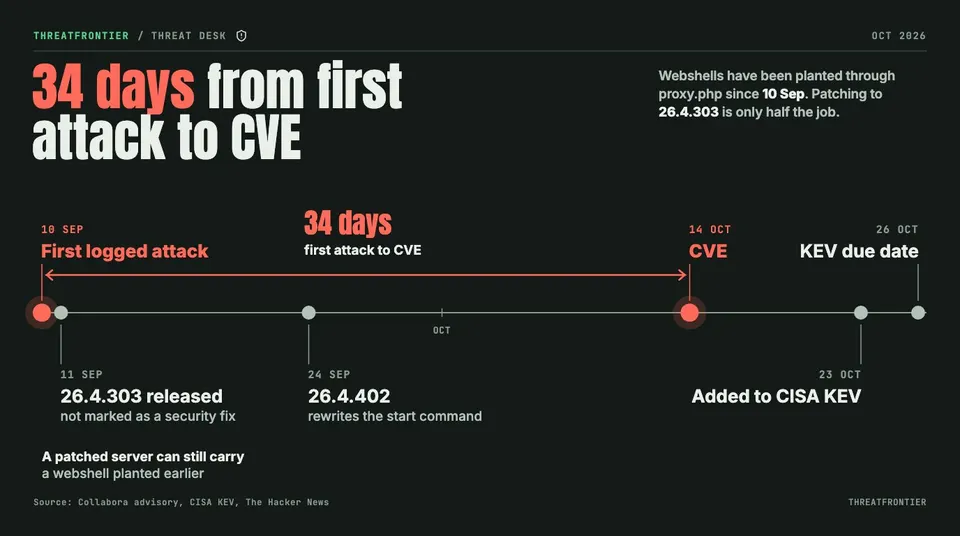
Attacks began on 10 September; the fix shipped quietly the next day, but the CVE and advisory took 34 days, and CISA's deadline is 26 October.
What to do
- Patch or remove. Update
richdocumentscodeto 26.4.303 or later, or uninstall it if you do not use it. Do not rely on disabling the app. - Hunt for webshells, even on a patched server. Run the Nextcloud integrity check and look for
EXTRA_FILEentries underapps/richdocumentscode. Search the whole web root for stray PHP files, in particularshx*.php,shrf*.phpandNx_*.php. A Collabora maintainer's advice is to upgrade and also remove any lingeringshx*.phpfiles. Compare any file you find against the reported SHA-2564b9fbd0663fbfd6028fc216ed18e0d6ef3ae498a7fdc97083e4b0ce3cec40562, but treat a mismatch as inconclusive, since filenames vary between victims. - Read the logs back to 10 September. Look for
proxy.php?statusrequests containing%2e%2e,$(,${IFS}orbase64 -dpiped tosh, requests to any file you found in step 2, andsudoattempts by the web server account. Check the logs even if the app was disabled, because the forum thread warns the flaw may have been used regardless. - Rotate secrets. Assume anything the web server account could read is compromised: such as the database password and app passwords. Rotate them once the shell is gone, so a still-live backdoor cannot read the new values.
- Federal and regulated teams. The KEV entry flags forensic triage as required and cites BOD 26-04. It says to discontinue use of the product if mitigations are unavailable. The due date is 26 October.
Sources
- NVD record for CVE-2026-110447, read through the NVD API: https://services.nvd.nist.gov/rest/json/cves/2.0?cveId=CVE-2026-110447
- CVE record and CISA SSVC entry: https://cveawg.mitre.org/api/cve/CVE-2026-110447
- Collabora advisory GHSA-g3vx-3m76-fghh: https://github.com/CollaboraOnline/online/security/advisories/GHSA-g3vx-3m76-fghh
- richdocumentscode issue 354, "Security issue - Hack": https://github.com/CollaboraOnline/richdocumentscode/issues/354
- Nextcloud community thread, "To Collabora Built-in User: Update ASAP": https://help.nextcloud.com/t/to-collabora-built-in-user-update-asap/250516
- CISA Known Exploited Vulnerabilities catalog (JSON feed): https://www.cisa.gov/sites/default/files/feeds/known_exploited_vulnerabilities.json
- The Hacker News: https://thehackernews.com/2026/10/hackers-backdoor-nextcloud-servers.html