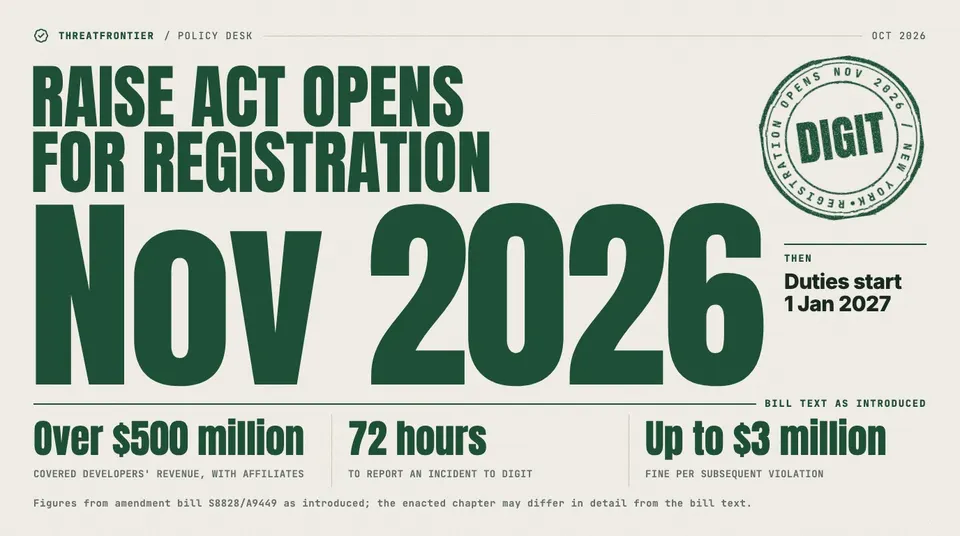
New York's DIGIT office will register large frontier AI developers from November 2026, with disclosure, incident and quarterly duties from 1 January 2027.
New York is moving its Responsible AI Safety and Education (RAISE) Act from statute into operation. On 21 September 2026, Gov. Kathy Hochul and the Department of Financial Services (DFS) said a new office inside DFS, DIGIT, will direct large frontier AI developers to register from November 2026, with compliance and regular reporting starting in January 2027. Attorney General Letitia James said her office will enforce the law.
When it starts
Hochul signed the original RAISE Act on 19 December 2025. A chapter amendment, S8828 in the Senate and A9449 in the Assembly, was signed as chapter 96 on 27 March 2026 and set the effective date at 1 January 2027, replacing the original 90-day start.
DFS says registration opens in November 2026 but has not given an exact date. It has not published fees, forms or filing instructions either: that DIGIT guidance is still to come. The Pillsbury law firm noted on 9 October 2026 that detailed guidance on filing forms, risk assessment and incident identification had not yet been issued.
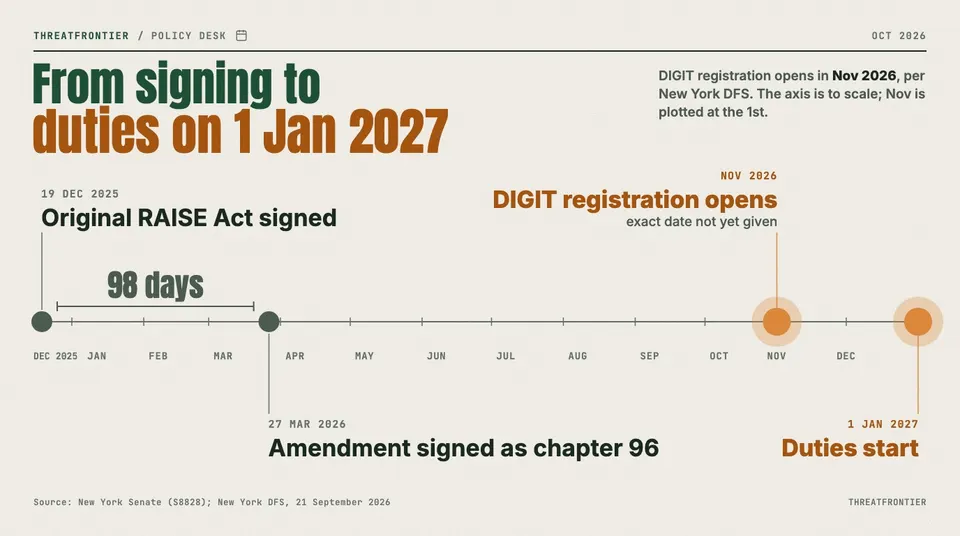
The RAISE Act from its signing on 19 December 2025 to duties starting on 1 January 2027.
Who is covered
The DFS announcement does not define a large frontier developer. The amendment bill does. A large frontier developer is one with annual gross revenues above $500 million in the preceding calendar year, counted together with its affiliates. A frontier model is a foundation model trained with more than 10^26 integer or floating-point operations.
These thresholds, and the reporting windows and penalties below, come from the amendment bill text as introduced (S8828/A9449). The legislature's pages show that text, not the final enacted wording, so the enacted chapter may differ in detail. Check the final wording with counsel before relying on an exact figure.
What DIGIT receives
DIGIT is the Office of Digital Innovation, Governance, Integrity and Trust. DFS says it takes registrations, disclosure statements, quarterly assessments of catastrophic risk and critical safety incident reports. Marc Gilman is the office's Deputy Director for the RAISE Act.
Duties from 1 January 2027
- Register and disclose. A large frontier developer may not operate in New York without a current disclosure statement. DFS says the first is due on 1 January 2027, and the statement is renewed every two years.
- Pay assessments. The bill splits DIGIT's costs among large frontier developers in pro rata shares and sets no fixed dollar amount.
- Publish frameworks. Developers publish safety and transparency frameworks, review them at least yearly and publish material changes within 30 days. A transparency report is due before or with the deployment of a new or substantially modified frontier model.
- Report incidents. Critical safety incidents go to DIGIT within 72 hours of the developer determining one occurred. Where an incident poses an imminent risk of death or serious injury, an appropriate authority must be told within 24 hours.
- File quarterly. Developers send DIGIT a summary of their assessment of catastrophic risk from internal use of their models every three months, or on another agreed schedule.
Penalties
The Attorney General may seek civil penalties of up to $1 million for a first violation and up to $3 million for each subsequent violation. The office may also levy $1,000 per day for a missing disclosure statement, after notice and a hearing. There is no private right of action. The DFS announcement itself states no penalty amounts.
What to do before January
- Test your status against the $500 million revenue and 10^26 operations thresholds, counting affiliates.
- Be ready to register when DIGIT opens filing in November, and watch for its guidance on dates, fees and forms.
- Publish or update your safety framework, and give one person the yearly review.
- Build a 72-hour incident path: who decides that an incident is a critical safety incident, who files with DIGIT, and who tells other authorities within 24 hours when lives are at risk.
- Set up the quarterly risk-assessment cycle and budget for pro rata assessments.
- Enterprise buyers: ask AI vendors whether they are covered, whether they will register, and where their published framework lives. Expect to revisit contracts once DIGIT issues guidance.
New York joins other governments setting rules for AI suppliers. California recently changed its AI Transparency Act, and the US General Services Administration added a contract clause on model changes and training on agency data.