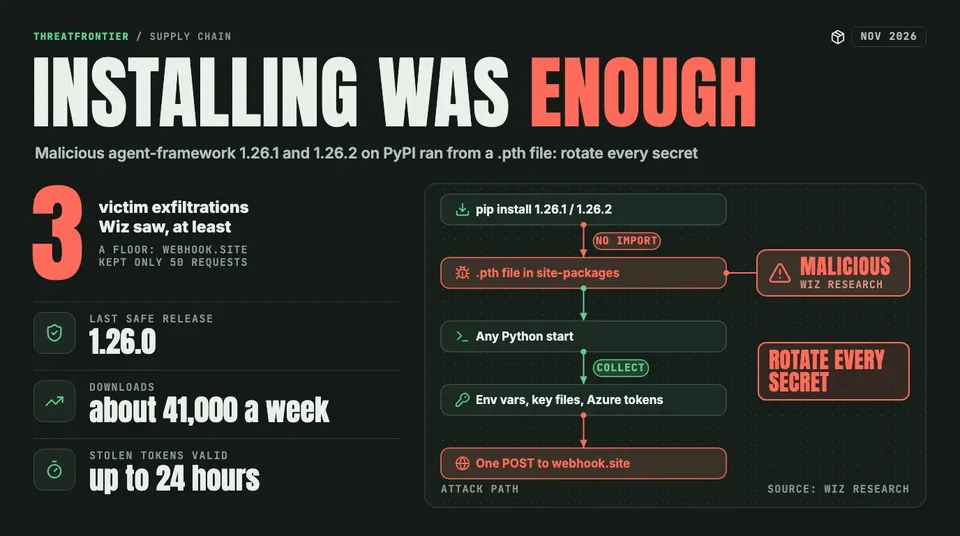
Two malicious agent-framework releases on PyPI ran a .pth stealer at every Python start, taking Azure and GitHub OIDC tokens. Pin 1.26.0 and rotate secrets.
If a developer machine, container, build agent or CI runner installed Microsoft's agent-framework 1.26.1 or 1.26.2 from PyPI, treat every secret in that environment as stolen and rotate it. The two releases, published on 17 November 2026, carried a credential stealer in a .pth file, which Python runs at every interpreter start: the package never had to be imported. Pin to 1.26.0, the last safe release.
The package draws about 41,000 downloads a week, according to Wiz Research. No CVE id has been assigned; Wiz tracks the incident as wiz-adv-2026-214.
What happened
Wiz's timestamps put the malicious 1.26.1 on PyPI at 20:35 UTC on 17 November and 1.26.2 at about 21:08 UTC. Both were gone by about 21:30 UTC. The last legitimate release, 1.26.0, went up on 12 November.
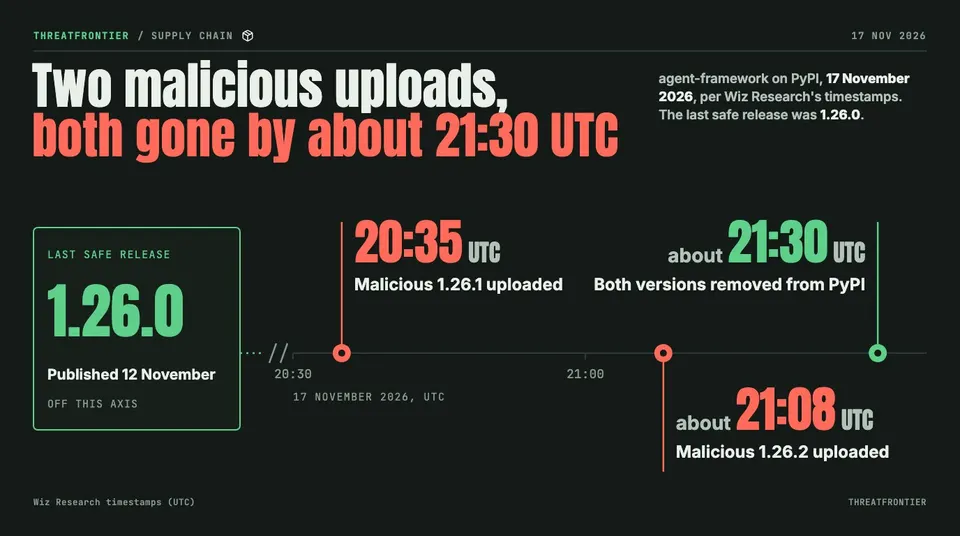
The malicious uploads and their removal on 17 November 2026, from Wiz Research's timestamps (UTC).
BleepingComputer gives a different account of the timing, saying the second upload followed a quarantine of the first. Either way, the attacker was able to publish twice. Microsoft had not said how its publishing was breached when BleepingComputer published.
How the stealer ran
Python executes .pth files in site-packages whenever the interpreter starts. Per Wiz, version 1.26.1 dropped agent_framework_meta.pth; version 1.26.2 switched to af_runtime_diag.pth plus a new top-level af_runtime_diag.py. A search for only the 1.26.1 file name misses the second release.
Wiz lists what it collects:
- environment variables that look like tokens, secrets and keys, and secret-looking values from up to 300
/proc/*/environfiles; - up to 60 credential files in 1.26.1 and up to 80 in 1.26.2, among them Azure CLI sessions,
.npmrc,pip.conf,.netrc,.git-credentials, Docker config, Hugging Face tokens, Azure DevOps agent credentials and.envfiles; - Azure DevOps OIDC tokens, Azure instance metadata, and managed-identity tokens for 12 resources, including Azure Resource Manager, Graph, Key Vault and Storage.
Version 1.26.2 added GitHub Actions OIDC theft. In workflows with id-token: write, it requests tokens for the audiences api://AzureADTokenExchange and https://management.azure.com/. Where an Entra ID federated credential trusts the workflow, such a token can be exchanged for Azure access with no stored secret involved.
Everything leaves in one compressed HTTPS POST to a webhook.site URL, with no fallback channel.
ESRP and Cairn, per Wiz
Both of the following rest on Wiz's analysis alone; BleepingComputer's report mentions neither.
Wiz says the attacker appears to have stolen a client certificate and private key for Microsoft's ESRP publishing service. In Wiz's account, a first publish attempt from AWS was rejected by ESRP's IP filtering, and a second from Microsoft-owned IP space succeeded. How the credentials were obtained is unknown. Wiz has not linked the incident to the earlier compromise of Microsoft's durabletask Python package.
Wiz also reports that the attacker's tooling identifies itself as Cairn, an open-source AI penetration-testing framework: it staged files in /tmp/cairn_pkg and sent a CAIRN_ESRP_PROBE2 probe. The attacker ran the stealer on their own machine, which captured an AI coding-agent configuration, and their tooling reported progress to the same public webhook. That is how Wiz saw part of the operation. For what Cairn deployments have looked like elsewhere, see our report on exposed Cairn panels hitting online retailers; a shared tool name does not by itself tie the two operations together.
How many were hit
The free webhook.site tier keeps at most 50 requests. Wiz sorted the 50 it saw: 4 from the attacker, 29 from sandboxes and scanners, and 17 that represent 3 unique successful victim exfiltrations. Treat that as a floor, not a victim count: requests past the limit were never logged.
What to do
- Search lockfiles, CI logs, virtualenvs and container images for
agent-framework1.26.1 or 1.26.2, and pin to 1.26.0. - Look in site-packages for
agent_framework_meta.pthandaf_runtime_diag.pth. Any Python process started in that environment ran the payload. - Search proxy and DNS logs for webhook.site and for the user-agents Wiz lists,
af-runtime-diagnostics/1andruntime-diagnostics/1. - Rotate every secret present on affected hosts and runners: Azure CLI sessions, Azure DevOps PATs and service connections, npm, PyPI, NuGet, Docker and Hugging Face tokens, Git credentials, and the repository and organisation secrets exposed to those jobs.
- Audit Azure sign-ins for managed identities and federated credentials reachable from affected VMs, App Services, AKS nodes and pipelines. Per Wiz, stolen tokens stay valid for up to 24 hours.
- If 1.26.2 ran in a GitHub Actions job with
id-token: write, review the Entra federated credentials that trust that repository and the app registrations behind them.
Earlier PyPI and CI token thefts follow the same pattern; see how the Mini Shai-Hulud worm exposed the limits of trusted publishing and how MemTensor's own GitHub Actions jobs leaked the tokens behind the sckit worm.
Sources
- Wiz Research: malicious version of Microsoft's agent-framework published to PyPI: versions,
.pthmechanics, collection, ESRP, Cairn, indicators and remediation - BleepingComputer: Microsoft's agent-framework PyPI package compromised to steal credentials: corroboration and the absence of a Microsoft statement