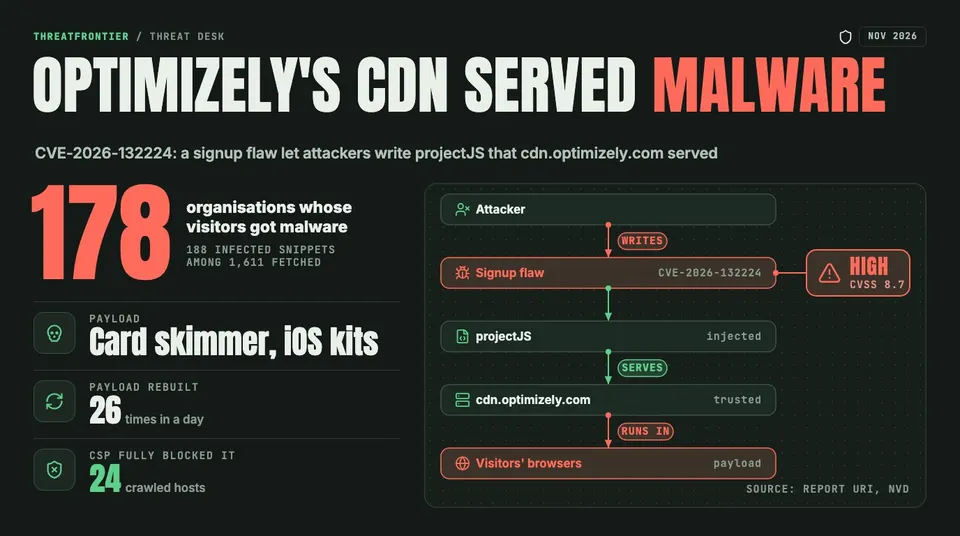
A signup flaw let attackers plant JavaScript that Optimizely's CDN served to visitors of 178 brands. It is now on CISA KEV, and only 24 sites' CSP blocked it.
If your site loads Optimizely Web Experimentation, check your Project JavaScript for injected code, rotate every user and API token with write access, and treat card data typed into your own forms on 16 November as potentially exposed. On 16 November, attackers used a flaw in Optimizely's signup flow to plant malicious JavaScript that cdn.optimizely.com then served to visitors of 178 organisations, including BBC, CNN, Zoom, Equifax and Ledger, per Report URI. CISA added the flaw, CVE-2026-132224, to its Known Exploited Vulnerabilities (KEV) catalog on 24 November, with a due date of 27 November.
What happened
NVD describes the bug as a mishandled account signup flow in Optimizely Web Experimentation before 2026-11-17. It let attacker-controlled code land in the projectJS field of certain cdn.optimizely.com assets. NVD rates it CVSS 3.1 8.7 (High) and classes it CWE-642, External Control of Critical State Data. CISA's SSVC entry lists exploitation as active and technical impact as total.
Report URI found 188 infected snippets among 1,611 it fetched, covering 178 organisations. That is probably an undercount, since only snippets fetched in time were checked. The CDN served what it was given: this was not cache poisoning. How the attackers got in beyond NVD's "signup flow" wording is not public; Report URI says the access method is unknown.
Per Krebs, Optimizely says it blocked the vulnerable path, deployed a fix, removed the injected code, ended active sessions, revoked tokens and added protections at Cloudflare. A third-party investigation is under way.
Report URI's timeline puts the first injection at 04:21 UTC on 16 November and has every infected file confirmed clean by 23:11 UTC. NVD published the CVE on 18 November.
The payload
The loader came in three forms: a script tag for 1688360.cc/track.js, a base64 (atob) variant, and an inline eval fallback. One file did four jobs:
- Swapped cryptocurrency wallet addresses for the attacker's.
- Skimmed card numbers, expiry dates and CVVs from a site's own form fields (the skimmer was added at 13:43 UTC). Per Report URI, cards entered in hosted payment iframes were out of its reach.
- Stole cookies readable by scripts, and took screenshots.
- Loaded iOS exploit kits: Coruna for iOS 13-17 and DarkSword for iOS 18.x. The kit's own comments suggest iOS 18.7.3+ and 26.3+ are patched. TF covered DarkSword when it first surfaced: DarkSword: Pure-JavaScript iOS 18 Watering-Hole Full Chain.
The attackers rebuilt the payload 26 times in a day. Report URI counted about $7,040 received by the attacker's wallets as of 19:25 UTC on 16 November; how many card records were taken is unknown.
Why CSP mostly failed
A Content Security Policy (CSP) was the main control on the site owner's side that could have stopped this. Report URI crawled 256 of the affected organisations' own hosts and sorted the results into four outcomes:
| Result | Hosts |
|---|---|
| No CSP | 68 |
| Payload and data theft both allowed | 50 |
| Payload ran, connect-src blocked the data theft | 17 |
| Payload fully blocked | 24 |
Report URI puts the fully blocked group at 15%, which matches the 159 hosts in these four groups, not the 256 crawled.
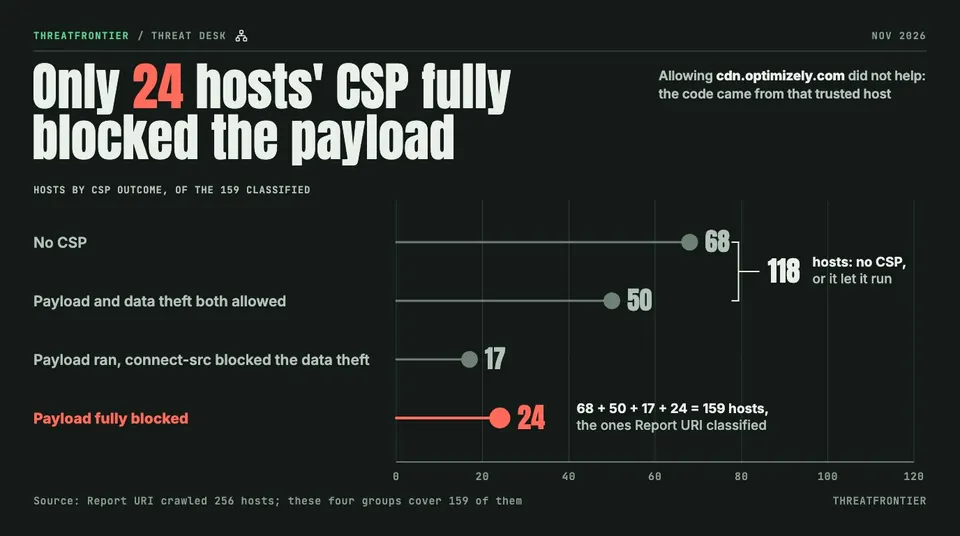
How the CSPs of affected hosts handled the Optimizely payload, per Report URI. Report URI crawled 256 hosts; these four groups cover 159 of them.
Allowing cdn.optimizely.com did not help, because the code came from that trusted host. A tight script-src that omitted 1688360.cc did block the loader. 'unsafe-eval', which Optimizely's documentation recommends, let the inline fallback run, as seen at HSBC. connect-src stopped data theft but not address swapping, which happens inside the page. Across the web's busiest sites, CSP adoption is about 10%, per Krebs, citing crawler.ninja.
The same lesson came out of Magento skimming campaigns: a trusted source of script is only as safe as whoever can write to it. See Beyond the Patch: evicting CosmicSting backdoors and StyleSmuggler skimmers.
What defenders should do
- Search Project JavaScript and experiment code for 1688360.cc, atob( and scripts you did not write; audit users and API tokens with write access, and rotate them.
- Treat card data entered on your own forms on 16 November as potentially exposed, and rotate any secrets stored in cookies that scripts can read.
- Deploy a restrictive CSP with a narrow connect-src, avoid 'unsafe-eval', and turn on violation reporting.
- Block the indicator domains: 1688360.cc and the others in Report URI's list.
- Federal agencies: apply the vendor mitigations under BOD 26-04 by 27 November.
- iPhone users: update to iOS 18.7.3+ or 26.3+.
As Report URI's Scott Helme told Krebs, "trusted JavaScript doesn't always remain trustworthy."
Sources
- NVD, CVE-2026-132224: https://nvd.nist.gov/vuln/detail/CVE-2026-132224
- KrebsOnSecurity, "Attackers used Optimizely to A/B test malware on top websites": https://krebsonsecurity.com/2026/11/attackers-used-optimizely-to-a-b-test-malware-on-top-websites/
- Report URI, "World's largest brands infected with malware via Optimizely": https://blog.report-uri.com/worlds-largest-brands-infected-with-malware-via-optimizely/