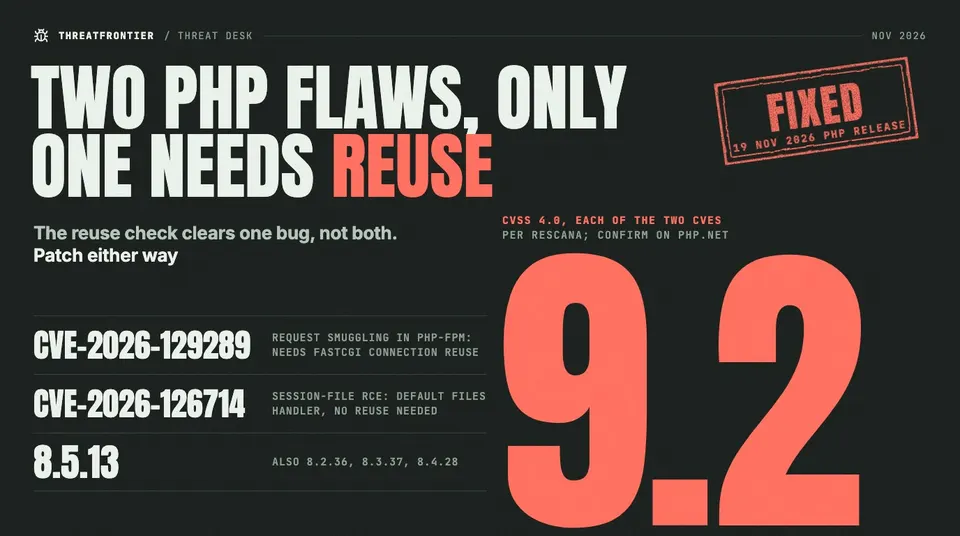
PHP 8.5.13 and sibling releases fix two flaws rated 9.2. FPM request smuggling needs FastCGI connection reuse; the session-file bug does not. Patch both.
Upgrade PHP to 8.2.36, 8.3.37, 8.4.28 or 8.5.13 and restart the PHP-FPM master. Before you do, check one setting: whether your web server reuses FastCGI connections to PHP-FPM. That setting decides whether you are exposed to the request-smuggling bug. It does nothing for the session-file bug, which hits the default session handler.
PHP's 19 November 2026 release fixes both. CVE-2026-129289 is request smuggling in PHP-FPM. CVE-2026-126714 is session-file corruption that can lead to remote code execution. Both are rated 9.2 on CVSS 4.0, per the Rescana and Lilting write-ups of PHP's advisories; confirm the scores and your branch's fixed version on php.net before you rely on them. PHP 8.6.0 also contains the fixes.
Neither CVE is in CISA's Known Exploited Vulnerabilities catalog, and NVD's SSVC entry read "exploitation: none" as of 19 November, per Rescana. That is a point-in-time reading. This batch is separate from the exploited PHP2Shell flaws PHP fixed in October.
Only one of the two needs connection reuse
The two bugs are easy to file under one exposure check. Only CVE-2026-129289 needs FastCGI connection reuse. If your web server does not reuse connections, you are still in scope for CVE-2026-126714 whenever PHP stores sessions in files, which is the default.
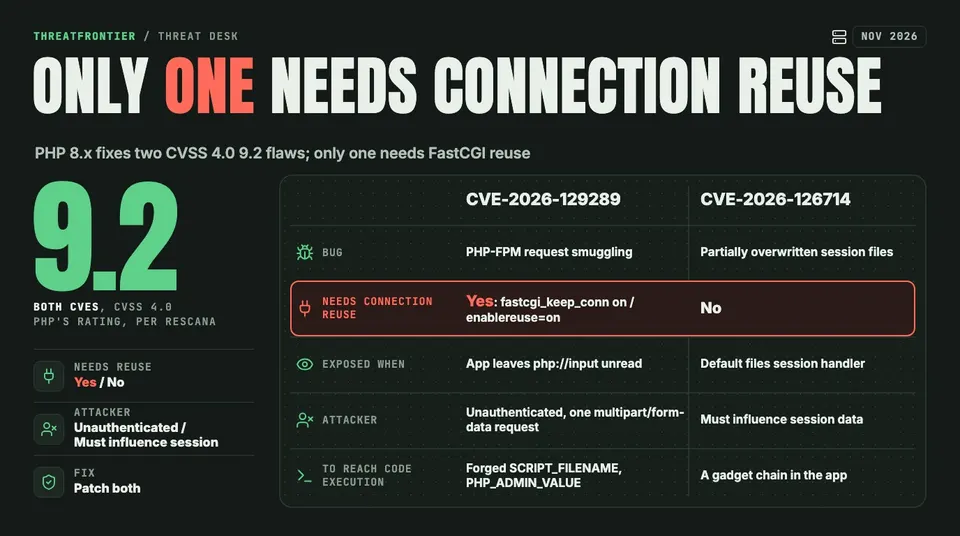
Connection reuse gates CVE-2026-129289 only; CVE-2026-126714 turns on the session handler. Sources: Rescana, Lilting, Debian security tracker.
Who is affected
PHP 8.2 before 8.2.36, 8.3 before 8.3.37, 8.4 before 8.4.28 and 8.5 before 8.5.13. PHP's analysis, per Rescana, traces CVE-2026-129289 back to PHP 5.6.0 and CVE-2026-126714 back to PHP 4.1.0. End-of-life branches are therefore probably affected. PHP did not evaluate them and they will not get a fix.
CVE-2026-129289: request smuggling through an unread body
Advisory GHSA-qc49-hpvq-g2w6. If an application opens php://input and does not read it to the end, the leftover request-body bytes are not discarded. When the front end reuses the backend connection, PHP-FPM can parse those bytes as a new FastCGI request. One crafted multipart/form-data request from an unauthenticated attacker can forge FastCGI parameters such as SCRIPT_FILENAME, REMOTE_ADDR and PHP_ADMIN_VALUE, which can lead to execution of attacker-controlled PHP.
Connection reuse is not the default in nginx or Apache. It is on when you have set:
- nginx:
fastcgi_keep_conn on; - Apache with
mod_proxy_fcgi:enablereuse=on
PHP's advisory also names HAProxy FastCGI backends and LSAPI, per the Debian security tracker.
CVE-2026-126714: partially overwritten session files
Advisory GHSA-fm2m-fjf5-v3cp. The default files session handler wrote into an existing session file without truncating it first. If a write was interrupted, new session data could sit in front of the tail of an older session. That mix lets ordinary string bytes be unserialized as objects, an object-injection condition. Turning that into code execution needs a usable gadget chain in the application or its dependencies.
Researchers at depthfirst published a write-up with a demonstration on 19 November, per Rescana. They say they reached code execution by chaining the flaw with a memory-corruption bug in a PHP-native class. That claim is theirs; TF has not validated it.
The attacker needs a way to influence session data, for example session upload progress or an application that stores user-supplied strings in sessions. None of this depends on FastCGI connection reuse.
What to check
# nginx
sudo nginx -T 2>/dev/null | grep -n fastcgi_keep_conn

# Apache
sudo grep -rn enablereuse /etc/httpd /etc/apache2 2>/dev/null

# sessions (CLI values; confirm the FPM pool's values separately)
php -i | grep -E 'session.save_handler|session.upload_progress.enabled'
- No reuse setting found: CVE-2026-129289 is not reachable through that front end. Patch anyway.
- Reuse is on: treat the server as exposed until it is patched.
- Session handler is
files: you are in scope for CVE-2026-126714 whatever the reuse setting says.
What to do
- Upgrade to 8.2.36, 8.3.37, 8.4.28 or 8.5.13. On Debian, the fixed packages are 8.2.36-1
deb12u1 for bookworm and 8.4.28-1deb13u1 for trixie (DLA-4916-1, DSA-6641-1). - Restart the PHP-FPM master so no old workers keep running.
- Until you can patch, turn off backend connection reuse and keep PHP-FPM and LSAPI listeners off untrusted networks.
- Set
session.upload_progress.enabled=0if you do not use it. That does not protect applications that write user input into sessions, so limit how much untrusted data you store there.
The fixed session handler truncates the file before writing and aborts if truncation fails, so an interrupted write can still lose session data.
The same release also fixes CVE-2026-129291, a use-after-free in PHP-FPM's epoll handling that can give local privilege escalation, and CVE-2026-129292, cross-site scripting on the PHP-FPM status page.
Sources
- PHP 8.x ChangeLog: 8.5.13 release, CVE and advisory mapping
- Rescana: PHP security releases 8.5.13, 8.4.28, 8.3.37, 8.2.36 and 8.6.0: versions, preconditions, scores, exploitation status
- Lilting: PHP 8.5.13 critical CVEs in FPM and sessions: mechanism, mitigations, the session patch
- Debian security tracker: CVE-2026-129289: connection-reuse defaults, Debian fixed packages